
Your Love Will Live in Me
Love after death in Passion, Rent, Hamilton, and West Side Story
Death does the parting in West Side Story, as the old vow always said it would. Tony and Maria’s dress-shop ceremony fails with Chino’s bullet—and yet the desire inside that vow does not disappear. The young lovers’ “even death won’t part us now” was brave and impossible, a revision of the marriage liturgy that dared to cross the greatest threshold. (We explored that in detail last week.)
But when death acts anyway, when the promise proves powerless against the fact, our great musicals don’t stop talking about love. What we see, in fact, is a shift from promise to practice. Love persists as something carried, inhabited, tended, and told.
Vows are future-facing speech acts. They draw lines forward in time, staking a claim on what will be. Elegy works differently. It speaks in the aftermath, when the future that was promised has been foreclosed. When Tony is shot dead—indeed, when any loved one dies—“forever” ceases to be a horizon. It becomes instead a question: what remains?
Thank you for reading! Upgrade to a premium subscription for full access to The Sondheim Hub: an exclusive essay, crossword, extended interview & more each week, plus our complete, paywall-free library of 250+ essays, features & interviews.
Musical theatre offers answers, but they’re not metaphysical guarantees. What persists after death seems to take three main forms: love as inhabitation (the beloved lives in the survivor’s altered interior), love as carrying (devotion performed through ritual action after loss), and love as stewardship (the labor of preserving, telling, and keeping the story alive). These are the shapes love can take when “till death do us part” has already happened.
Love that lives in you
Sondheim and Lapine’s Passion ends with a letter. Fosca is dead; Giorgio reads her final words aloud. What unfolds is deeply affecting:
GIORGIO
Now at last
I see what comes
From feeling loved.
Strange, how merely
Feeling loved,
You see thing clearly.Fosca’s voice quietly begins to join his from offstage.
GIORGIO, FOSCA
Things I feared,
Like the world itself,
I now love dearly.
Sondheim is describing an interior transformation so profound it dares to defy the promise of heaven. What need is there to talk of reunion in some celestial future when love has already restructured the self? Death, rather than negating that transformation, becomes the condition under which Fosca can recognize it.
This is perhaps love’s deepest work: not promising eternity, but conferring identity. Fosca has lived unloved, unlovable in her own estimation. Giorgio’s love hasn’t saved her life, but it has conferred upon her a self she can recognize:
FOSCA
But though I want to live,
I now can leave
With what I never knew:
I’m someone to be loved.GIORGIO
I’m someone to be loved.FOSCA
And that I learned from you.
“I’m someone to be loved.” That’s the sum of it, as Mary Flynn might say. Now she knows. And it’s a claim that remains as true for Fosca in death as in life. Love has made the loved one legible to herself—and that knowledge is what she carries across the threshold.
The company joins Fosca and Giorgio. Their final refrain, “Your love will live in me,” multiplies, overlaps, insists. It’s not sentiment. Those last words offer a precise description of what actually persists when a loved one dies. Fosca is gone, but the interior architecture her love constructed remains. The survivor carries forward a self that was made in relationship, and that self continues. The beloved lives as the change they caused, as the identity they confirmed or co-created.
That closing refrain functions like liturgy. And Sondheim and Lapine, over the course of Passion, have earned those words, have made them flesh and had them dwell among us. The love-after-death vow, in their hands, is credible—not because death is defeated, but because what love builds doesn’t vanish when the body does.
Our loved ones might not return. But they’re not entirely gone either. They’re lived into, every day, in our altered ways of being in the world.
Love you carry
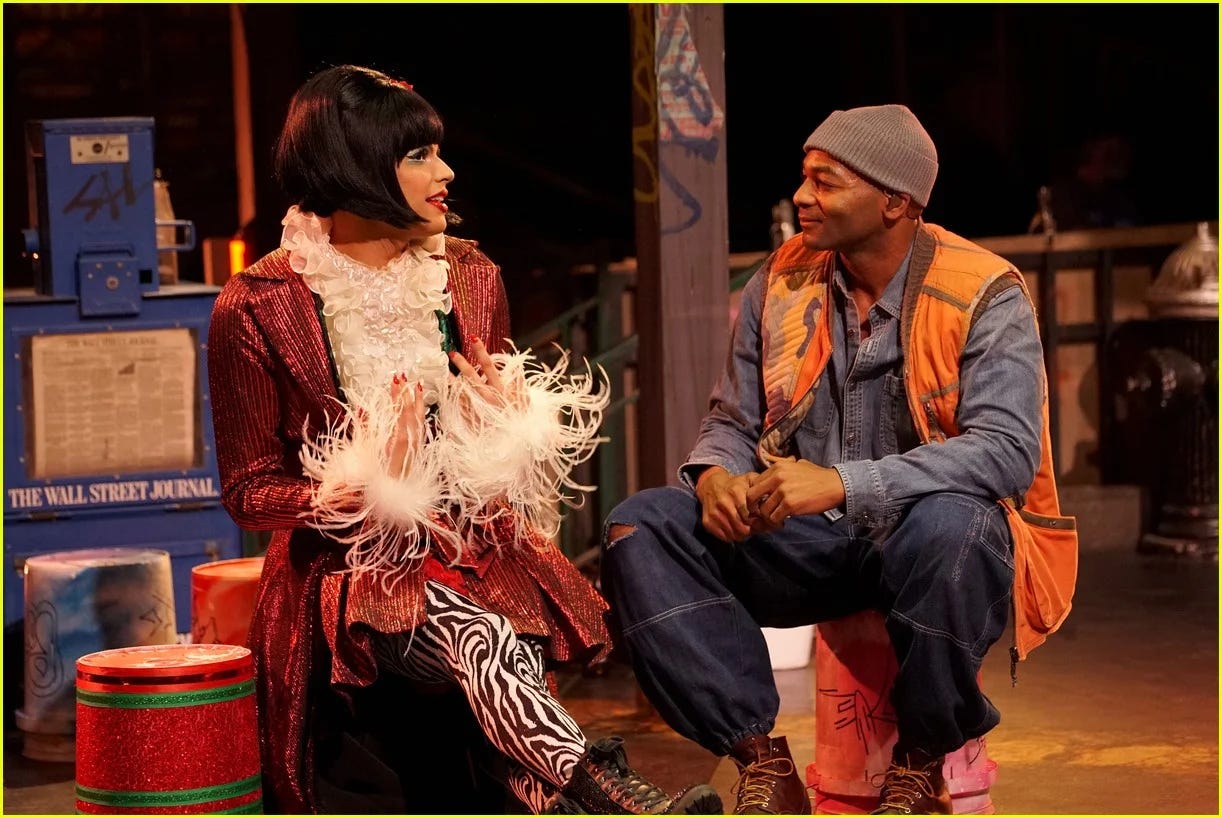
Jonathan Larson’s Rent takes that inward persistence and turns it outward, into the world, into action. When Angel dies, Collins reprises “I’ll Cover You,” a song that was playful in its first iteration, full of early-love negotiation and flirtation. “Live in my house, / I’ll be your shelter. […] Be my lover / And I’ll cover you.” As elegy, it becomes something else entirely: love as action performed after loss. The words are the same; context transforms them.
Collins sings:
I think they meant it
When they said you can’t buy love.
Now I know you can rent it.
A new lease you are, my love,
On life.
The theology here is earthly, grounded. Angel gave Collins “a new lease on life”—crucially, this life, vivid and time-bound and mortal. And now that Angel is gone, Collins continues the lease by embodying what they shared: care, shelter, the choice to cover someone vulnerable in a world that offers little protection.
Private grief becomes public witness as the community joins Collins, layering their voices over his. Love persists not just in one man’s singular devotion but in the communal act of remembering, of refusing to let Angel disappear into silence. And this is convincing in part because it refuses abstraction. Here, love is no feeling preserved in memory’s amber. It’s a series of tasks: showing up, testifying, sheltering those who remain.
A loved one can outlive their body through the practices of the living—through what we do in their name, how we carry forward the work they began.
The streets of heaven, as President Bartlet once said, are perhaps too crowded with angels. But in Collins’s devotion, in his community’s witness, in every choice to shelter, to cover, to care, one Angel might just become many here on earth.
Love as story
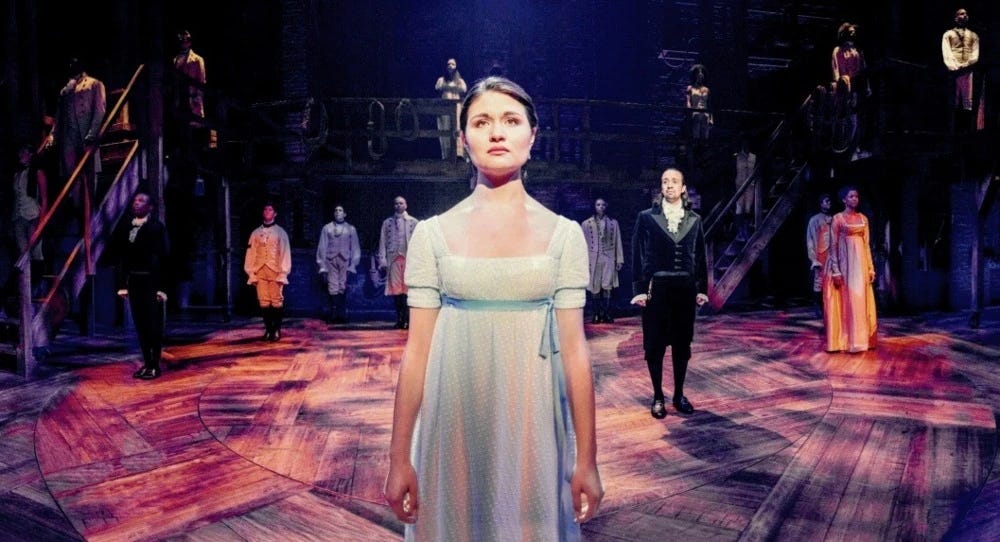
Enter Eliza Schuyler Hamilton. Through Eliza, Lin-Manuel Miranda stages love’s afterlife as story, as archive. “I’m erasing myself from the narrative,” she sings in “Burn.” We watch on as she withdraws her consent to let her love be told, pored over, made public. “Let future historians wonder / How Eliza reacted when you broke her heart,” she continues. Miranda’s metatheatrical move here is thrilling; we are wondering, we do speculate.