Even Death Won't Part Us Now
Tony and Maria's impossible vow, and the romance & risk of forever
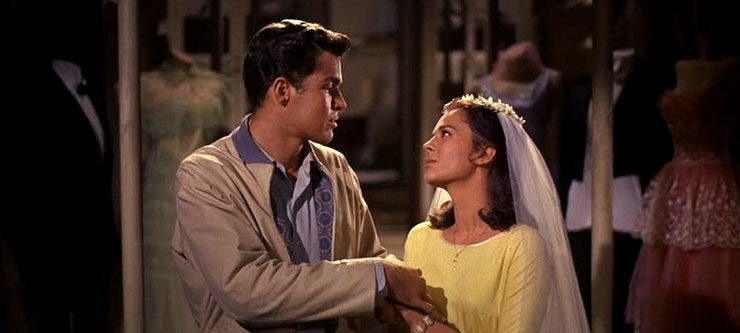
It’s a dress shop, not a church. There’s no priest, no congregation—just two teenagers alone with bolts of fabric and borrowed vow-language. Tony and Maria stand together in West Side Story’s “One Hand, One Heart,” conducting a private ceremony that has no legal force but bursts with emotional weight.
We recognize in their words the grammar of traditional marriage: “Make of our vows one last vow: / Only death will part us now.” It’s the promise that has been at the heart of wedding ceremonies for centuries: “till death do us part.”
But then, mid-song, they rewrite that vow. The lyric pivots: “Even death won’t part us now.” The shift is small, and incalculably vast. The greatest of all boundaries is crossed; death is demoted. That single word—even—changes the entire logic of the vow. What had been a limit becomes a challenge. What had been a boundary becomes something to press against. Tony and Maria, improvising a marriage, dare to revise its most solemn clause.
Death as the agent
The phrase many of us carry in our ears, “till death do us part,” originates in the Book of Common Prayer, though the earliest (1549) wording was slightly different: “till death us depart.” Depart here meant separate, not go away or leave. By the time English had shifted enough for depart to sound misleading, the phrase appears as “till death us do part”—with the now-familiar “do us part” word order arriving later. Here, then, is a small linguistic adjustment made in the service of clarity. No doubt Sondheim would have approved.
And that shift matters: death becomes the actor, the agent that performs the parting. The grammar encodes a theology. Marriage is framed as a bond so serious, so binding, that death alone can dissolve it. No human court can adjudicate it cleanly; no priest can unwind it without residue. Death is the sole “clean” terminus, requiring no moral explanation, no scandal. When Jesus says (in Matthew 22:30) that in the resurrection people “neither marry, nor are given in marriage,” he confirms marriage as an earthly arrangement. It belongs to mortal life: to time, to succession, to finitude. It does end—not through a failure of love, but as a feature of mortality.
This is the rulebook Tony and Maria inherit. And it’s tempting to dismiss their “even death…” revision as romantic hyperbole, the kind of wild promise teenagers make when they don’t yet understand what death means. But there’s a sincerity, even a solemnity, about them in this scene that resists that reading. This isn’t the giddy infatuation we see elsewhere. Just before they begin singing, they have spoken actual marriage vows to each other—including that all-important phrase, “till death do us part.” They’ve used the words, performed the ritual, treated the moment as binding even without legal witness. Tony and Maria feel the full weight of that boundary before they decide to cross it.
Fidelity forever?
By the time of Company—1970—the theological and legal architecture that once made “forever” legible had thinned considerably. Amy, standing at the altar in “Getting Married Today,” hears the same promise Tony and Maria sang—“fidelity forever”—and experiences it as semantic overload. It’s as if the words have grown too large for the life they’re meant to contain.
Amy is arguing against a ritual that demands she promise something she can’t verify, witnessed by people who won’t help her survive it. “We’ll both of us be losing our identities,” she sings, framing the vow as erasure rather than union. The public pressure to perform permanence meets her private terror of annihilation, and the collision is played comedically—but the critique is serious. If Tony and Maria feel steadied by the weight of inherited language, Amy is crushed by it.
Thank you for reading! Upgrade to a premium subscription for full access to The Sondheim Hub: an exclusive essay, crossword, extended interview & more each week, plus our complete, paywall-free library of 250+ essays, features & interviews.
Where Amy recoils from the vow’s infinitude, Bobby approaches it with a red pen. In “Marry Me a Little,” he attempts to shrink “forever” into something survivable: “just enough.” “Not too far.” “Tender distance.” That song is a thought experiment in managed intimacy. It is, though, a serious attempt to solve the problem Amy articulated: how do you make commitment bearable when “forever” sounds like a life sentence? Bobby’s answer is to negotiate the vow downward. He wants intimacy, but only up to a point. He wants connection, but with a built-in buffer.
Where Tony and Maria cross the boundary knowingly, and Amy refuses it outright, Bobby redraws it closer in, hoping that a smaller promise might hold. But this, too, is a response shaped by fear. The vow has become negotiable, provisional, endlessly qualified.
Forever, with you
The question of how to promise honestly without promising impossibly finds a different answer in The Last Five Years, which reframes the marriage vow not by shrinking it, but by breaking it into pieces small enough to be spoken truthfully.
In “The Next Ten Minutes,” Jamie proposes to Cathy with a series of vows, graduated in scale. “Will you share your life with me / For the next ten minutes?” he asks. Almost as soon as the first promise is made, it multiplies: another ten, and another, and then—suddenly—ten lifetimes, a million summers, a future that balloons outward into extravagance. What makes this escalation convincing is its structure, not its poetry. Jamie earns his way to the absolute by starting with the achievable. He treats commitment as a sequence of renewed consent, not a single leap.
Cathy, answering, brings death back into the frame. “I want to die / Knowing I / Had a long, full life in your arms,” she sings. Death is no longer the enemy of the vow, nor its undoing, but the horizon that gives the promise its shape. A life is something that can be full precisely because it is finite.
But Cathy doesn’t end there. She builds through that finitude toward something larger. “That I can do,” she says—“forever, with you.” The word forever arrives only after death has been acknowledged, named, absorbed into the shape of a life. It is not spoken in defiance of mortality, the way Tony and Maria’s “even death” is. It is spoken on the far side of it.
As Jamie’s next verse takes off—ten lifetimes, a million summers—Cathy sings “forever,” and then “forever, Jamie,” as if fastening the extravagant future he’s imagining to the particularity of a person, a body, a shared duration. Forever here isn’t infinity without shape but continuity within time, love renewed again and again until time itself runs out.
Where Tony and Maria try to outbid death, Cathy allows death its place—and then lets forever emerge anyway, as a relational claim about how life will be lived while it lasts. Remarkably, she consecrates the limit she’s just named, and discovers that forever, here, does not oppose finitude but grows out of it.
Even death…
And so we return to our doomed young lovers and their brave, solemn, impossible vow. Death will part Tony and Maria. He will bleed out in her arms, Chino’s bullet doing the parting their language tried to refuse. The dress-shop vow fails in every practical sense but one: it was spoken; it was meant.
Amy is right to be afraid. Bobby is right to hesitate. Jamie and Cathy are right to insist on a forever that is incremental, truthful, earned. But Tony and Maria are also right, in a way that has nothing to do with wisdom or survival. They are right to want love to be the thing that remains when everything else is gone. They are right to mean what they say, even when what they say proves impossible.
The vow Tony and Maria inherit, only death, draws a line. Their revision, even death, crosses it. And the failure of that crossing doesn’t negate its ambition. In a world of careful promises, of negotiated forevers, of love calibrated to risk and reason, they insist—disastrously, beautifully—on something large.
And somewhere beneath our own fears and contingencies, beneath our cautious grammars of love, we still want to believe that meaning is made by those who risk everything to speak it aloud.
✍️ Support our work by upgrading to a premium subscription:
The Sondheim Hub exists solely thanks to the generous support of our readers. Please consider supporting our work for a few dollars each month. A premium subscription gives you full access to The Sondheim Hub: an exclusive essay, crossword, extended interview & more each week, plus our complete, paywall-free library of 250+ essays, features & interviews. 📚
Other essays you may enjoy:
A Boy Like That / I Have A Love
In Act 3, Scene 2 of Romeo and Juliet, Juliet learns from her nurse that Romeo has killed her cousin Tybalt.
Who is this Santa Evita?
“Who is this Santa Evita?” asks Che, as Andrew Lloyd Webber’s 1978 musical begins.
Is This What You Call Love?
Netflix has a new word-of-mouth hit on its hands. Baby Reindeer was viewed 56.5 million times in its first 26 days on the platform. In the next couple of weeks, it is on track to enter the top 10 most-viewed English-language Netflix shows of all time, joining the likes of


