
Site-Specific Sondheim: Into the Actual Woods
The woods are lovely, dark and deep...
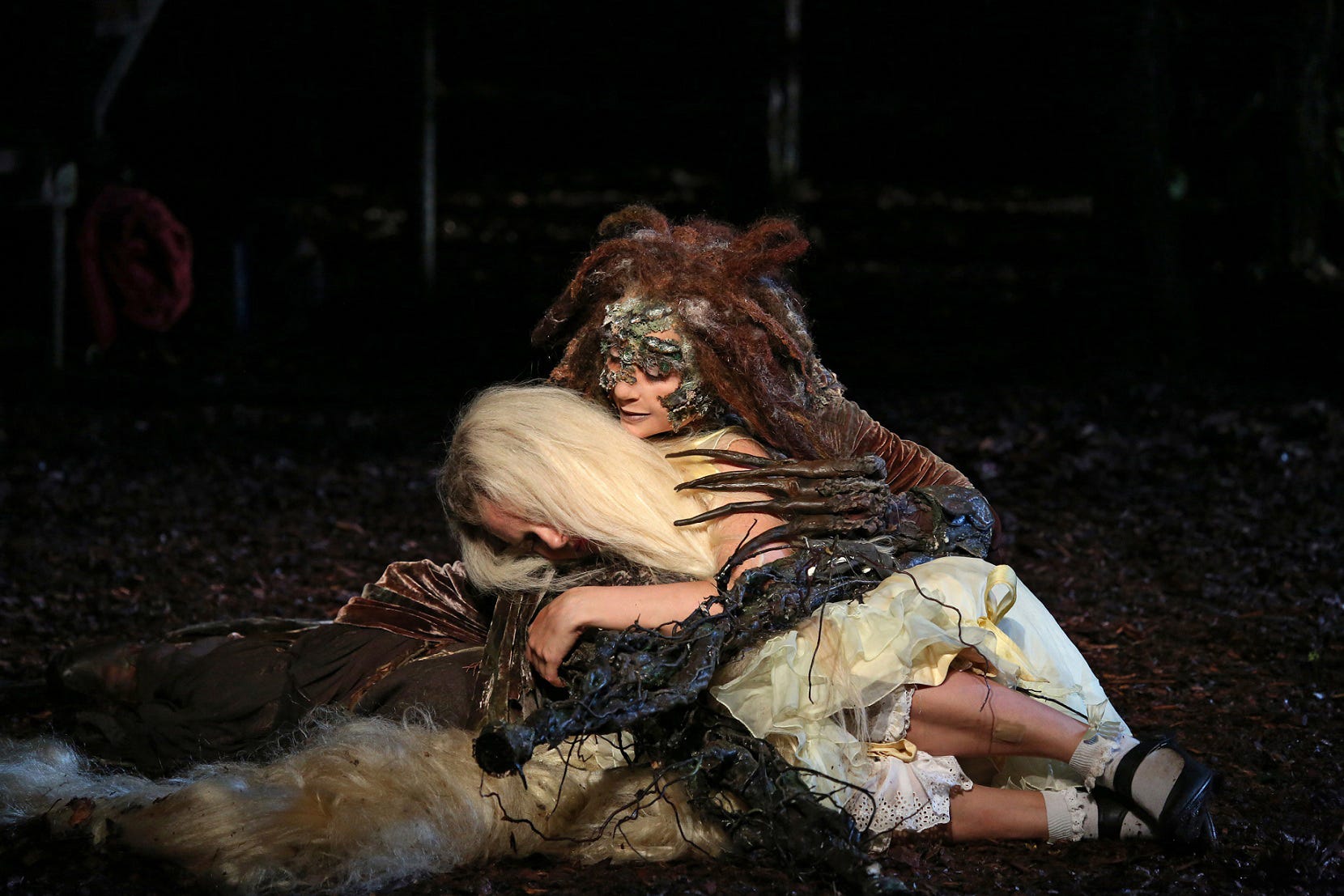
Last week, we looked for Sondheim in unconventional but theatrically irresistible places: Sweeney Todd in a pie shop; The Frogs in a swimming pool. In both cases, the site sharpened aspects of the show: Sweeney was claustrophobically thrilling, The Frogs equal parts ridiculous and ritualistic.
But no Sondheim title offers a more obvious invitation than Into the Woods. So obvious, in fact, that a site-specific or site-responsive production risks being a too-literal (albeit fun) gimmick. At their best, though, these productions extend a double invitation: enter the woods, yes, but understand them too…
It’s worth being precise about what the woods actually does in Into the Woods, because the argument for site-specific staging only holds if there is something in the material the space itself can unlock.
In the first act, the woods is a place of possibility: dark, possibly dangerous, but navigable. The various characters enter with wishes and, against considerable odds, they get what they think they want. The woods, then, is the shared space the show’s intersecting narratives require: strangers’ paths cross, social rules loosen, fears and desires are heightened.
In the second act, the enchanted forest becomes a crisis zone. Adults and children alike find themselves unprotected, vulnerable, exposed to consequence. But in neither act is this shared territory neutral. The forest of Into the Woods is, I’d suggest, a kind of teacher — a sort of god or spirit hanging over the show like, as a certain prince might say, “a fine morning mist.”
The question an outdoor production gets to ask is whether a real landscape — one that can darken, grow cold, send wind through branches, and make sounds beyond a designer’s control — can do some of that teaching itself.
Camp Pouch, Staten Island: into the forest as pilgrimage
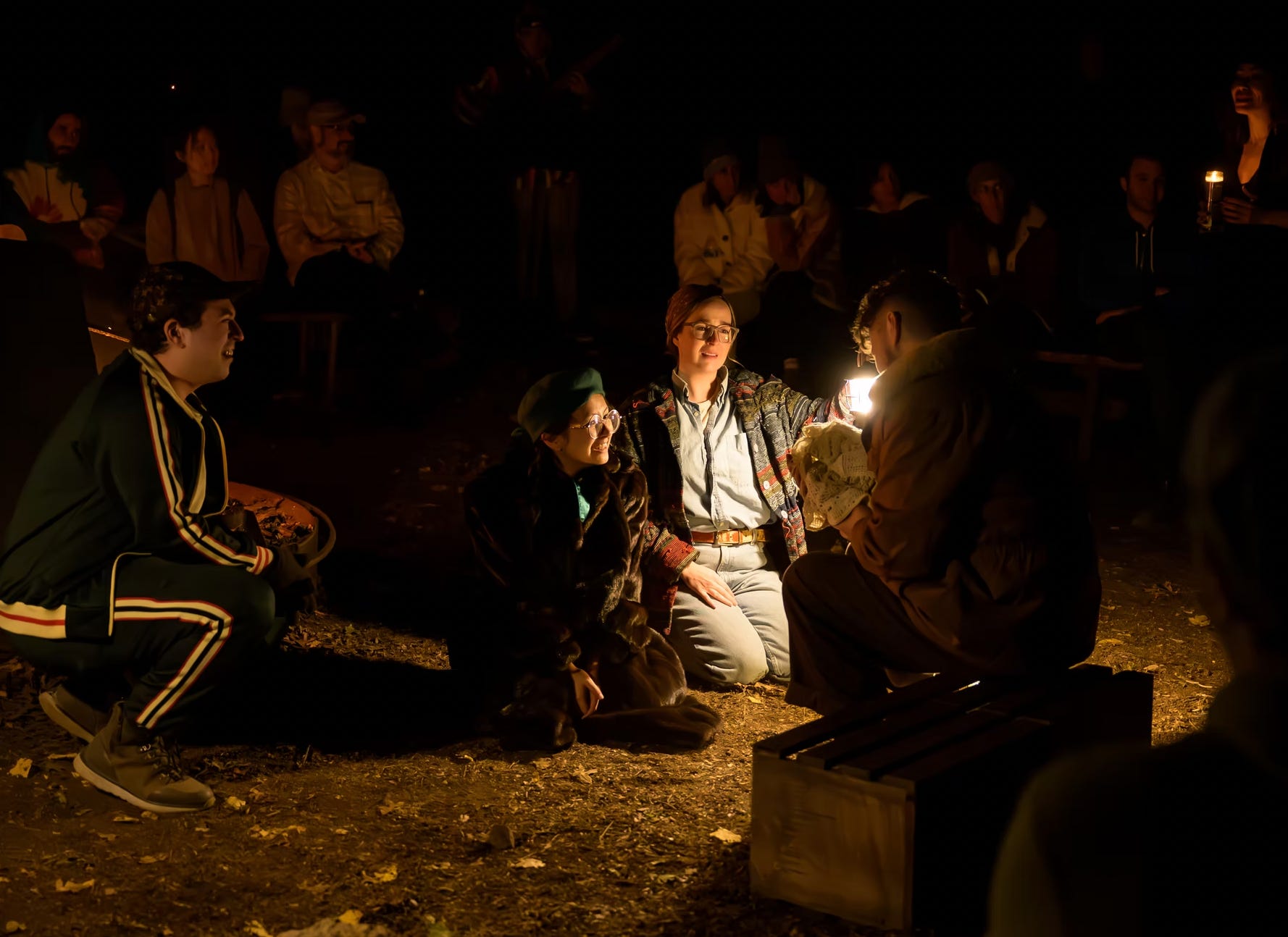
The purest recent example of site-specific Into the Woods may be the 2025 production at Camp Pouch on Staten Island, which transformed a 140-acre woodland camp into a living fairy tale. The audience size was kept to 25 people per performance, closer to the scale of the Tooting pie shop Sweeney Todd than to any conventional staging. The orchestration was newly arranged by Lena Gabrielle for an acoustic ensemble: guitar, bass, violin, melodica, accordion, and hand percussion, with musicians doubling as narrators and guides.
Fairy tales are, among other things, a technology for managing fear of the dark — for telling children, gathered perhaps around a hearth, perhaps around a campfire, what the wood can contain and how to survive it. The campfire opening at Camp Pouch restored that original context.
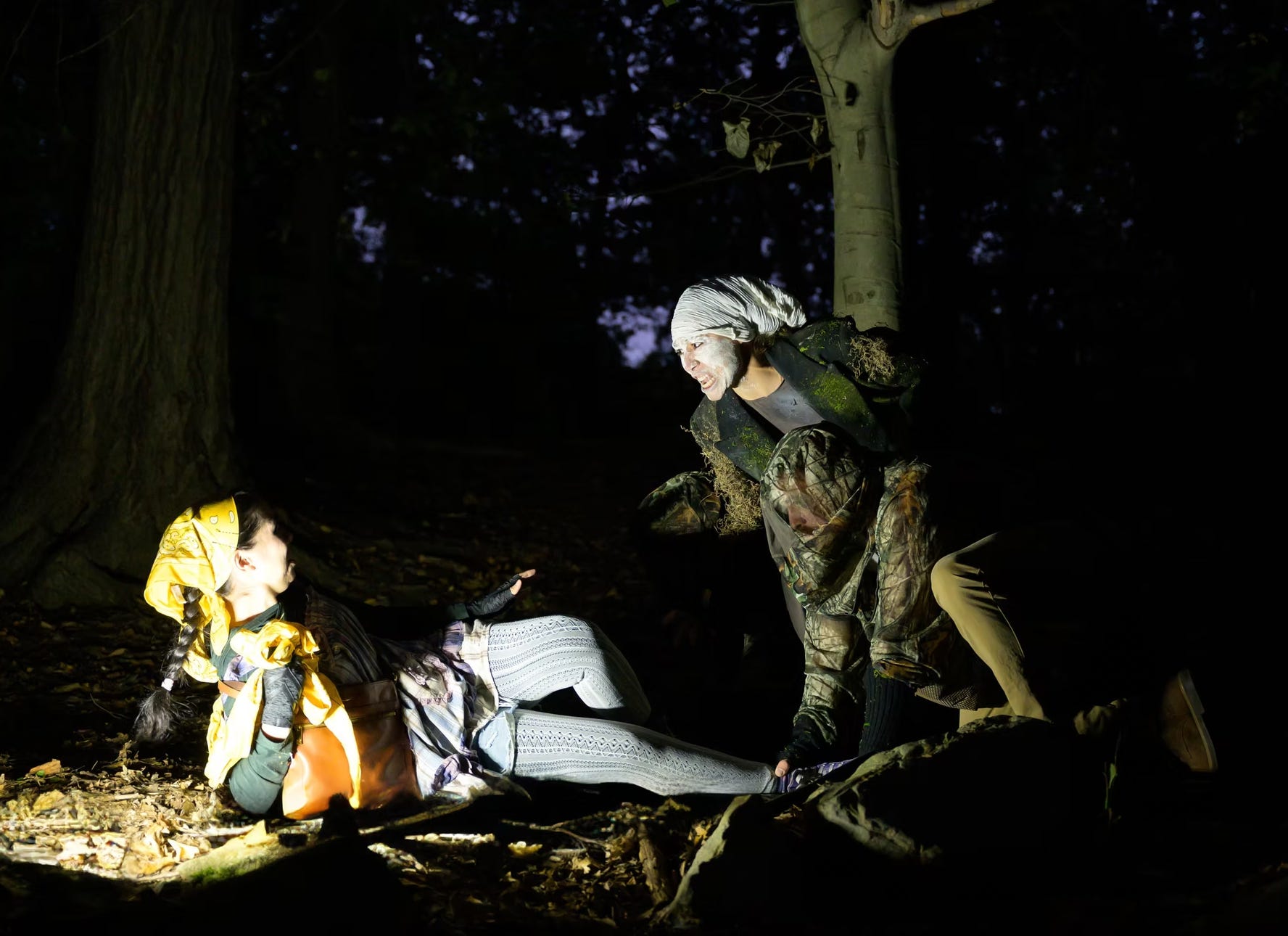
Then, as the story deepened, the audience followed along, literally; by lantern light, they were guided deeper into the woods as the plot moved forward. And with just 25 people in each audience, there’s something more communal than theatrical about this. It’s closer to the oral tradition from which these stories came than to the Broadway tradition which birthed the show. Something about that smaller scale, the same scale that made the Tooting pie shop Sweeney Todd so remarkable, returns the material to human dimensions.
Talk Is Free Theatre: from Barrie to Auckland
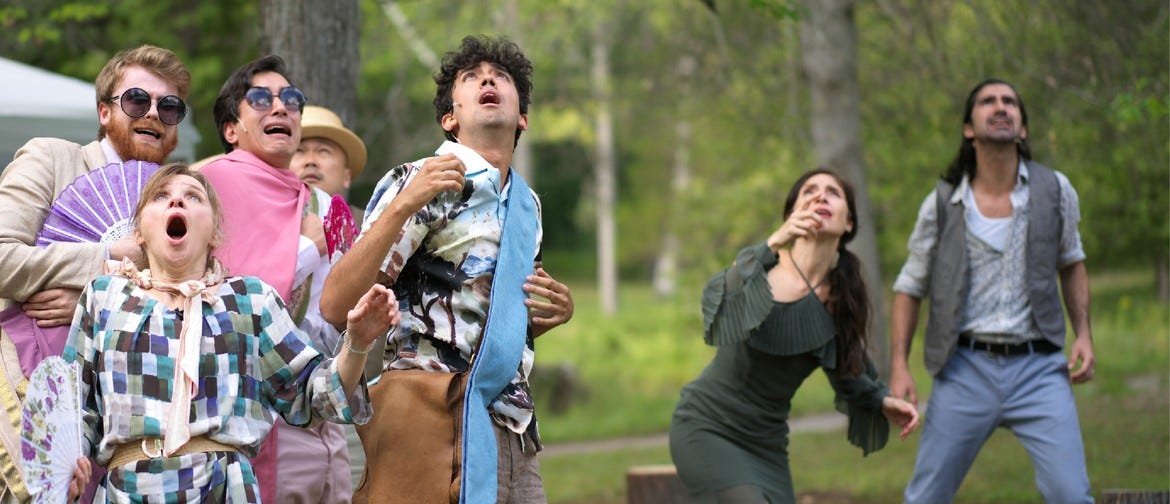
The production of Into the Woods that Talk Is Free Theatre brought to Auckland in January 2024 had, by that point, already had a life. Michael Torontow’s staging began indoors at Barrie’s Georgian Theatre in November 2019. It was remounted outdoors at Springwater Park in August 2021, before transferring that October to Toronto’s Winter Garden Theatre, where it earned seven Dora Award nominations. Then it went into what TIFT artistic producer Arkady Spivak described as a kind of “repertory closet.”
In January 2024 that closet was opened again. The venue was a clearing in the wooded grounds of Corban Estate Arts Centre in Auckland’s west end, presented by local company A Mulled Whine. Billed by the presenters as “Broadway in your backyard,” the production used the surrounding landscape as frame rather than labyrinth — less a journey into the forest, as at Camp Pouch, but a gathering within it.
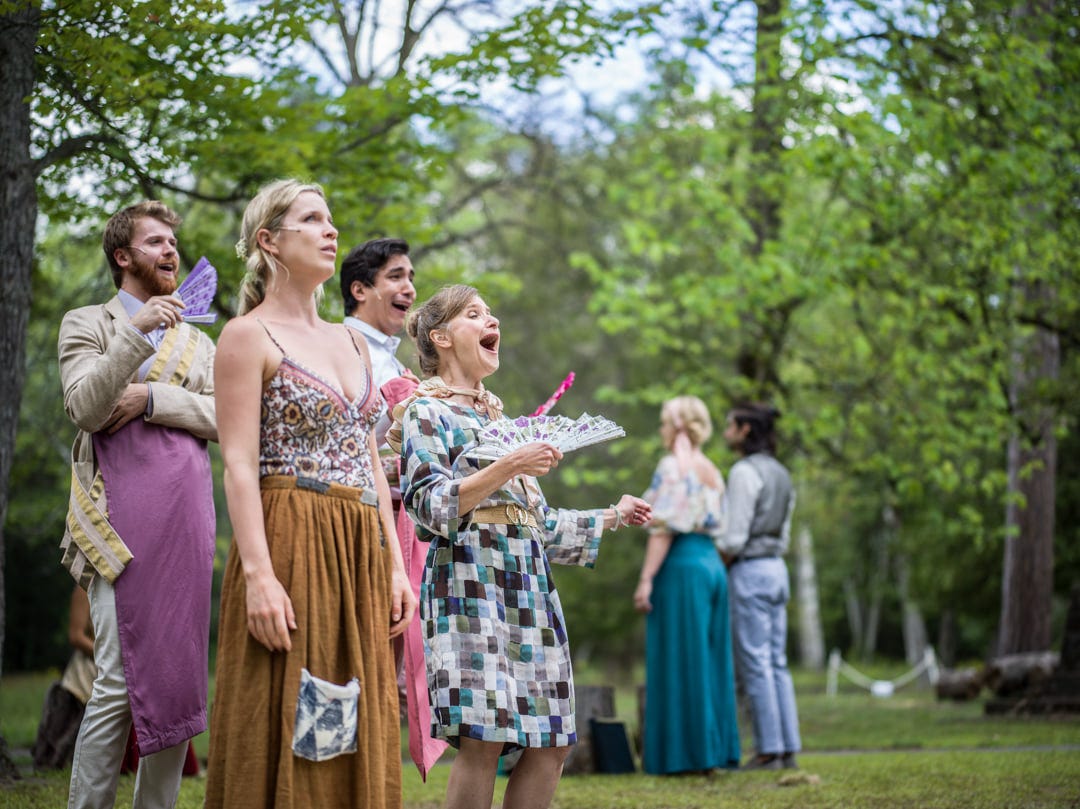
What the Auckland transfer makes visible is the seriousness with which TIFT approaches site. Four company members had flown to New Zealand the previous June, six months in advance, specifically to assess the location: not only the space itself but the light, the humidity, the timing of dusk. “We wanted to look at certain locations so that they could be soaked organically and brewed over time,” Spivak explained. “We also considered things like sunlight, because we’re doing Into the Woods in daylight and wanted to make sure the audience and the cast had the opportunity to leave before it got dark.” Costuming was planned with the summer humidity in mind.
Spivak’s description of TIFT’s touring ambition catches something important: “What’s amazing is we get to invent the world from the beginning every time.” That is, in miniature, what site-specific theatre is. The world is not given. It is found, then made.
Regent's Park, 2010: theatre using nature’s own timing

Regent’s Park Open Air Theatre is an established London venue with a fixed stage, a ticketing infrastructure, and a history going back to 1932. A production of Into the Woods there is not site-specific in the way that Camp Pouch or Corban Estate were site-specific: the audience knows exactly where it is going, the stage is a stage, and the production does not ask anyone to follow lanterns through the dark. So why include it here?
Because the 2010 production of Into the Woods at Regent’s Park is one of the strongest arguments for what we last week called site-responsive theatre — and because it would be absurd to talk about outdoor Into the Woods productions without it.
The production was staged to mark Sondheim’s 80th birthday. It won the Olivier Award for Best Musical Revival in 2011, and at the time of its run it became the highest-grossing production in the theatre’s history. Those are measures of popular success, but they are also signals: audiences responded to something that they found genuinely compelling, and the outdoor setting was central to that response.
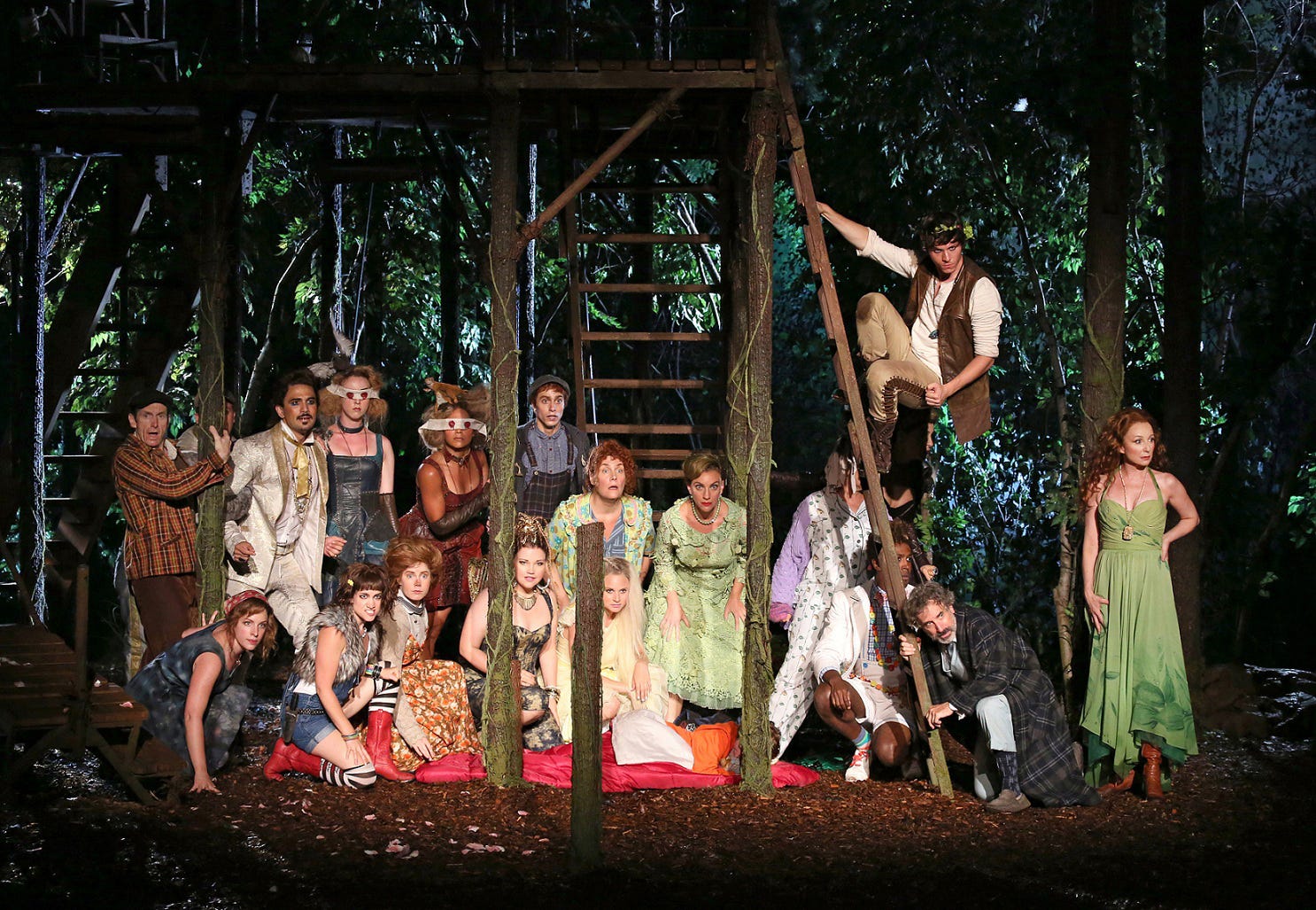
So central, in fact, that the production found another outdoor life across the Atlantic. In 2012, the Public Theater presented a new incarnation of the Regent’s Park staging at the Delacorte Theater in Central Park, with Timothy Sheader and Liam Steel returning to re-explore the production for Shakespeare in the Park. The cast included Donna Murphy as the Witch, Amy Adams as the Baker’s Wife, Denis O’Hare as the Baker, and original Broadway Baker Chip Zien as the Mysterious Man. Soutra Gilmour’s design, now created in collaboration with John Lee Beatty, rose more than 50 feet into the air, with tree-covered catwalks and pathways. Beyond the stage, the trees of Central Park remained visible — as did Belvedere Castle.
What Regent’s Park, and later Central Park, offers Into the Woods specifically is time. Outdoor theatre has a dramaturgy that indoor theatre cannot replicate: the light changes. A production that begins in the early evening at the height of summer will open in daylight and close in darkness. That’s a compelling prospect for almost any show. For Into the Woods, with its structural pivot from sunnier wish-fulfilment to night-world grief, it is almost too perfect.
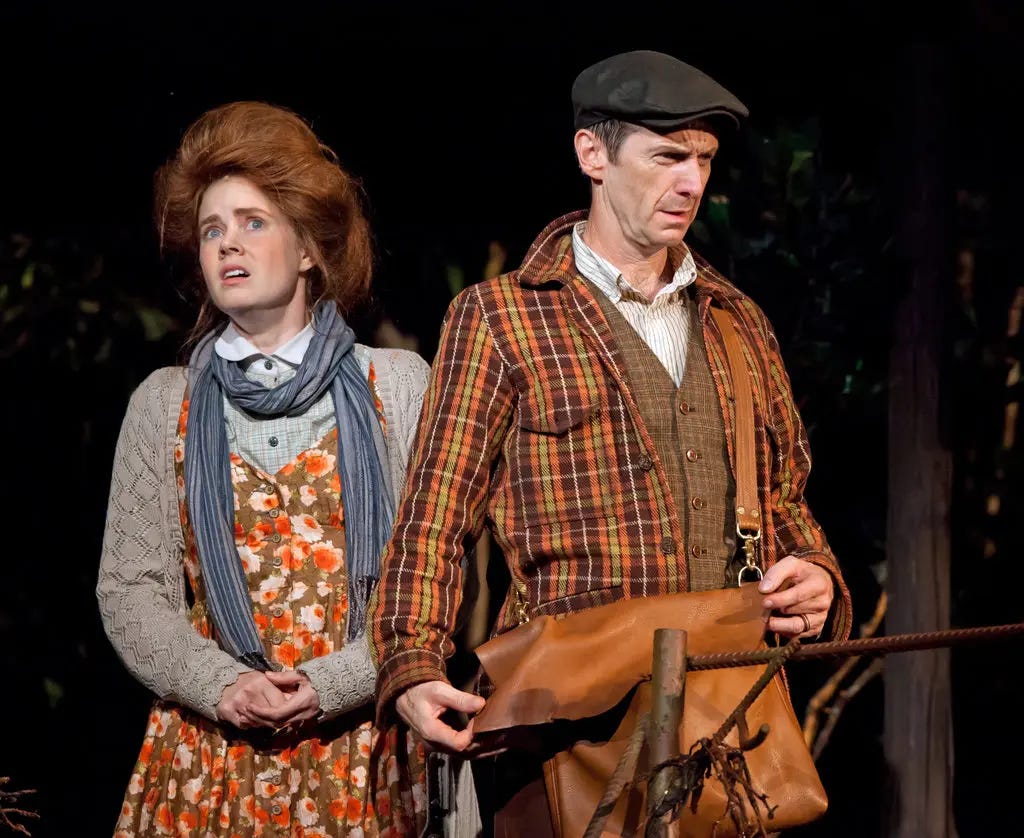
Darkness arriving in real time means we experience Act II as a real-world change, beyond and yet inseparable from the shift in the show’s emotional register. Act II of Into the Woods casts shadows, with or without a lighting designer’s help. We are conscious of actual shadows, cast by actual trees, in the actual park. Into the Woods, in Regent’s Park and then Central Park, could not help but let the real world cast its own spell.
Three productions: a pilgrimage through a 140-acre Staten Island woodland camp; a clearing in the grounds of an Auckland arts centre, reached after six months of scouting and preparation for four nights of performance; established open-air stages in the heart of London and New York. They differ considerably in what they ask of the audience and what they ask of the material.
But they understand the same thing. The woods of Into the Woods is where theatrical distance collapses, where our safety and the characters’ safety can be made to feel like the same thing. A real or responsive outdoor environment can make that collapse physical. In darkness, in weather, with trees at the edge of our vision and sound coming from places not fully planned for, we share something of what the characters are moving through: the experience of being in woods that, to borrow Frost’s line, are lovely, dark and deep.
That is what site-specific staging can offer this particular show. A traditional theater building reassures us. It tells us we are in a safe place, that the journey is performed, that the exits are lit. The wood itself makes no such promise.
The Sondheim Hub is a reader-supported publication
If you find our work valuable, consider becoming a paying subscriber.
You’ll get access to our full archive of 250+ essays, interviews & features, an exclusive essay each week, more from each interview, and a weekly Sondheim crossword. Paid subscriptions make our work possible. 📚
Great essay!
"Into the Woods" is one of my favorite Sondheim shows. It seems like it would have been amazing to experience it in Central Park :)