
Site-Specific Sondheim: Sweeney and The Frogs
Pies, Pools, and Proximity
The Harrington’s Pie and Mash Shop in Tooting, feeding south Londoners since 1908, could hold just 34 people at a time.
Two years ago, we spoke to Jeremy Secomb, who played the title role in Tooting Arts Club’s Sweeney Todd, staged inside that working pie shop. Sondheim, he told us, sat in the closest possible seat when he came to see it. Just one blood bag was used in the production, for the Judge’s death; because Harrington’s still served pies by day, splatter had to be kept to a minimum.
On the night Sondheim attended, something went wrong.
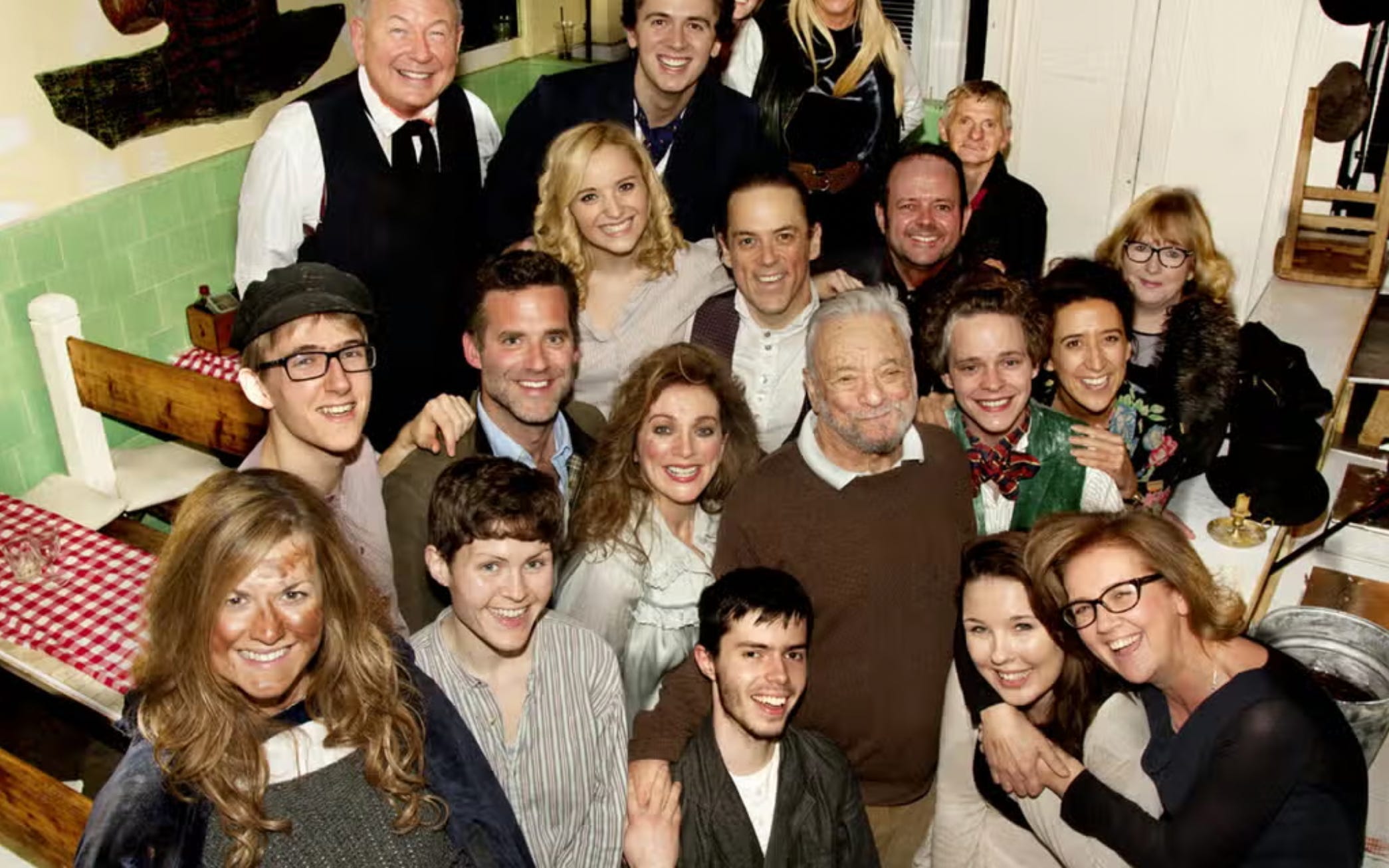
“The blood went through my fingers,” Secomb told us in our 2024 interview, “so I snapped the bag and the blood spurted forwards. And because Steve was sitting so close, it literally just went over the top of him. There’s a massive big red light behind me, but all I can remember is a snapshot of Steve sitting in front of me with the blood going towards him in slow motion, and him leaning back, watching what was happening.”
After the show, Sondheim told the cast that this — this small, close, 34-seat version — was how he had imagined the show. He said it was 50 times scarier than any production he had ever seen.
Today, as we look at site-specific Sondheim, we’ll explore the relationship so vividly captured above: between theatrical space and dramatic effect. Because the most interesting question here is less “was the show staged somewhere unexpected?” and more: did the place change the meaning?
Thank you for reading! If you find our work valuable, consider upgrading to a paid subscription for the full Sondheim Hub experience. ✍️
What we mean when we say site-specific
Before we proceed, it’s worth drawing a line (not a sharp academic line, but at least a working one) between two things that often get conflated:
A site-specific production is one built around a particular place: the space is a structural part of the show, rather than just a backdrop. A site-responsive production may be more portable, but still draws something essential from its environment; it might travel between spaces while retaining a quality that a conventional theatre couldn’t produce.
In practice, many productions blend both. What matters for our purposes is the question underneath: did the building, the room, the outdoor landscape do anything to the show that a proscenium couldn’t?
The pie shop as dramaturgy
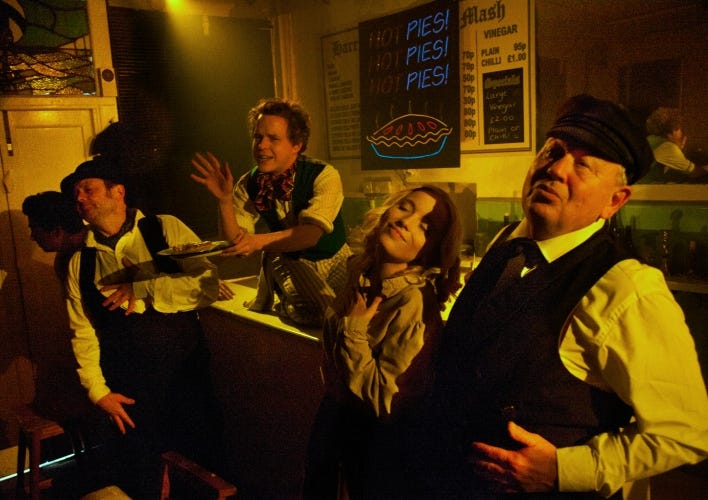
When Bill Buckhurst staged Sweeney Todd at Harrington’s Pie and Mash Shop, audiences were first gathered at Anton’s barber shop across the road before being led into Harrington’s to become Mrs. Lovett’s clientele. The gas lights, the tiled walls, the marble counters, the ovens… Harrington’s looked like the world of the show because it was the world of the show, and had been for more than a century.
Secomb is the best witness to what that did to the material.
“The big difference in our production to a normal theatrical production,” he says, “was that we had access to the audience.” In a conventional theater, when Sweeney threatens the audience in “Epiphany,” there is usually a buffer — the dark, the stage, the proscenium arch — between the character and the people watching him. At Harrington’s, of course, there was no such thing. “I literally could eyeball people — and people would get uncomfortable because they knew that I was just there. I wasn’t behind a proscenium. I wasn’t up on a stage.”
“We had so many different reactions from people. People would laugh because they were uncomfortable. People would shout because they got scared. You never knew what you were going to get from them.”
Sweeney Todd swirls with questions surrounding who is responsible for what happens in a corrupt and hungry city — who enables it, who profits from it, who looks away. And in a pie shop, “you became complicit in the story,” Secomb says. “In the murders, in the love story. Everything that happens in the show, the audience become complicit in it.” That word — complicit — is the key to the whole production.
Tooting, Shaftesbury Avenue, Barrow Street
The Tooting production transferred first to the West End — a run at a venue on Shaftesbury Avenue, where Harrington’s interior was meticulously recreated as an exact replica — and then to Barrow Street Theatre in New York, which was completely transformed into a working pie shop for the run there. The show could leave Harrington’s, but it took Harrington’s with it.
John Rapson, who played the Beadle both at Barrow Street and in the most recent Broadway production, can speak to what that physical environment did to the music. The scale of the space created specific, practical challenges that a Broadway house simply doesn’t generate. “When a high baritone or a tenor is singing a G-sharp, it’s going to be really loud,” he told us in our interview last year. The “Kiss Me – Part 2” quartet had to be calibrated differently in a tiny room. “Figuring out that balance of how much to sing — and because it’s so exciting, not over-singing it — was a hard thing to learn.”
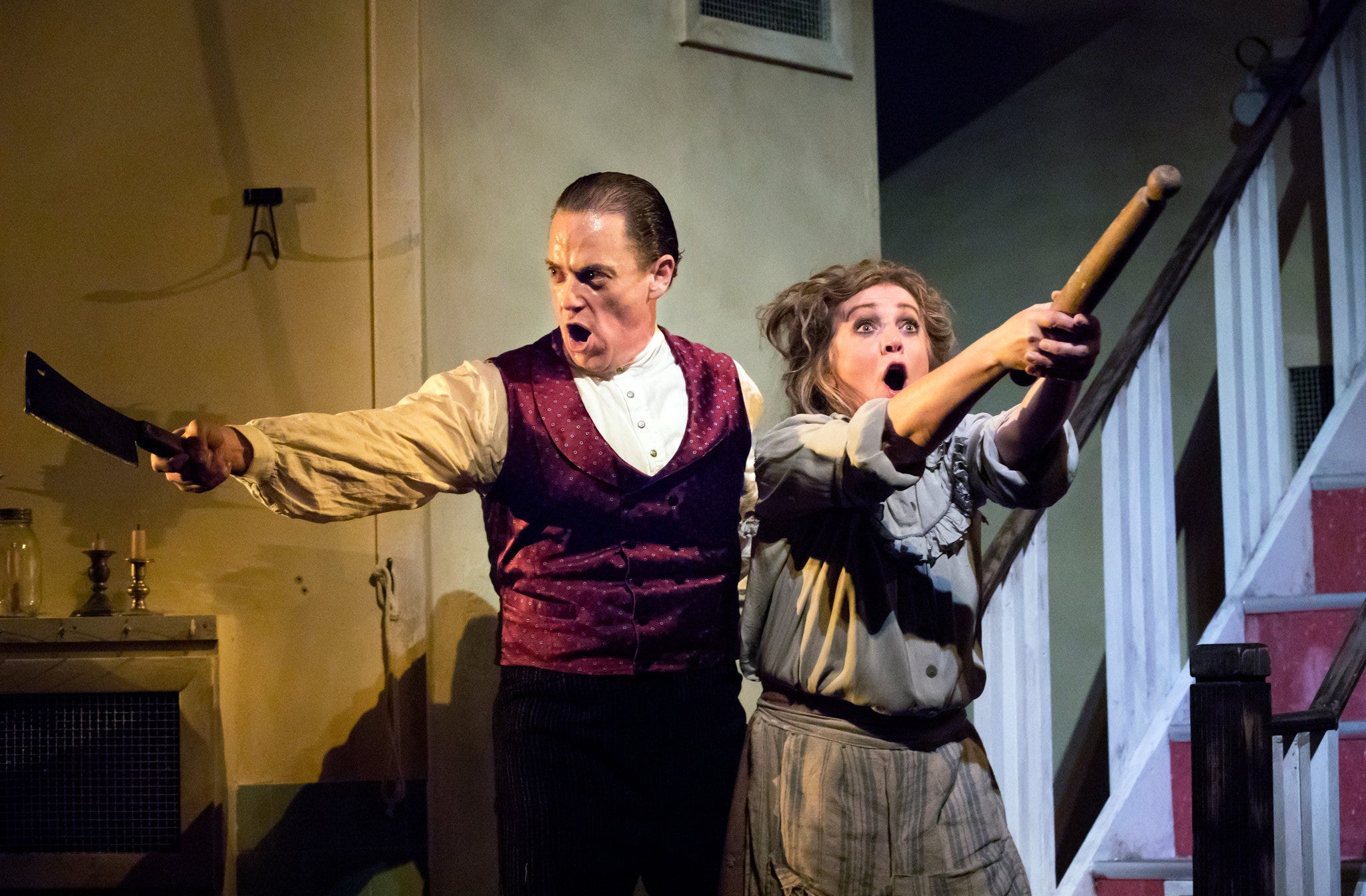
Secomb described the emotional stakes of the pie-shop environment. Rapson gives us a window into the craft detail: the way the scale of a space rewires vocal performance, changes the feel of the music, makes demands that a large theatre would never make. Together, they describe a production in which the venue functioned as an active creative force.
Sondheim recognized this. He came to Barrow Street multiple times, and his behavior during performances became something of a feature. “Every single time,” Secomb says, “you would just hear that laughter during the show. He would just find it funny.”
Bodies in the water: The Frogs at Yale, 1974
Let’s now look at site-specific Sondheim in an altogether stranger mode: not blood on the tables, but bodies in the water.
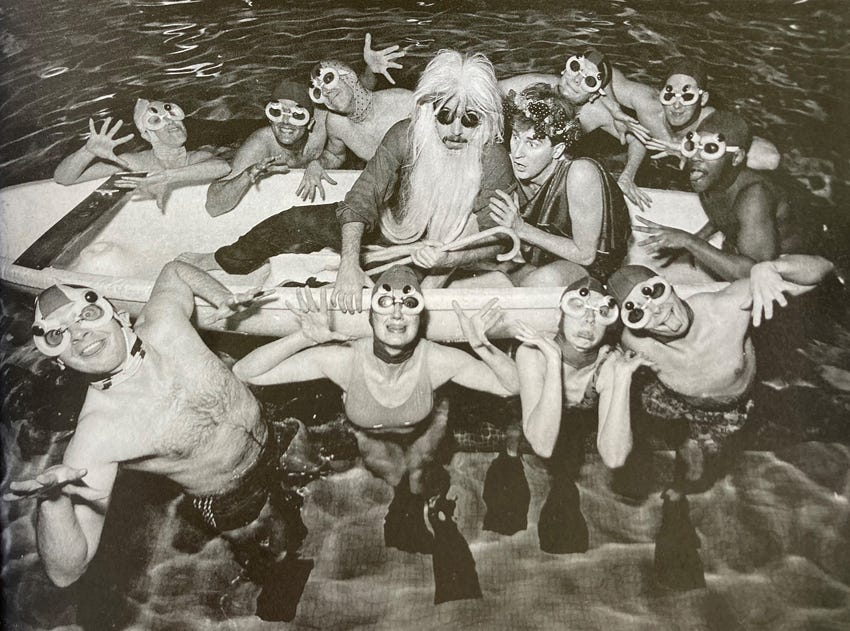
The original production of The Frogs, Shevelove and Sondheim’s adaptation of Aristophanes, was staged in the pool at Yale’s Payne Whitney Gymnasium in May 1974. Shevelove directed; Carmen de Lavallade choreographed. The cast ran to dozens of performers plus 21 members of the Yale swim team, playing the frogs. Among the singers were Christopher Durang, Meryl Streep, and Sigourney Weaver. MTI records eight performances, beginning May 20, 1974.
But the strangeness of that setting was not without precedent. It had a Yale history of its own. More than three decades earlier, when Shevelove was himself a Yale drama student, he had staged Aristophanes’s The Frogs in the exhibition pool of the very same gymnasium. A photograph (below) from that 1941 Yale Dramat production appeared on the cover of the Yale Alumni Magazine, showing a young Shevelove already imagining Aristophanes as something to be plunged into. Then, as later, the frogs themselves were played by members of the Yale swim team.
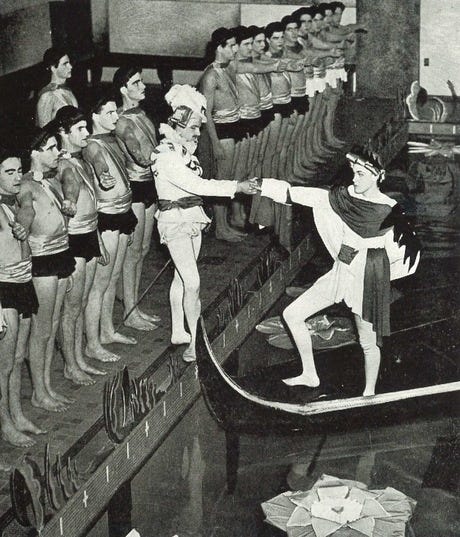
So when Shevelove returned to Payne Whitney in 1974, now with Sondheim, he was returning to a theatrical memory — and to a Yale joke that had become almost ritualistic. The frogs’ ancient cry in Aristophanes, “Brek-ek-ek-ex, ko-ax, ko-ax,” had long since entered Yale culture as part of the “Long Cheer” performed at athletic events. The eccentric staging, then, was layered with local resonance. The pool was a pool, yes — but it was also a campus amphitheatre, an athletic arena, a house of echoes, and a place where Aristophanes had already somehow become watery Yale property.
There is something wonderfully Sondheimian about that collision of elements: Aristophanes, Yale athletics, Greek chorus, musical comedy, university ritual, swim-team spectacle. In that sense, The Frogs may be one of the purest examples of site-specific Sondheim precisely because it is so peculiar. It uses site to create event, to create spectacle — to create a kind of inhabited absurdity.
And perhaps that is where site-specific Sondheim really lives: in the gleeful collapse of categories, more so than in the promise of greater realism. Not in the piece of theatre made real, but in the real world made theatrical.
The story of site-specific Sondheim does not begin and end with pies and pools. Next week, we head into the woods…
The Sondheim Hub is a reader-supported publication
If you find our work valuable, consider becoming a paying subscriber.
You’ll receive an exclusive essay each week, access to our full archive of 300+ essays, interviews & features, more from each interview, and a weekly Sondheim crossword. Paid subscriptions make our work possible. 📚