
Please Hello: Oui, Détente!
The French Admiral, détente, and "unending please hello"
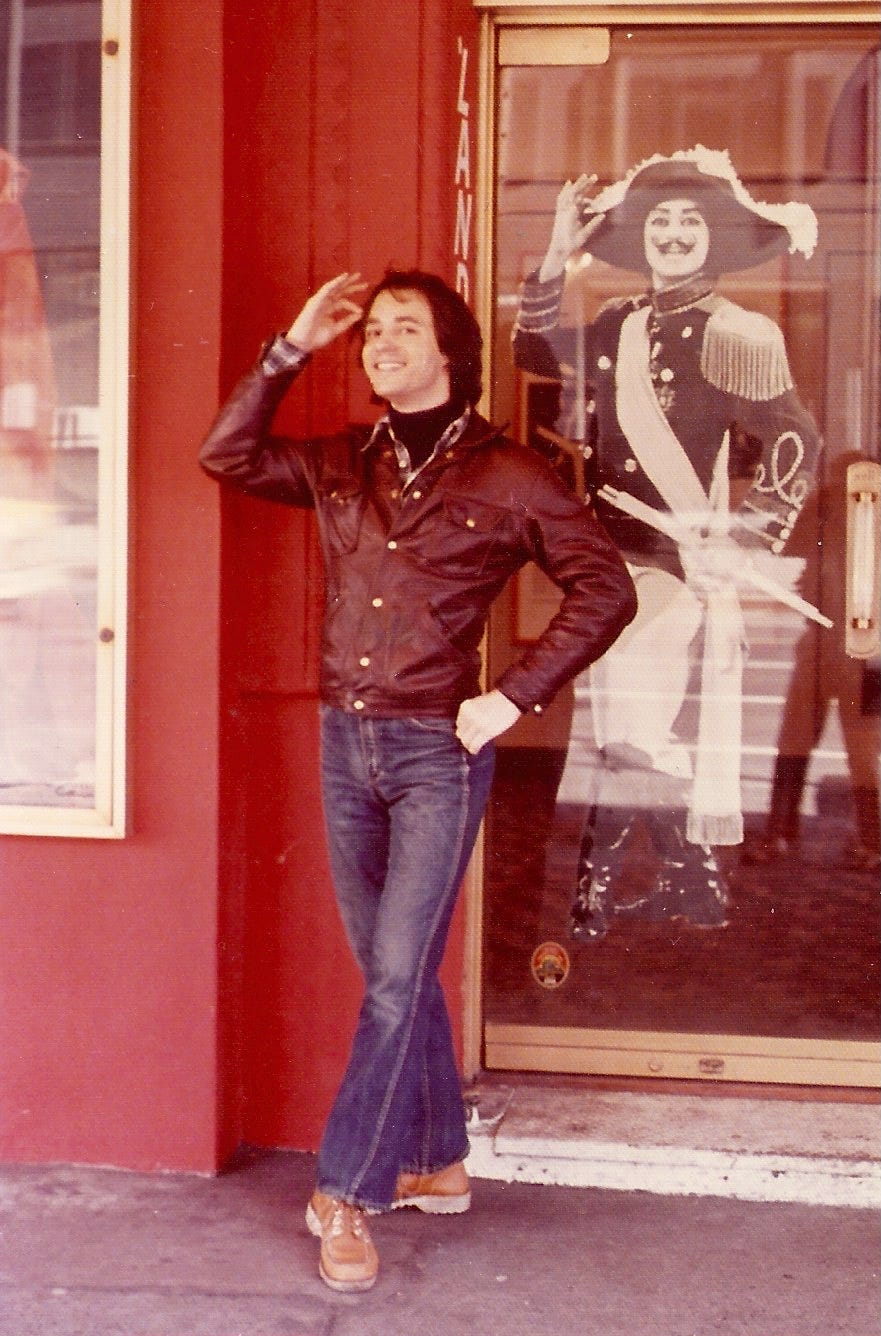
Recently we were lucky enough to speak to James Dybas, who in 1976 created the role of the French Admiral in Pacific Overtures. 50 years on, as we bring our five-part essay series on “Please Hello” to a close, let’s meet the Admiral himself…
We’ve looked on as four other Admirals have arrived, threatened, bribed, and coerced their way to signatures. We’ve watched “Please Hello” descend, in the wake of Russia’s extraterritoriality clause, into a chaotic scrum of competing demands. Amidst this chaos, the French Admiral arrives with a word — a single, luminous word — that proposes to make all of it disappear.
That word is détente.
Thank you for reading! If you find our work valuable, consider upgrading to a paid subscription for the full Sondheim Hub experience. ✍️
Before we get there, though, we’ve learned throughout this series to pay attention to entrances. The French Admiral tells us he brings word from “Napoleon ze Third.” That word, at first, would seem to be ‘allo. He enters, dancing, with no fewer than six such greetings.
Here is a man, it would seem, who is conscious of his lateness and intends to make up that deficit:
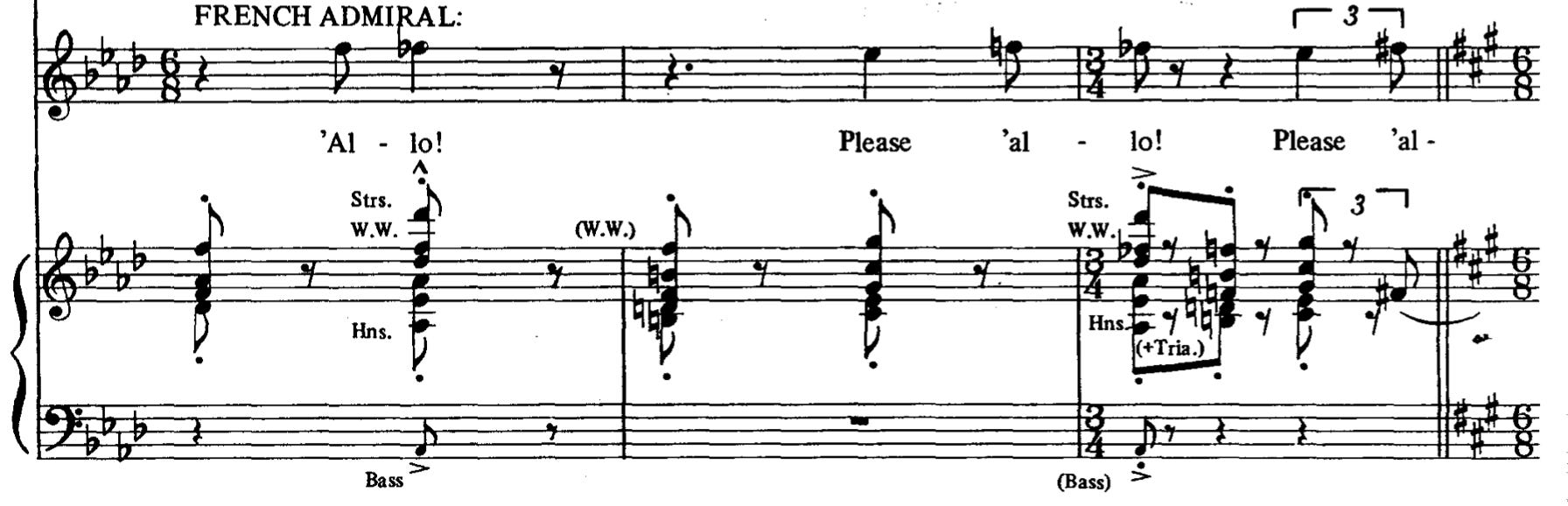
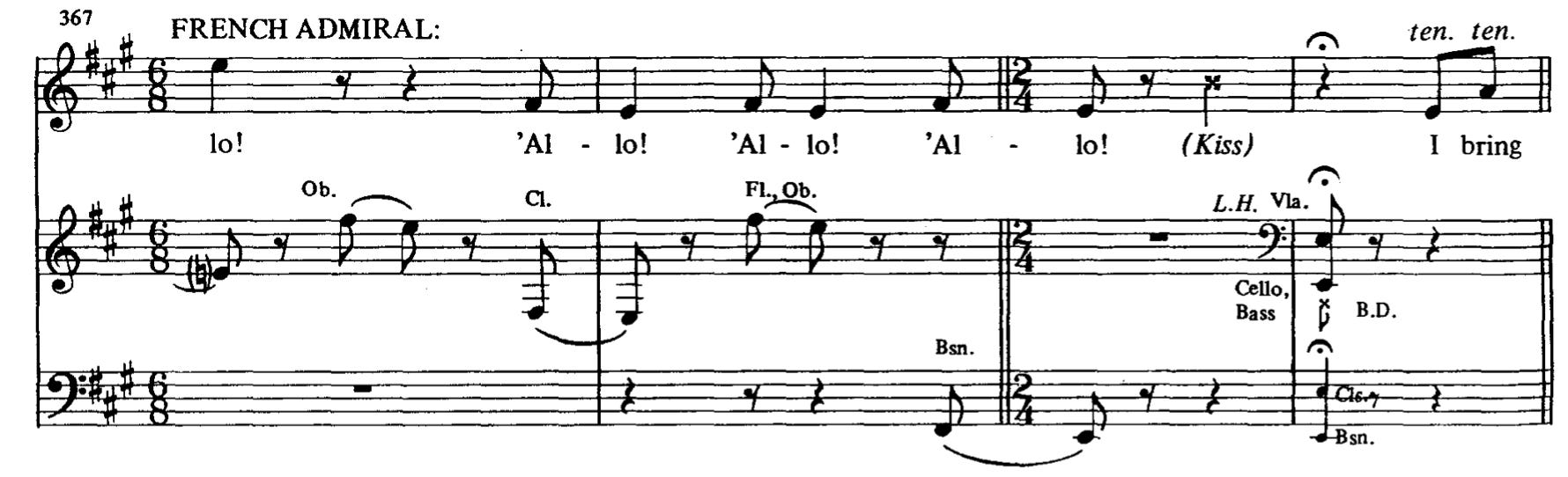
That lateness chimes historically. France was the last of the major Western powers to force treaty concessions from Japan in this period, signing its first treaty of amity and commerce in 1858 — three years after Russia’s Shimoda treaty, four years after the American Convention of Kanagawa. By the time France arrived at the negotiating table, the door had been broken down by everyone else; France was simply walking through it.
And yet France arrives with perhaps the most ambitious demand of all — not a port, not a legal clause, not an ambassador, but an ideological reframing of what has just happened.
What Is Détente?
Détente means a loosening or relaxation, the easing of tension between hostile parties. In the diplomatic vocabulary of the nineteenth century, it described the careful management of great-power rivalry: not resolution necessarily, nor alliance, but the maintenance of a working relationship between nations that might otherwise come to blows. In twentieth-century vocabulary, it would come to mean specifically the managed coexistence of the superpowers during the Cold War. It’s worth noting that Sondheim was writing Pacific Overtures during Nixon and Kissinger’s détente era with the Soviet Union (a policy critics derided as a polite framing for acquiescing to power, for calling that acquiescence peace). But the word means, in both contexts, roughly the same thing: we have decided not to call this what it is.
As the French Admiral puts it:
Just détente! Oooh, détente!
No agreement could be more fair!
Signing pacts,
Passing acts,
Zere’s no time for making warfare
When you’re always busy
Making wiz ze
Mutual détente!
The word “mutual” here recalls the American Admiral’s “first result of mutual trade,” again applying symmetrical language to an asymmetric situation. The détente is mutual in the sense that both parties are participating; it is not mutual in the sense that both parties are equal. Japan is being offered détente as a name for what has been happening to it for the past several years, retroactively, by the last in a series of uninvited guests who has decided to reframe the party as a dinner to which everyone was always welcome.
This is a new kind of ideological move. Previous Admirals brought ideologies that justified their specific actions: we bring technology (USA), we bring civilization (Britain), we bring trade (the Dutch), we note what our laws say (Russia). The French Admiral brings an ideology that justifies all of it, all at once. Détente says: we are all cooperating. We are all, together, relaxing tension. The coercions of the previous four years were not coercions. They were the gradual construction of a framework of mutual goodwill. You may thank us now.
The Gifts
A reminder of the “gifts” Abe has so far received:
From the USA, infrastructure — the physical systems of extraction and monetization. From Britain, tea — which Japan already had. From the Dutch, chocolate, tulips, and a wooden shoe. Naturally. From Russia, strictly speaking, nothing — which was at least honest.
The French Admiral brings champagne:
Leave ze grain,
Leave ze train,
Put Champagne among your imports!
These lines fly by, but they’re impressively audacious. “Leave ze grain, leave ze train” dismisses the entire economic justification the US offered for its presence. The French Admiral, uninterested in infrastructure or development or any moral argument about technological progress, foregrounds luxury and pleasure.
We might think of champagne as the reductio ad absurdum of the whole gift-giving tradition in “Please Hello.” America offered kerosene and cement and said: we are civilizing you. France offers champagne and says: we are partying with you. The distinction is meaningless in practice — both are one-sided exchanges dressed as generosity — but the champagne is, in its way, more honest. It at least makes no claim to your improvement.
✍️ If you’re enjoying our “Please Hello” series, consider supporting The Sondheim Hub and unlock the full experience for just $7 a month:
an exclusive paid-only essay each week
this week, we’ll look at Sondheim’s “French” music, its roots in Offenbach, and its future life in Beauty and the Beast…a weekly Sondheim crossword and more from each interview
full access to our archive of 250+ essays, features, and interviews
The champagne, like the wooden shoe, is a kind of branded national souvenir. The difference is that Sondheim’s Dutch Admiral offered his stereotypes desperately, at the bottom of the bag, having run out of actual arguments. The French Admiral offers his first, before making any argument at all. The champagne is the détente — the sensory embodiment of the claim that this is all, really, just a very nice party.
The Mask Slips
For roughly the first two-thirds of his section, the French Admiral maintains the performance perfectly. Détente, he insists, is the only thing France wants. No agreement could be more fair. Everyone is cooperating. And then Abe speaks:
It is late,
And I fear—
Well,
You see,
There’s a famine.
Could you wait
For a year?
We’ll agree
To examine it
Abe, who has been steamrolled, manipulated, coerced, and ignored since America fired its first cannon, finds in this moment a voice. But it’s an exhausted voice, not a defiant one. All of this — all the signing, all the explosions, all the mutual détente — has been happening to a nation that is actually suffering. As Abe lists the disasters one by one — “But we’ve had a quake and a flood and a famine” — it is clear no one is listening. But he keeps speaking anyway, because what else is there to do?
What the French Admiral does in this moment is pretty dark. Rather than dismissing Abe’s famine, rather than arguing against it, he incorporates it:
Why discuss,
Make ze fuss,
Since ze West belongs to us?
And ze East
We ‘ave leased
For ze French administration.
Japan has been leased — a term that preserves the fiction of Japanese ownership while describing total French administrative control. The famine, rather than something to be considered or addressed, exists inside a piece of territory France has already decided belongs to its sphere of management. The champagne is still on the table. There is, apparently, no reason to stop celebrating.
This is the endpoint of the ideological progression. Progress, civilization, commerce, law… France has something that subsumes all four: a vision of the world already arranged, already leased, already administered, in which the question of Japan’s consent is not refused but simply never asked.
The Collapse
After the French Admiral’s mask slips, “Please Hello” reaches its extraordinary finale. All five Admirals sing simultaneously, their individual national idioms dissolving into a single, cacophonous whole:
Please hello!
We must go,
But our intercourse will grow
Through détente,
As détente
Brings complete cooperation.
By the way,
May we say
We adore your little nation,
And with heavy cannon
Wish you an un-
Ending please hello!!!
“We adore your little nation.” The diminutive has been implied since the very beginning of this number, the American Admiral speaking as if to a child. Here it is finally spoken plainly, the condescension stripped of any particular national wrapping.
“Please hello” began as America’s phrase, the broken-English courtesy of an empire that assumed the world should accommodate its arrival. By the end of the number, it belongs to everyone, repeated endlessly, a sound that has lost its meaning in its own repetition and become simply the permanent condition. The Admirals must go, they tell us. Their intercourse will grow. They will be back. The door is open. The coat is untouchable. The champagne is poured. The train runs on time. And through it all, please hello, please hello, please hello — the sound of the Western world deciding to stay for good.
Five Admirals, One Argument
This essay series began with a question: what does each imperial power’s mode of arrival reveal about how it understands its own presence? Over five months, we have traced five answers.
America’s answer was progress — the circular logic of technological supremacy that creates dependency in order to prove the right to impose itself. Its gift was infrastructure; its threat was disguised as festivity; its most lasting move was the fine print, the most-favored-nation clause that wrote America into every subsequent negotiation without appearing at the table.
Britain’s answer was civilization — the permanent installation of process as power, bureaucracy as occupation. Its gift was formality; its threat was apologized for; its most lasting move was the word “tentative,” which promised that whatever had just happened was only a beginning.
The Netherlands offered little to no ideology, only empire as supply-chain management, sovereignty as a question of port logistics, two centuries of profitable humiliation concluding in a tantrum when the incumbent’s position was superseded by more aggressive newcomers.
Russia offered law — or rather, law’s negation: a clause that removed its citizens from the jurisdiction of the country they were visiting, a coat that could not be touched, a frank dismissal of the question of whether Japan wished to vote.
And France offered détente — the proposal that required no argument because it had already incorporated all the others. It’s an assertion that the arrangement already exists, that Japan’s disasters are administrative matters within a leased territory, and that the only question remaining is whether to have champagne now or later.
Taken together, these five ideologies form a complete grammar of imperial justification. Progress. Civilization. Commerce. Law. And finally, the master term that renders all the others unnecessary: the claim that everyone has always been cooperating, that the coercions were collaborations, that the endless please hello was, and remains, mutual.
And so concludes our five-part essay series on “Please Hello.” For now, please goodbye! On Friday, exclusively for our paid subscribers, we’ll be looking at the French Admiral’s music — tracing it back to Offenbach, and forward to Alan Menken’s “Be Our Guest…”
The Sondheim Hub is a reader-supported publication
If you find our work valuable, consider becoming a paying subscriber.
You’ll get access to our full archive of 250+ essays, interviews & features, an exclusive essay each week, more from each interview, and a weekly Sondheim crossword. Paid subscriptions make our work possible. 📚
Loved this series! Funniest/harshest line has always been “We adore your little nation” for me. Perfectly executed condescension
A brilliant conclusion to this insightful series.