
Judge Turpin's Private Theatre
Reading Turpin's "Johanna" through Foucault & Douglas | Plus, a Valentine-themed crossword & more from our conversation with Jacob Fowler
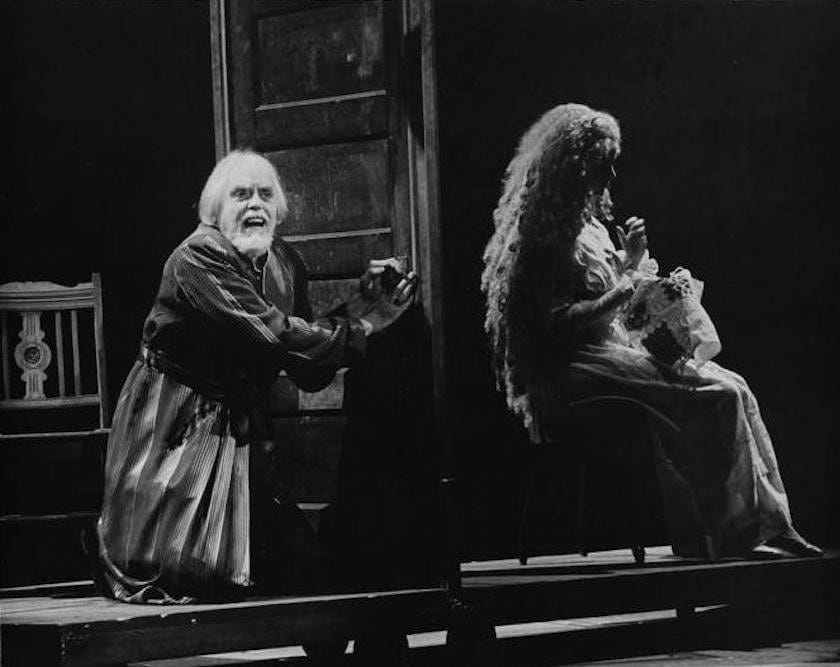
Last Sunday, we explored why Judge Turpin’s “Johanna” matters dramaturgically in Sweeney Todd: how it reveals compulsion rather than stability, and how it makes visible the private ritual sustaining Johanna’s enclosure.
Today, let’s take a closer look at what that ritual means when read through Michel Foucault’s analysis of confession and sexuality, and Mary Douglas’s anthropology of purity and pollution. In this wider context, what does Turpin’s “Johanna” reveal about how power, desire, and moral authority become mutually constitutive?
If you’re currently a free subscriber, consider upgrading to a premium subscription for full access to The Sondheim Hub: an exclusive essay, crossword, extended interview & more each week, plus our complete, paywall-free library of 250+ essays, features & interviews.
Sondheim, speaking to Mark Eden Horowitz about Turpin’s “Johanna,” framed the number in historical terms: this mixture of lechery and guilt wasn’t gratuitous kink, but “the rotten core of a particular kind of respectability.” What Sondheim described intuitively, Foucault theorized systematically: that Victorian sexuality wasn’t repressed so much as it was incited—channeled into specific rituals of speech, of self-examination. These were specific performances of guilt that often intensified the very desires they claimed to temper.
The Confessional Subject
Foucault’s central provocation in The History of Sexuality is that we’ve misunderstood the Victorians. The received narrative, that the nineteenth century “repressed” sexuality, forcing it underground, gets the mechanism backward. What the Victorians actually did was proliferate discourse about sex: in medical treatises, legal testimonies, psychiatric case studies, religious confessions, educational warnings, and domestic advice literature. It became a subject that had to be constantly spoken, examined, brought to light.
The confession, in Foucault’s account, is the West’s master technology for this work. It not only reveals but produces truth about the confessor, forcing desire into language, making the self knowable and therefore governable. You confess to a priest, a doctor, a judge—to an authority who can interpret, classify, even prescribe. The act of confession transforms you into a particular kind of subject: one who harbors secrets, who must be made to speak, who can be known through what you reveal.
Turpin’s “Johanna” stages exactly this dynamic, but with a crucial twist: he is simultaneously confessor and penitent, the one who speaks and the one who listens.
What Foucault helps us see is why confession itself has become necessary to his desire. His term is “scientia sexualis”—a will to knowledge about sex—which contrasts with the “ars erotica” of other cultures, where pleasure is cultivated as art. Turpin’s use of the Confiteor, that ritualized Catholic formula, reveals how thoroughly his desire has been routed through institutional structures of power. Foucault argues that confession produces the subject it claims to reveal; Turpin is producing himself as a lustful subject through the very act of confessing it. The Latin liturgy, the invocation of God, the plea for restraint: this is necessary architecture for his desire, not an obstacle to it.
This is why Turpin’s confession doesn’t—indeed, can’t—lead to change. Turpin must confess again tomorrow, and the day after, because the ritual doesn’t resolve his desire. His “pervade me” isn’t a failure of penitence but its consummation: the moment when surrender to divine authority becomes indistinguishable from erotic surrender, when the structures meant to regulate become the medium of arousal itself.
The Ritual Structure of Desire
What makes Turpin’s “Johanna” particularly legible through a Foucauldian lens is its insistence on repetition. The libretto is explicit about the song’s choreography: