
Where does one begin with Pacific Overtures? An American warship? Chrysanthemum tea? A bowler hat? Just this once, let’s simply begin with A.
In Pacific Overtures, we see one order confronted, unsettled, and eventually remade by another. Today, order of an alphabetical kind will serve simply as one of many possible routes through the musical: from Abe to zaibatsu, and from a floating kingdom to whatever comes Next…
Abe
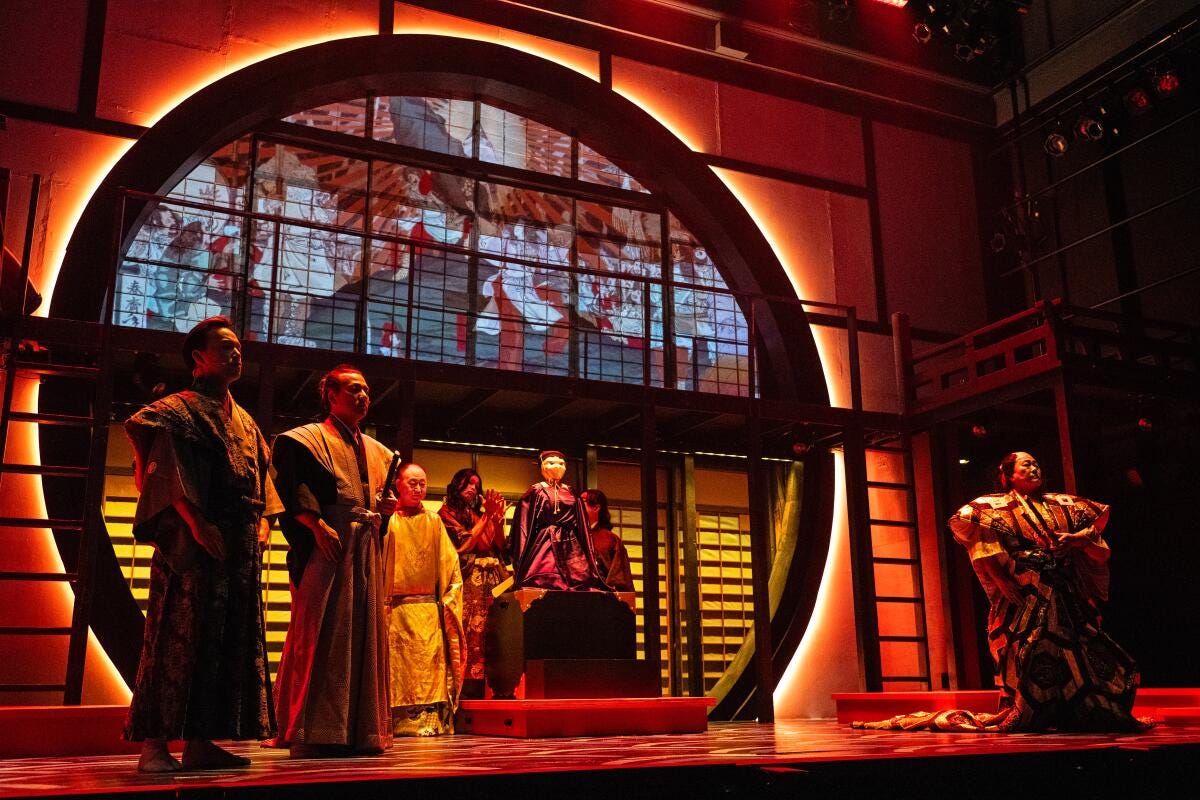
Poor Lord Abe... Pacific Overtures keeps handing him problems that cannot be solved, then punishing him for failing to solve them. Manjiro brings warning of Perry, the Shogun’s court dithers — and then, in “Please Hello,” five Western powers arrive with fully armed battalions to remind him of their love… Historically, Abe Masahiro was the senior councillor who led the shogunate’s response to Perry, although the musical plays freely with offices and succession. Its Abe gradually comes to stand for the government itself: ceremonially important, theoretically powerful… but increasingly unable to finish a sentence.
Bowler Hat
Does anyone still wear a bowler hat? In Pacific Overtures, Kayama does. At first, it seems comic, out of place: a small, stiff, unmistakably Western object sitting atop a samurai. The pocket watch will follow, as will the cutaway coat, a pistol, spectacles, white wine. Sondheim lets the change happen item by item, and the slow creep is unsettling. Kayama has no Todd-like epiphany where he resolves to abandon Japan. He accommodates, acclimatizes, learns, makes himself useful. Each choice seems entirely reasonable. By the end of “A Bowler Hat,” those reasonable choices have remade the entire man.
Chrysanthemum Tea
The Shogun is ill, indecisive, seems incapable of responding to Perry, so his mother poisons him. Everything about “Chrysanthemum Tea” is decorous: the court, the serving ritual… Chrysanthemums carry associations of longevity and the Imperial House. Here, that promise is turned rather blackly on its head. Still, the tea is properly prepared. Government may be collapsing, but standards must be maintained.
Dejima
Dejima sounds like a theatrical invention: a fan-shaped artificial island, roughly the size of a city block, built for the Portuguese and occupied by the Dutch from 1641. But it was real. The island allowed Western goods and knowledge into Japan while keeping the Westerners themselves under extraordinary restriction. For two centuries, the Dutch accepted the indignities because the monopoly was profitable. Then Perry arrived and made the whole arrangement look quaint. The Dutch Admiral’s frantic “Don’t forget the Dutch!” carries that history inside it — a history we explored in depth in this recent essay.
Extraterritoriality
The only nine-syllable word in the Sondheim canon? Surely… Extraterritoriality meant that foreigners in Japan could remain beyond the reach of Japanese law, answering instead to their own consular authorities. A Russian sailor committing a crime in a Japanese city might therefore be tried by Russians, under Russian law. The Russian Admiral explains the arrangement in “Please Hello”: his countrymen, like his magnificent coat, are not to be touched. For more on this, see our full essay on the Russian Admiral.
Floating Kingdom
In the middle of the world, they float. In that single word, we sense both serenity and a kind of precariousness. Japan, balanced above depths and currents, believes the water has placed the world at a safe distance as Pacific Overtures begins. The opening number makes this existence sound complete: screens are painted, rice is planted, flowers are arranged, the moon is viewed. Elsewhere, kings burn and machines roar. Not here. But the same sea that protects Japan carries Perry towards it. One can float serenely only for as long as the current agrees…
Gunboat Diplomacy
In our essay series on “Please Hello” earlier this year, we became intimately acquainted with gunboat diplomacy. Perry, who carried a presidential letter, impressive gifts and proposals of friendship, also carried enough naval firepower to make refusing such friendship extremely unwise. In “Please Hello,” every explosion is larger than the last, while every Admiral continues to insist upon the peaceful and mutually beneficial nature of his visit.
Hanamichi
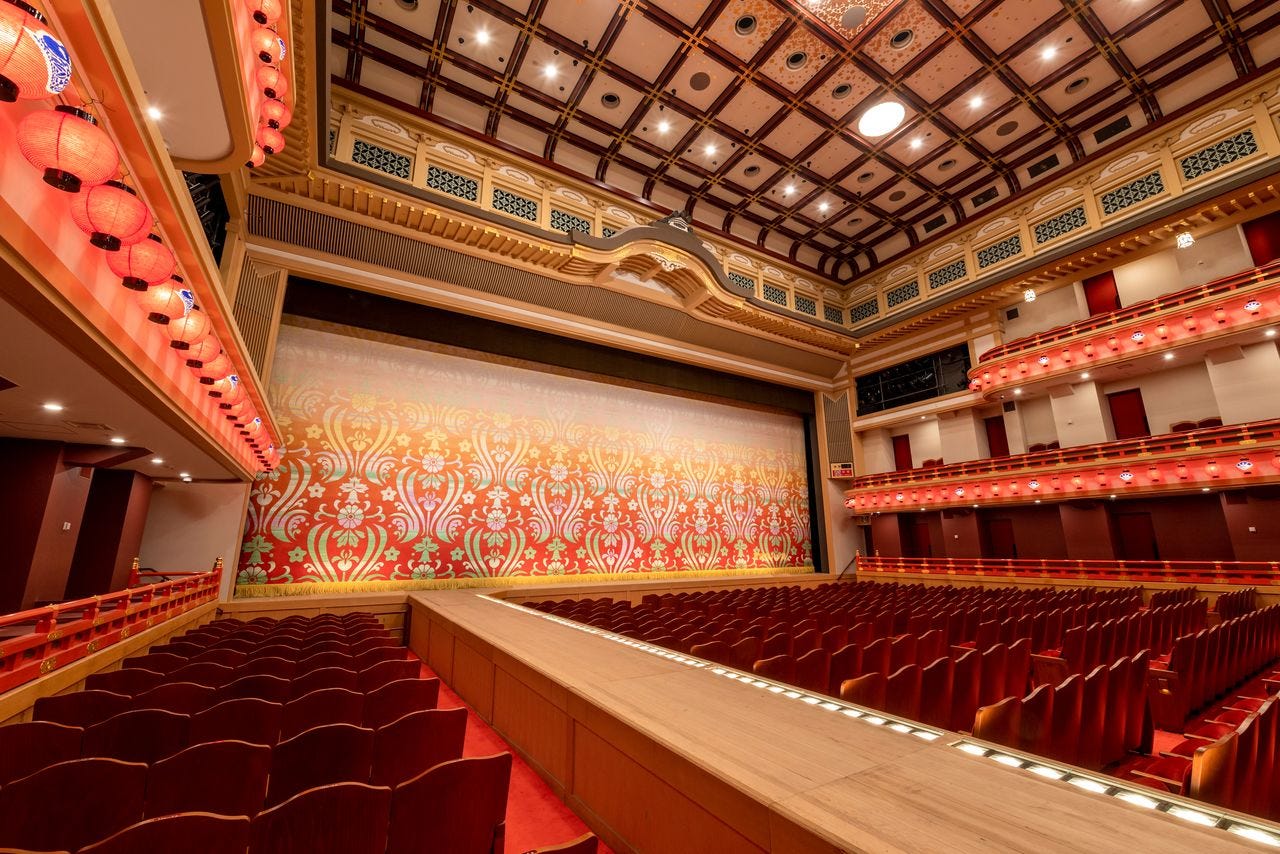
The hanamichi, literally the “flower path,” is a raised walkway running from a Kabuki stage through the audience. Depending on the scene, it can become a road, a corridor, a riverbank or the sea; an actor travelling along it seems to bring the fictional world through the spectators themselves. It’s too simple to call Pacific Overtures a Kabuki musical — Prince’s original production borrowed, adapted, and sometimes freely reinvented Japanese theatrical forms for Broadway. But the hanamichi is a useful reminder that history, not content to approach from a safe distance, can pass right beside us on its way to the stage.
Imperialism
Sadly, imperialism itself needs little explanation. What’s perhaps most noteworthy in Pacific Overtures (to use another “I” word) is how insidious it can be. In Pacific Overtures, it asks for a coaling port. Then an ambassador. Then another port, an extra clause, exemption from local law. Japan was never formally colonized by Western powers, but its sovereignty was steadily pared away through treaties it had little genuine freedom to refuse. And Japan’s eventual answer was to study the system thrust upon it very carefully. During the Meiji period, it built an empire of its own.
John Manjiro
It’s a name that has already crossed the Pacific before he enters the story. Born Nakahama Manjirō, he was shipwrecked as a teenager, rescued by an American whaling ship and educated in Massachusetts before returning to Japan in 1851. That made him extraordinarily useful when the country urgently needed knowledge of America. Pacific Overtures stretches his biography much further. Its Manjiro begins by loving the West, becomes Kayama’s friend, and ends as an anti-Western samurai who kills him. The real Manjiro did no such thing. Weidman turns him instead into one half of the show’s great reversal: Manjiro travels from West to East…
Kayama
… as Kayama travels from East to West. A samurai of little consequence, Kayama is made Prefect of Police and told to send Perry away — largely because more important men would prefer not to die trying. Kayama survives by recruiting Manjiro, covering the shore with mats, and building a Treaty House so the Americans can land without technically setting foot on Japanese soil.
Lion Dance
For a moment, the Japanese believe they have won. Perry has delivered his letter inside a temporary Treaty House; the building and its mats can now be destroyed, leaving the ancestral soil symbolically untouched. Then Perry reappears as a lion. Lion dances occur in several East Asian traditions and may promise luck, protection, or purification. The original Pacific Overtures twists the form into an American victory lap, ending in a flag-waving cakewalk. Perry, having entered Japan, almost immediately begins taking possession of the theatrical language used to represent him. Later productions removed the dance — but what a remarkable dramatic conceit.
Meiji Restoration
“Restoration” is doing quite a lot of heavy lifting here. In 1868, political authority in Japan was indeed formally restored to the Emperor Meiji after centuries of shogunal rule, but this was not a country turning back the clock. It centralized, industrialized, built a modern army and dismantled the samurai class. Pacific Overtures reaches this vast upheaval at tremendous speed. The Emperor reclaims power, orders the samurai to put aside their swords, and announces that Japan will master the methods of the West. Something old is restored in order to authorize something radically new.
✍️ If you’re enjoying this feature, consider supporting The Sondheim Hub and unlock our full archive & exclusive content each week:
an exclusive weekly member-only essay
an extended edition of each of our interviews
a weekly Sondheim crossword
full, paywall-free access to our archive of 300+ essays, features, and interviews
A small percentage of readers currently support us with a paid subscription. If you’re able to help sustain this work, please consider becoming a Sondheim Hub member! 📚
Next
“Next” is a tiny word that refuses reflection. Pacific Overtures’ finale rushes from 1853 to the Japan of 1976 (sometimes later in subsequent productions) through an onslaught of transactions and technological progress. Earlier in the show, a bow can take several seconds and a treaty meeting can be reconstructed from the memories of three partial witnesses. Now there is scarcely time to register one development before another arrives.
Overtures
Few Sondheim titles work harder. We register “overture” as being the music before the drama begins; it is also (more literally here, of course) an approach or proposal offered by one party to another. And “Pacific,” which places us geographically, also subtly seems to want to assure us that those overtures will be peaceful. Perry uses that very description in his journal, even as he reserves the right to impose his peaceful proposals by force.
Perry
And what of Perry himself? He is everywhere in Pacific Overtures, even before he appears. He is a rumor brought by Manjiro, a presidential letter, four black shapes on the horizon. The historical Commodore Matthew Calbraith Perry entered Edo Bay with four ships in 1853 and returned with a larger squadron in 1854. The resulting Convention of Kanagawa opened two ports for supplies and assistance to shipwrecked sailors, although full commercial trade came later. The musical wisely declines to make Perry a rounded protagonist. Seen from the Japanese shore, he is closer to a natural phenomenon: smoke, noise, enormous scale.
Quake
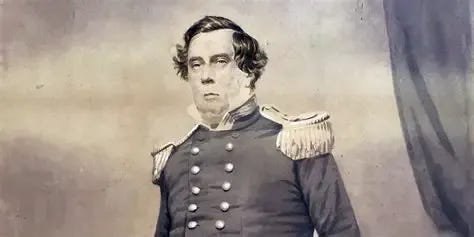
“Quake” is not only here because every A to Z needs help with Q. Well... there might be a little of that. But while the various Admirals pile demand upon demand in “Please Hello,” Abe tries to explain that Japan has suffered a quake, a flood and a famine. Nobody is interested. And the detail has a grim historical basis. The Ansei earthquakes of 1854 and 1855 devastated parts of Japan during the treaty period; a tsunami at Shimoda even wrecked the Russian frigate Diana while Admiral Putyatin was negotiating nearby. The country was dealing with natural and diplomatic catastrophe at once.
Reciter
The Reciter begins the musical with his forehead touching the floor. From there he rises to introduce Japan, guide us through its history and, in the original production, become Shogun and Emperor too. “Someone in a Tree” is, in some ways, a direct challenge to his authority. There is no trusted Japanese record of the treaty meeting, so history must be assembled from a boy peering through branches and a warrior listening beneath the floorboards. The Reciter, telling the story, cannot make the story whole.
Sakoku
Sakoku, usually translated as “closed country,” describes the Tokugawa restrictions on foreign trade, religion and movement. Japan was not truly sealed, however. Dutch and Chinese traders came through Nagasaki, while other relationships continued through Korea, the Ryukyu Kingdom and the northern borderlands. The serene, untouched country we encounter in Pacific Overtures’ opening number is partly telling a story about itself. The outside world has not entirely disappeared, but it has been channelled through a handful of heavily guarded gates.
Tamate
In the original staging of “There Is No Other Way,” Tamate moved silently while two Observers sang about her and voiced her thoughts. Soon-Tek Oh played the role under the production’s Kabuki-derived convention of casting men as women. By the time Kayama returns, unexpectedly alive and newly important, Tamate has killed herself in the belief that he is dead. The opening of Japan has already claimed a life, and no treaty records it.
Ukiyo-e
Ukiyo-e, “pictures of the floating world,” were paintings and, most famously, woodblock prints depicting actors, courtesans, landscapes and the pleasures of Edo life. Their bold outlines and flattened, framed spaces became hugely influential outside Japan. Boris Aronson drew deeply upon this visual world for the original Pacific Overtures: screens open onto further screens, scenes appear like prints, and Perry’s ship unfolds into a great black image.
VOC
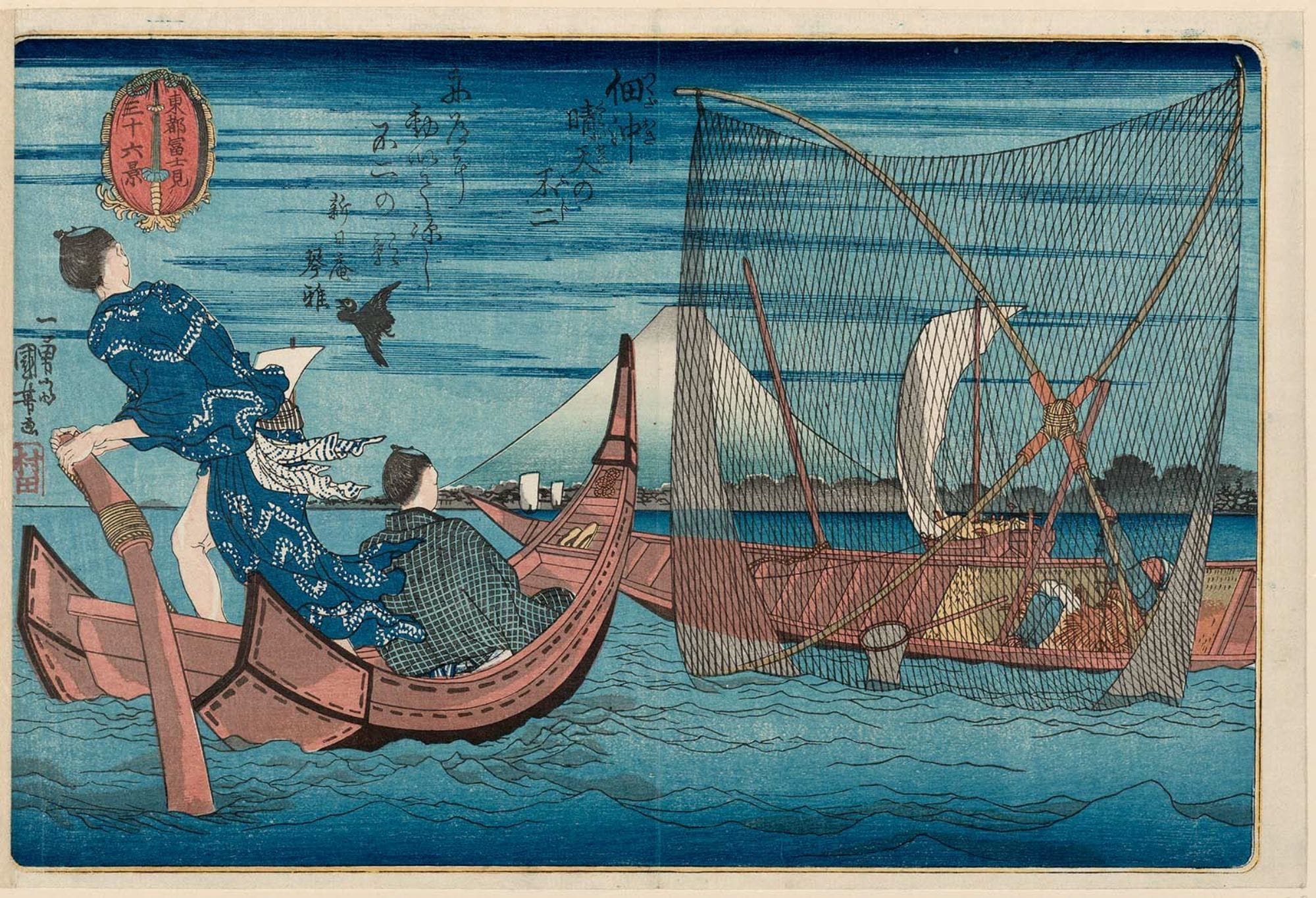
Behind the Dutch presence at Dejima stood the VOC: the Vereenigde Oostindische Compagnie, or Dutch East India Company. The VOC, which traded with Japan from 1609 and moved onto Dejima in 1641, was gone by the time of Perry, dissolved in 1799 under the weight of debt and corruption, so the Dutch Admiral is not literally its representative. He does, however, inherit its view of the world. Countries are ports, cultures are catalogues of saleable goods, and sovereignty is a lesser concern.
Weidman
Let’s not forget that Pacific Overtures began with John Weidman. While at Yale Law School, having majored in East Asian history at Harvard, he wrote to Hal Prince with an idea for a play about the opening of Japan. Prince commissioned it, then decided it should become a musical and brought in Sondheim. The resulting book, with additional material by fellow “W” Hugh Wheeler, is as daring as the score: the Japanese speak formal, elegant English; the Westerners are reduced to mangled national caricatures. Again and again, Weidman changes the scale and ownership of history.
Xavier
Walk with me here… Francis Xavier never appears in Pacific Overtures. He had been dead for three hundred years by the time Perry arrived. Yet the Jesuit missionary, who landed at Kagoshima in 1549, belongs to the history buried beneath the show’s opening decree. Portuguese trade and Catholic evangelism came to Japan together, and the growth of Christianity gradually became associated with foreign influence and divided political allegiance. Persecution, prohibition and the eventual expulsion of the Portuguese followed. Xavier did not single-handedly cause sakoku, any more than Christianity alone did. His mission does help explain, though, why the show’s Japan remembers its previous welcome to foreigners as something dangerous.
Yokohama
The Dutch Admiral almost loses Yokohama halfway through saying it. He wants two ports, one of them for cocoa, but must pause to remember what the place is called: Yoko—ah, yes—Hama. Two centuries of Dutch contact with Japan have apparently not encouraged him to learn much geography beyond Nagasaki. At the time of Perry’s arrival, Yokohama was a small settlement. Its opening as a treaty port in 1859 transformed it at remarkable speed into a center of international trade and foreign residence.
Zaibatsu
Zaibatsu is possibly the least immediately theatrical word in this alphabet. It refers to the family-controlled industrial and financial conglomerates — Mitsui, Mitsubishi, Sumitomo, Yasuda — that became immensely powerful as Japan modernized. Their banks, factories, trading companies and heavy industries helped the country compete with the West and supported its later imperial expansion. The word never appears in Pacific Overtures, but lurks just beneath the surface of “Next.” How satisfying, though, to end both alphabet and show together.
The Sondheim Hub is a reader-supported publication
If you find our work valuable, consider becoming a paying subscriber.
You’ll receive an exclusive essay each week, access to our full archive of 300+ essays, interviews & features, more from each interview, and a weekly Sondheim crossword. Paid subscriptions make our work possible. 📚
Brilliant (and funny) as always. I was wondering how you were going to pull off "X."