
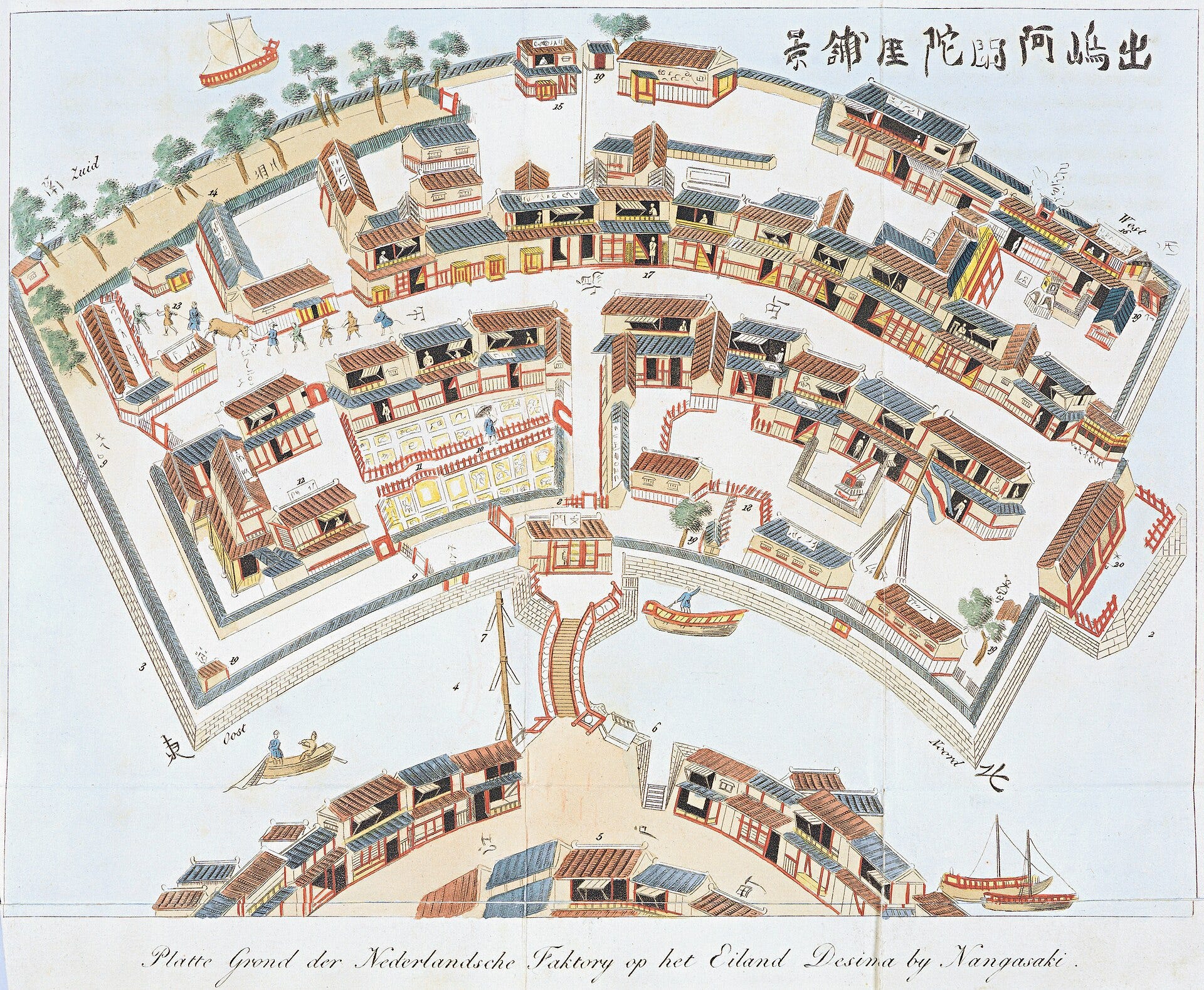
In last Sunday’s essay on the Dutch Admiral of “Please Hello,” I described Dejima as “a fan-shaped artificial island in Nagasaki harbor, roughly the size of a city block, connected to the mainland by a single guarded bridge.” That description is accurate, but it barely begins to capture the strangeness of the place — or the strangeness of the arrangement it represented. For over two hundred years, Dejima was the only formal point of contact between Japan and the Western world. Everything that passed between those two civilizations — goods, ideas, diseases, knowledge, contempt, curiosity — passed through this one small island.
It is worth going inside.
If you’re currently a free subscriber, consider upgrading to a premium subscription for full access to The Sondheim Hub: an exclusive essay, extended interview, crossword & more each week — plus, our complete, paywall-free library of 250+ essays, features & interviews.
How Dejima Came to Be
This story does not begin with the Dutch. Dejima was built for the Portuguese.
In the early seventeenth century, Japan’s Tokugawa shogunate was growing anxious about the influence of Catholic missionaries. The Portuguese had been trading with Japan since the 1540s and had arrived, inseparably, with Jesuit priests. By 1636, the shogunate had decided that the missionaries posed a threat to political stability — Christianity, with its allegiance to a foreign spiritual authority, was incompatible with the absolute loyalty the shogunate demanded. The Portuguese were ordered to confine themselves to a new artificial island, constructed in Nagasaki harbor specifically to contain them: Dejima, which translates roughly as “protruding island.”
The Portuguese were expelled entirely in 1639, following a Christian-led rebellion at Shimabara that confirmed the shogunate’s worst fears. Dejima sat empty for two years.
The Dutch got it by default — and by calculation. The Dutch East India Company (or VOC, Vereenigde Oostindische Compagnie) had been trading with Japan since 1609. Crucially, the VOC had made clear from the outset that it was not in the business of saving souls. Where the Portuguese arrived with merchants and priests, the Dutch arrived with merchants and accountants. When the shogunate offered the Dutch Dejima in 1641, along with a monopoly on Western trade, the VOC accepted without hesitation. The terms were extraordinary. But so was the prize.
Life on the Island
Dejima was small. Contemporary maps show a neat fan shape, roughly 120 metres long and 75 metres wide at its broadest point — about the area of a large city block, or a modest country estate. It contained warehouses, living quarters, a garden, a small hospital, and the residences of the VOC’s chief merchant (the Opperhoofd) and his staff. At any given time, the Dutch population of Dejima numbered between ten and twenty people.
The rules governing their existence were precise and comprehensive.