
A Conversation with Lonny Price
We speak to Merrily's original Charley Kringas
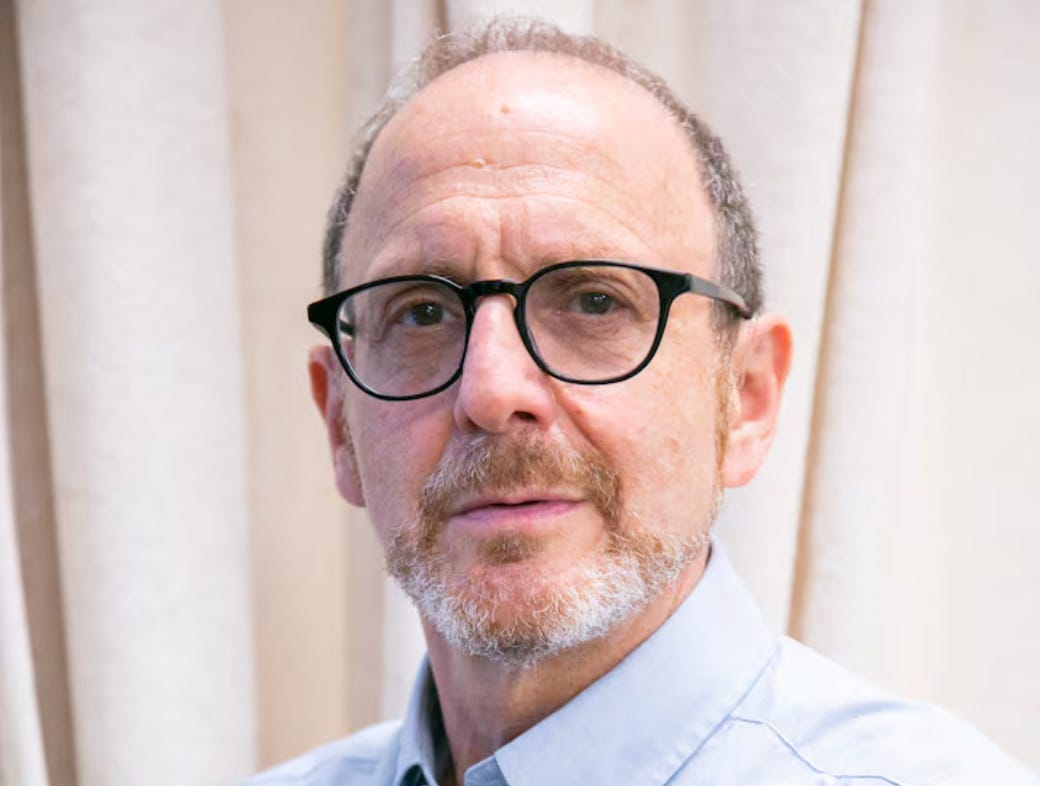
What a huge privilege it is to welcome Lonny Price to The Sondheim Hub. In this expansive and intimate conversation, Price reflects on his decades-long relationship with Sondheim and his work, from originating the role of Charley in Merrily We Roll Along to directing many of the celebrated PBS Great Performances of his works—including the legendary 80th birthday concert. Our conversation begins below:
If you find The Sondheim Hub valuable, consider a one-off $5 donation to support our work!
I’d love to start with Merrily We Roll Along—but with Merrily as we sit here in 2025. The show has seen such tremendous success on Broadway recently, a new generation is discovering it for the first time, and the Linklater film is in production. Having been there at the very beginning, how do you reflect on Merrily’s journey today?
Well, I’m thrilled for the show. God knows, I’ve always loved it. It’s got to be the most successful flop of all time. When I was growing up, everyone had the original cast album of Candide, and it was like, “Oh, poor Candide! It was such a great score.” And then Hal Prince did his spectacular version of it, and everybody was thrilled. It took about 20 years for Candide to have its moment, but Merrily just never went away. It seems like there have been revivals of it constantly.
And I really think it’s because of the album. If we had not done the album, I think the show’s fate might have been a little different. The album, with those orchestrations, was so exciting and so thrilling that I think it inspired so many people to want to fix it or work on it. Also, it’s about theater people—so it’s not a surprise that theater people love it.
But to answer your question, I’m delighted at its success, and thrilled that everybody else is loving something I’ve always loved so much. Even before Maria’s revival, though, it never felt to me like it was not respected or loved, at least by people who really love the theater. I hope there are a lot more Merrilys, and I hope I’m alive when the film comes out. It’s all terrific.
Do you enjoy meeting your fellow Charleys? And when they talk with you, are there certain questions that come up again and again?
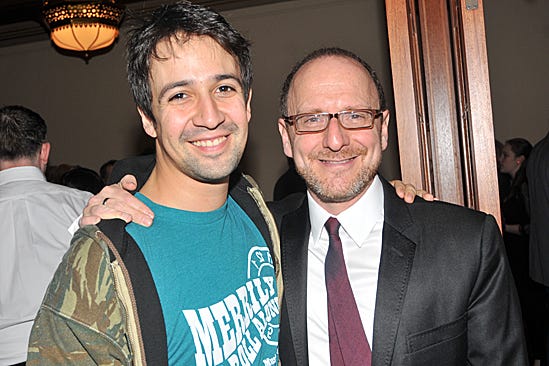
I met with Daniel Radcliffe, and he was just such a charming, lovely guy, and was so sweet to me. And I wrote to Lin-Manuel when they announced he was playing Charley at City Center. I just said, “I hope it gives you half as much joy as it gave me.” And he wrote such a sweet thing back. If someone’s playing Charley and they get in touch with me, I always call them and do a Zoom with them, and just send encouragement and love to them. So yeah, it’s kind of nice being the elder statesman of Charley Kringas, and bestowing my good wishes on the populace who play him.
Often, people will come up and say, “God, that Franklin Shepard, Inc. song is so hard! How did you do it?” And the truth is that Steve wrote it on me. I had three good notes at the top, and he kept hitting them. And I talk very fast. I always say it’s like the greatest tailor in the world made you a suit. Of course it fit great.
You’ll know this story, but I got a third of it three days before previews, and the second third the next day. The last third came either the day of the first preview or the day before, so I had hardly any time with it. We played it with just piano, bass, and drums for the first few days, because there was no time to orchestrate it.
And Steve really was a master at writing for a performer, when he knew who they were. I’m thinking of “Don’t Laugh” for Judy Holliday, which is just flawless, and obviously “Send in the Clowns.” When he knew what your strengths were, he knew how to play to them and how to make the character come alive through them. I think if another actor were in that chair at that moment, “Franklin Shepard, Inc.” would have been a different song. He liked writing for specific people, because that made things very clear to him. It gave him boundaries.
So yeah, when other Charleys ask me questions, they’re mostly about that song. They’re having trouble with it, and I’m embarrassed to say it, but I didn’t. The other thing, of course, is that I was 22. You’re pretty quick at 22, or you ought to be.
I’d love to hear more about your experience of Sondheim as a collaborator, as you just touched on. When you speak now of your three best notes, or talking fast, were those things you actively discussed with him? Or was it more a case of him observing, perceiving, absorbing all of those idiosyncrasies?
I had known him since I was 14, so he had known me a really long time. But I think what he did was match my essence to Charley’s essence, so that where he begins and I leave off is a little fuzzy, maybe. He was struggling to write that song. In rehearsals, Hal would just say, “And Lonny sings a song here,” and we’d jump past it.
But then I spoke to Steve on the phone late one night, and we were just talking about all kinds of stuff. Maybe he was trying to get inside my head. But when I suggested that to Paul Gemignani the next day, he said, “Oh, yeah, he’s procrastinating. He doesn’t want to write. He’ll talk to anybody.” What I do remember was going over to Steve’s townhouse, and him playing me the song and singing it. And honestly, I did it the way he did it. I think I was the only one who got to hear him sing that song, because by the time I had recorded it, he didn’t have to demonstrate it again.
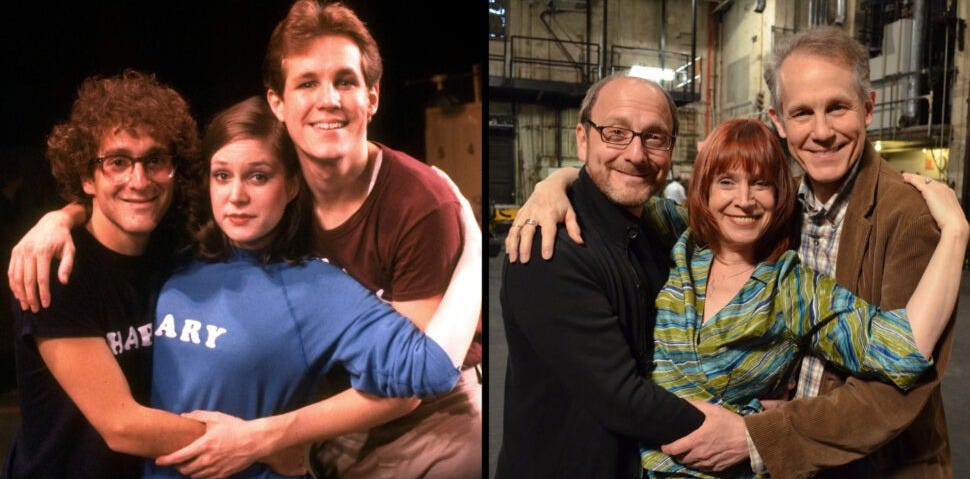
I remember after the third preview of Merrily, I saw Steve at the back of the theater. He said, “I know that quatrain isn’t quite right. I’m still polishing. I’ll get it right for you.” He was apologizing for something not being as good as he thought it could be—to a 22-year-old who idolized him, who thought, if he sneezed, I would save it. Everything that came out of him was just gold to me. And again, it wasn’t me—it was his respect for the actor. He wanted to give every actor the best material he was capable of, and at that point, he knew he could do better.
Turning to your directing work, I’d love to learn more about your various PBS Great Performances productions. So many people I speak to cite these as some of their earliest or most formative encounters with Sondheim’s work. Is this something you’re quite conscious of—this idea that the PBS recordings are now such an important part of how these shows exist and live in people’s minds?
No one’s ever asked me that before. It’s a great question. And what I will tell you is that in some cases, they were very hard to finance. I was desperate to film them because I wanted to capture them, and I was so proud of them. I also did feel, in terms of history, that people needed to see these performers. Young performers needed to see Audra McDonald. They needed to see where the bar was. They needed to see that that’s what you’re shooting for. So to preserve the best material with the best performers was very, very important to me. I wouldn’t say I forced them to happen, but I was certainly very strong in making them happen…
It was very clear to me, too, that we were doing it for people in Australia, and we were doing it for people who would never be able to get to these performances in person. Sweeney Todd was the first one I did, with Patti LuPone and George Hearn, and that was because I was replacing Walter Bobbie, the director of Chicago. And Patti, whom I had worked with a lot, said, “Get Lonny.”
Also, I had directed a soap opera for four years, so I knew how to shoot three-camera television, and how to shoot live television. I had no idea that that would serve me in the thing I loved the most.
And one of those Great Performances was the legendary concert for Sondheim’s 80th birthday. I’d be fascinated to hear about the process of putting that show together, and I’d love to know how you reflect on it now.
Well, I think it’s one of the best things I’ve ever done. It’s one of the things I’m most proud of in all of my work, because it was my gift to him. I haven’t reflected too much on it. To tell you the truth, I don’t look back very much, and maybe that’s part of it. That said, the show was extraordinary. When I did anything that had Steve’s name on it, nobody said no. And by the way, they were not paid. That was a benefit.
And so it was, “Oh, let’s see, what should Bernadette Peters sing?” “Oh, I think I’d like to see Patti sing that.” It was crazy. So actually, that concert was my wet dream of a concert. It was my fantasy of what I wanted to see. What was really cool is I got to hire the greatest performers in the world to do my favorite material in the world. How great is that?
I don’t think Steve knew too much about it in advance. I tried to keep it from him, and he trusted me by then. I wanted the night to be a surprise—and I think when you watch it and you see his reaction, it really is a surprise. He did not know what was coming next, and that was great. The only scary moment was when I gave him the seat, and he said, “Oh, no, I don’t want to sit that close.” I had a camera on that seat, and I was like, “You have to do this for me, Steve. Just sit in that seat. Please just sit in that seat.” It was really important for me to get his reactions.
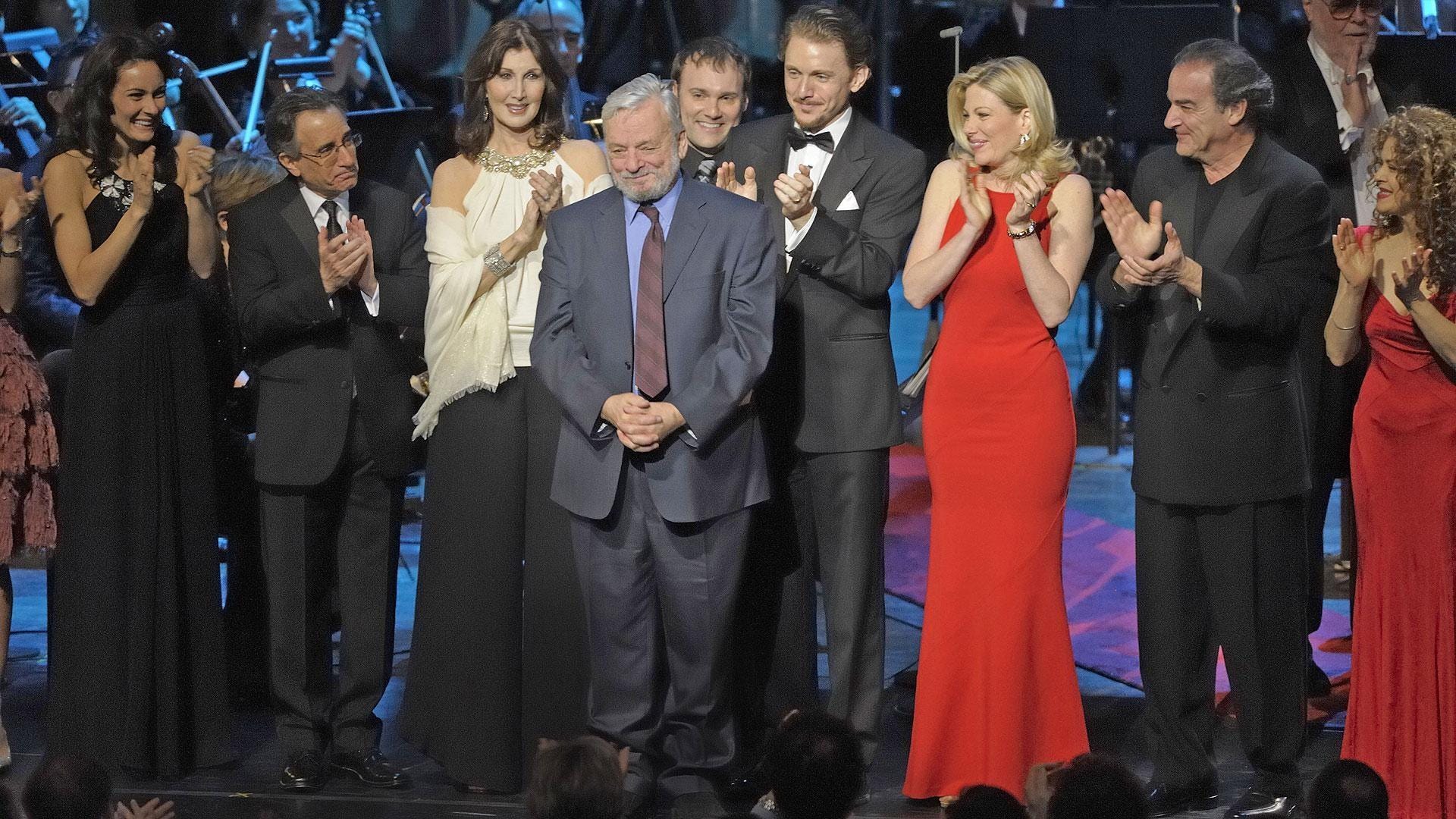
How it came together was very organically. I had seen the “Scrabble Night” concert in 1973 [Sondheim: A Musical Tribute], and it blew me away. I was 14. I hadn’t quite met him yet, but I had written to Mary Rogers about how much I loved him, and about that concert specifically, and she passed my letter on to Steve. He wrote to me, which was mind-blowing. So that concert changed my life, and all those years later I wanted to do a concert that was equally good. What that 1973 concert taught me was that original people doing original material works. And there’s a little bit of the structure that Bert Shevelove came up with. He didn’t put everyone in red dresses, but he did have them all sit around and watch each other. And getting our performers all to agree to sit there was not easy!
We’d rehearse each person separately at the New York Philharmonic, or I would travel to them. In terms of material, I don’t think we had any people saying, “I don’t want to do that.” And also, like I said, it was my fantasy. I was living out my dream of working with these people, on this material which was holy to me.
Many people reading this will be deeply familiar with Sondheim’s interviews, writing, and other public statements. With the benefit of a decades-long personal and professional relationship with him, how would you round out the picture we have of him—for those seeking a fuller understanding of who he was?
When I think about Hal and Steve, the word that comes to mind is always respect. I remember we were at Ravinia doing the first Sweeney with Patti, and she had a question. Steve was at a note session, and she asked him something. He said, “Well, Lonny’s here. You’ll have to ask him.” He just gracefully understood the hierarchy or the protocol of the theater, and he never made himself above that in any way. And because I was sitting in the director’s chair at that point, he said, “Let Lonny answer that.” That was just incredibly generous—when the man, the deity over there, goes, “No, that’s his purview.” Those are the sorts of things that I remember.
I switched the order of where the Judge’s song came in Sweeney. Initially, Steve said, “Why do you want to do that?” I explained it to him, and he said, “Okay, that makes sense.” So you could collaborate with him in a very respectful way, and he was not proprietary about the material. It was always about, what does this show mean in this hall, with this cast, in this time period, for this audience? He never said to me, “Well, in 1979, we did this...” It was a live thing to him. That’s something that I remember and carry with me a lot: what does the show mean now, for these people?
I was directing one of his shows on TV. I think it was Passion. It was going out live, and it was terrifying. It was my first one, and Steve came into the truck where we were calling the cameras. He sat in the back row. And it was one of the few times where I actually said, “You gotta go!” He made me too nervous!
He was great with the videos, though, because I’d always send him an early cut of them. He’d go, “You stay too long here, cut away from her sooner...” Because he loved film, as you know. And sometimes he would say, and this I hear in my head a lot, “You’re showing off. You’re cutting too much.” So I learned from him to serve the material and not to serve my showboating. But with all of those shows, I was trying to make them as perfect as I could—not only for him, but to reflect what he taught me about what work should be.
In terms of rehearsal notes, he would always give you doables. He was always helpful, but also understanding of time. If it was a dress rehearsal, and the show was going to be in an hour, he’d go, “Okay, there’s time to do that—but not that.” He would say, “This is possible. Tell her this.” He would know what the parameters of the exercise were, and never balk at them. He would acquiesce to them, and be useful and helpful.
Yeah, I miss him. I think we all miss him, because he was the standard of excellence we all were trying to strive for. He taught us what excellence was. So I think for all of us who knew him, he is inside us, saying not “Do better,” but “Do the best you can.” He’s everywhere.
It’s that Oscar Hammerstein story that I love so much about the Statue of Liberty. When it was carved, only birds would see the top and the back of it. Hammerstein explained to Sondheim that the back and the crown is carved with just as much care and attention as the foot and the places that people would actually see. He said, “So it doesn’t matter if anybody sees it. It has integrity. You do the best you can, whether anyone notices or not.”
If you find The Sondheim Hub valuable, consider a one-off $5 donation to support our work!
Wonderful conversation. What a gift! The documentary Best Worst Thing That Ever Could Have Happened is one of my favorite art movies ever. So great to hear more from Lonny Price.
This is absolutely fantastic!