
What Christopher Nolan and Stephen Sondheim Understand About Time
Nonlinear storytelling, from The Odyssey to Assassins
A funny thing happened on the way to the IMAX…
En route to see Christopher Nolan’s The Odyssey this week, I found my thoughts drifting toward Sondheim. This was in part because of something I’d heard Nolan say, in a recent Empire Film Podcast interview:
I’ve spent decades doing interviews like this. I’m often asked about nonlinear narratives. I’m often asked about my approach to time. Of course, then you go to the oldest foundational text of all Western literature, and it has the most radical nonlinear structure you’d ever encounter. It’s stories within stories. It’s flashbacks within flashbacks. There’s something pretty humbling about that. Because you go, yeah, this is not a new idea in literature. This is in fact the oldest idea.
Time and time again, Christopher Nolan has conjured with… well, time and time again. The thrill of his films is as much about structure as spectacle. And it’s humbling for us, too, to recognize that nonlinear storytelling is an itch we’ve collectively been scratching for thousands of years.
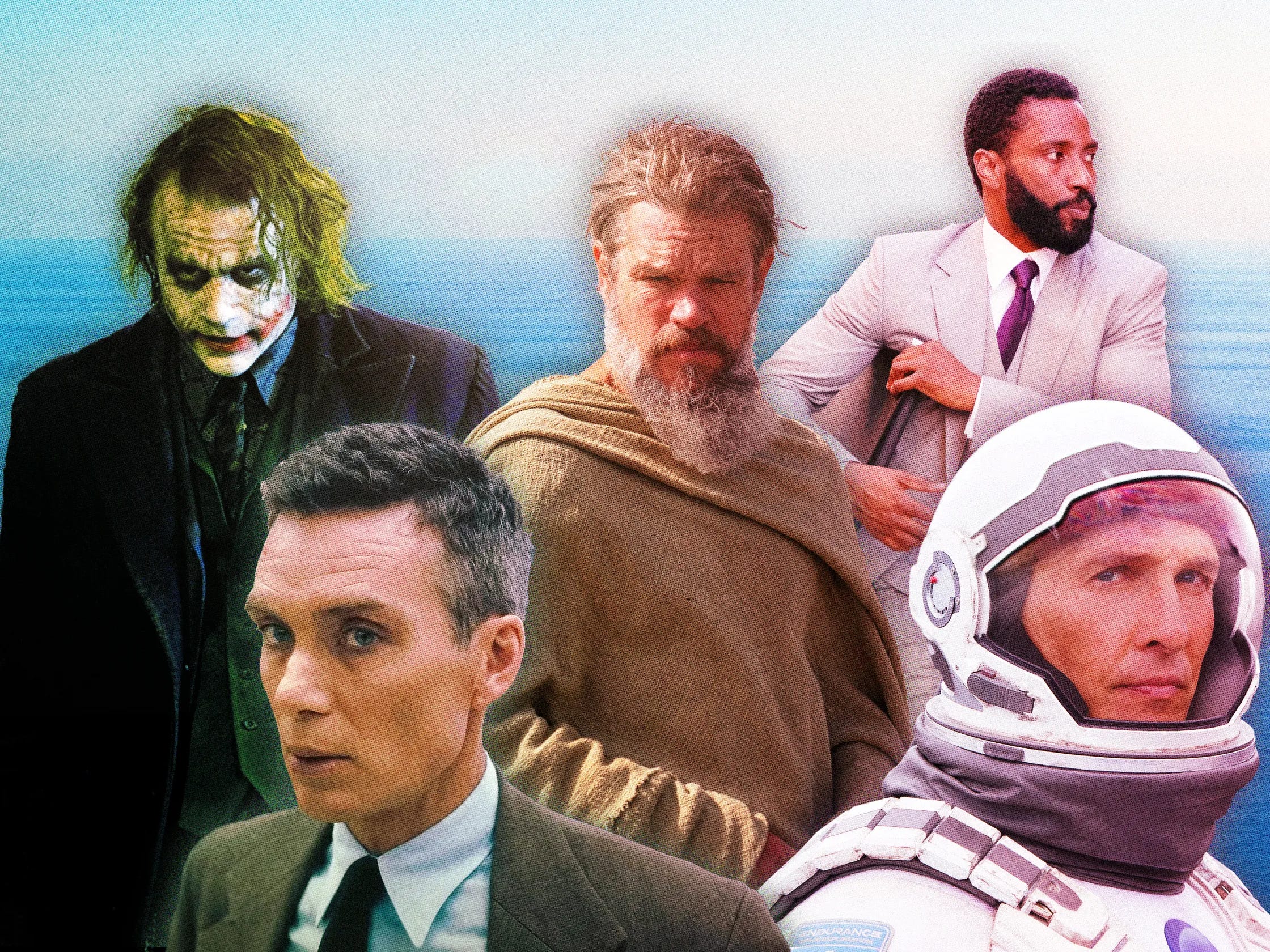
After all, why do we love stories? What keeps us glued to the page, the stage, the screen? What we’re told is part of it, for sure. But I’d suggest that we care about the what only insofar as we’re sufficiently gripped by the why, the how, and — crucially for today — the when. Information is withheld and revealed, teased, manipulated, obscured, all at the discretion of the storyteller. And great storytellers — auteur writer-directors and our parents at bedtime alike — know that a little narrative sleight-of-hand, a little chronological creativity, can go a long way.
On the musical stage, few writers have been as alert to the dramatic potential of when as Sondheim and his collaborators. Theirs is a body of work every bit as structurally adventurous as Nolan’s. And their temporal trickery, crucially, is never frivolous. The flourish is not the magic itself.
Today, let’s set stage and screen side by side. Let’s explore how Nolan’s films and Sondheim’s shows negotiate our access to cause and consequence. As Eliza Hamilton might say, it’s only a matter of time…
So let’s begin, naturally enough, at the end.
Memento begins with a Polaroid photograph of a dead man. As we watch, the image fades rather than develops; the photograph slips back into the camera, a spent casing leaps back into the gun, the man returns to life. Cause and effect, reversed. Nolan destabilizes, but does so with absolute clarity.
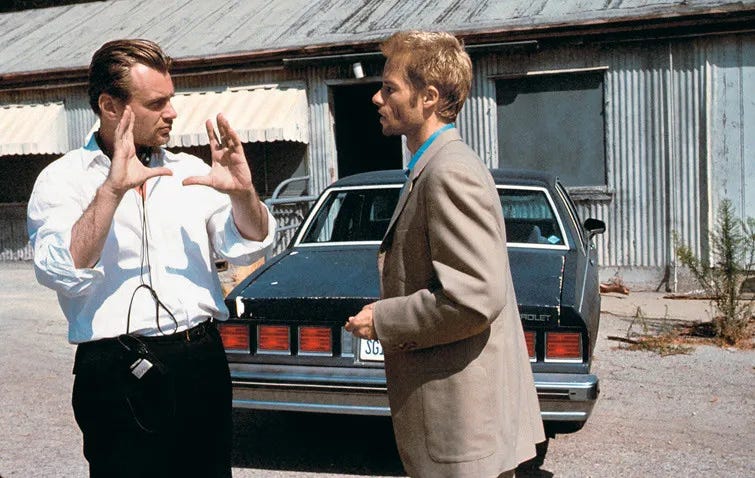
You might already be thinking about Merrily We Roll Along. And, while that will indeed be our Sondheim touchpoint here, Memento does not simply run backwards. Its color sequences proceed in reverse chronological order, while a second, black-and-white strand moves forward. Eventually the two meet, completing a story that has been assembled from opposite directions. At its center is Leonard Shelby, who has lost the ability to form new memories. Each time we rejoin him, he must work out where he is, what’s happened, who he can trust. And because the scenes are presented in reverse, we share his disorientation. Nolan does not allow us to know what Leonard cannot remember.
Merrily We Roll Along’s reverse structure, which originated in the 1934 Kaufman and Hart play, became the animating principle of Sondheim and Furth’s musical. But where Memento deprives us of the past, Merrily burdens us with the future.
Leonard does not know what caused the situation in which he finds himself. The increasingly young characters in Merrily do not know what their choices will eventually bring about. As the years slip backward, every deed un-done, every decision un-decided, those of us watching on retain everything we’ve learned. The characters become less informed as the evening proceeds; we become (painfully) more so.
This, of course, is what gives “Our Time” its extraordinary double effect at the end of the show. Frank, Charley, and Mary look out across New York with their lives and careers ahead of them. “Something is stirring,” they sing, “shifting ground.” To them, the future is unwritten. To us, it is carved in stone. The young trio’s optimism is genuine, but we cannot receive it innocently. A musical moving backward gazes eagerly forward, two trains hurtling toward each other on the same track.
Memento and Merrily both give us consequence before cause, then. But they use that reversal to place us in opposite relationships to their protagonists. Memento builds ignorance into its structure; Merrily does the same for dramatic irony. One tells its story with causes withheld. The other asks what hope feels like when the consequences are not.
Moving backward is one way to disturb chronology. Another is to make more than one experience of time available at once…
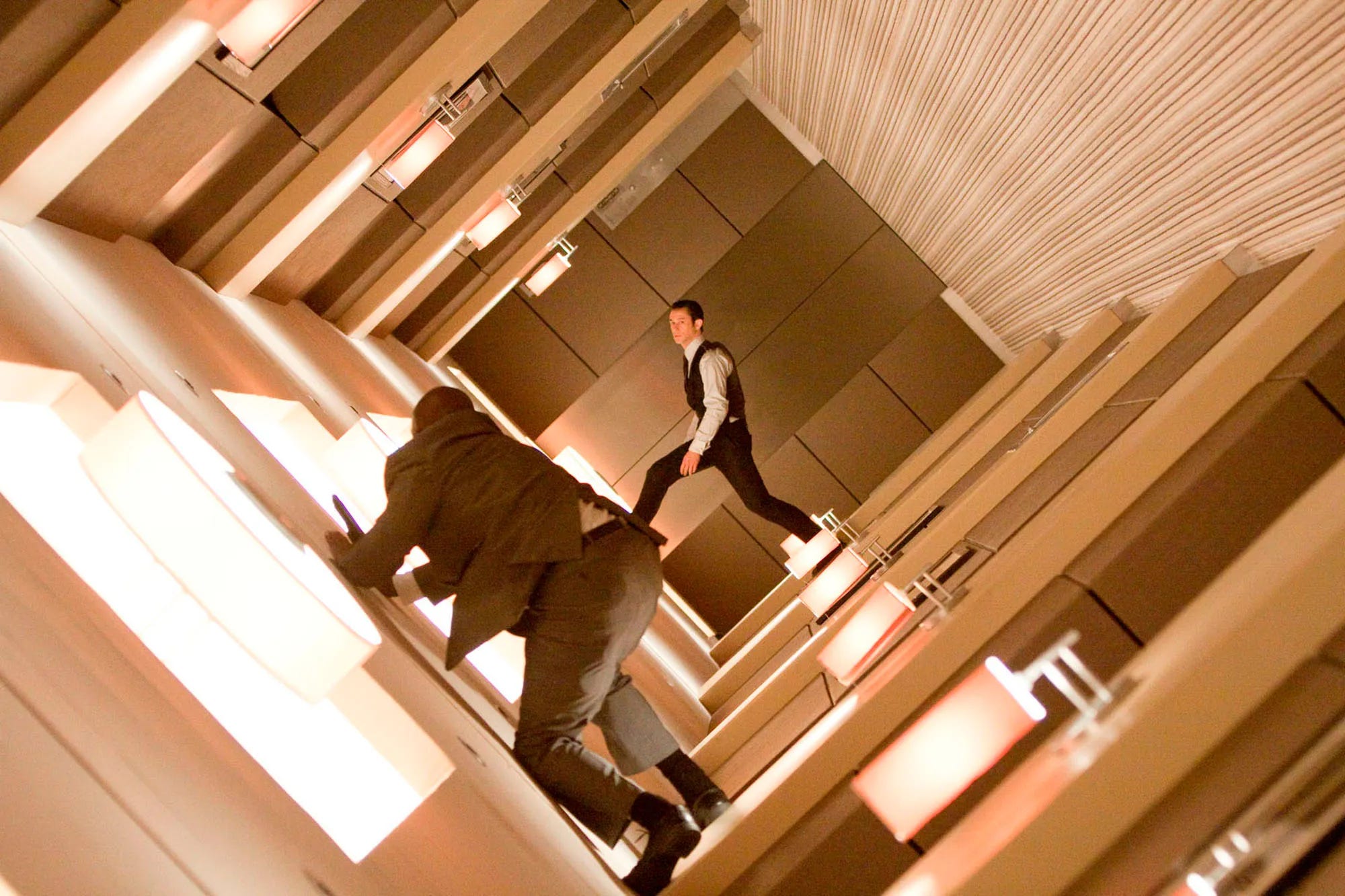
In Inception, each dream level possesses its own rate of time. The deeper the characters travel, the more time dilates. A few seconds at one level can accommodate a much longer passage in the next, which in turn expands into something longer still below it.
During the film’s climax, Nolan cuts between a van falling from a bridge, a hotel corridor without gravity, a fortress in the mountains, and the expanse of limbo. These actions are taking place simultaneously, but across radically different subjective durations. Shared goals, synchronized “kicks,” and the recurring musical signal of “Non, je ne regrette rien” bind them into a single gesture.
The musical stage has its own ways of achieving such simultaneity. Sondheim and Goldman’s Follies refuses to neatly house the past within conventional flashbacks. Younger and older selves occupy the same stage, variously shadowing one another, passing beside one another, remaining visible only feet apart, allowing us to see at once what these people were and what they have become.
Inception works hard to distinguish its realities so that we can follow their interaction. The threat is that its characters may forget which level they inhabit and lose their route back. Follies allows its own realities to bleed into one another. Its characters have spent thirty years carrying former selves who cannot be held safely in the past. By the time we enter “Loveland,” memory, fantasy, and theatrical performance have overwhelmed “real” time altogether. The past, not content merely to comment on the present, takes possession of it.
So far, we’ve looked at the ways in which temporal acrobatics can speak to private experience. But chronology can also determine how public history is understood — and, perhaps, how it is made.
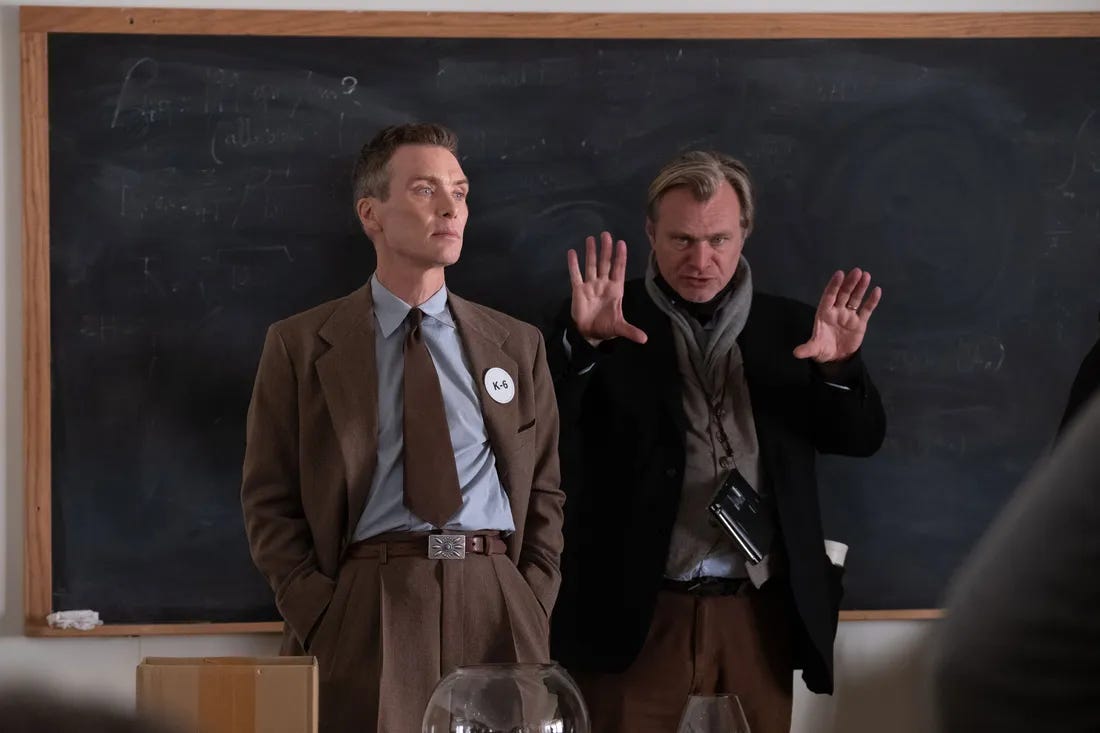
The narrative challenge facing Oppenheimer is obvious. We know that the bomb will be built. We know that the Trinity test will succeed. Nolan cannot depend upon the ordinary suspense of making us wonder what will happen. Instead, he asks how what happened acquired its meaning, and who was permitted to determine that meaning afterward.
The film is divided between two principal strands. “Fission,” presented in color, adheres closely to Oppenheimer’s subjective experience. (Nolan, delightfully, went so far as to write those portions of the screenplay in the first person, as Oppenheimer.) “Fusion,” in black and white, centers upon Lewis Strauss: his relationship with Oppenheimer, his role in Oppenheimer’s downfall, and the later Senate hearing that brings about his own. Within this braided structure, Nolan plots a broadly chronological path through Oppenheimer’s education, his work at Berkeley, the construction of Los Alamos, and the Trinity test. But that forward movement is continually interrupted by the 1954 security hearing and Strauss’s 1959 confirmation hearing: later scenes in which earlier decisions, both personal and professional, are variously reinterpreted, judged, and weaponized.
Trinity is therefore not a final sequence toward which the whole film builds. The explosion occurs, but its consequences (appropriately enough) continue to radiate outward: through Oppenheimer’s conscience, his public reputation, the political machinery gathering around him, and the still more destructive weapons that will follow.
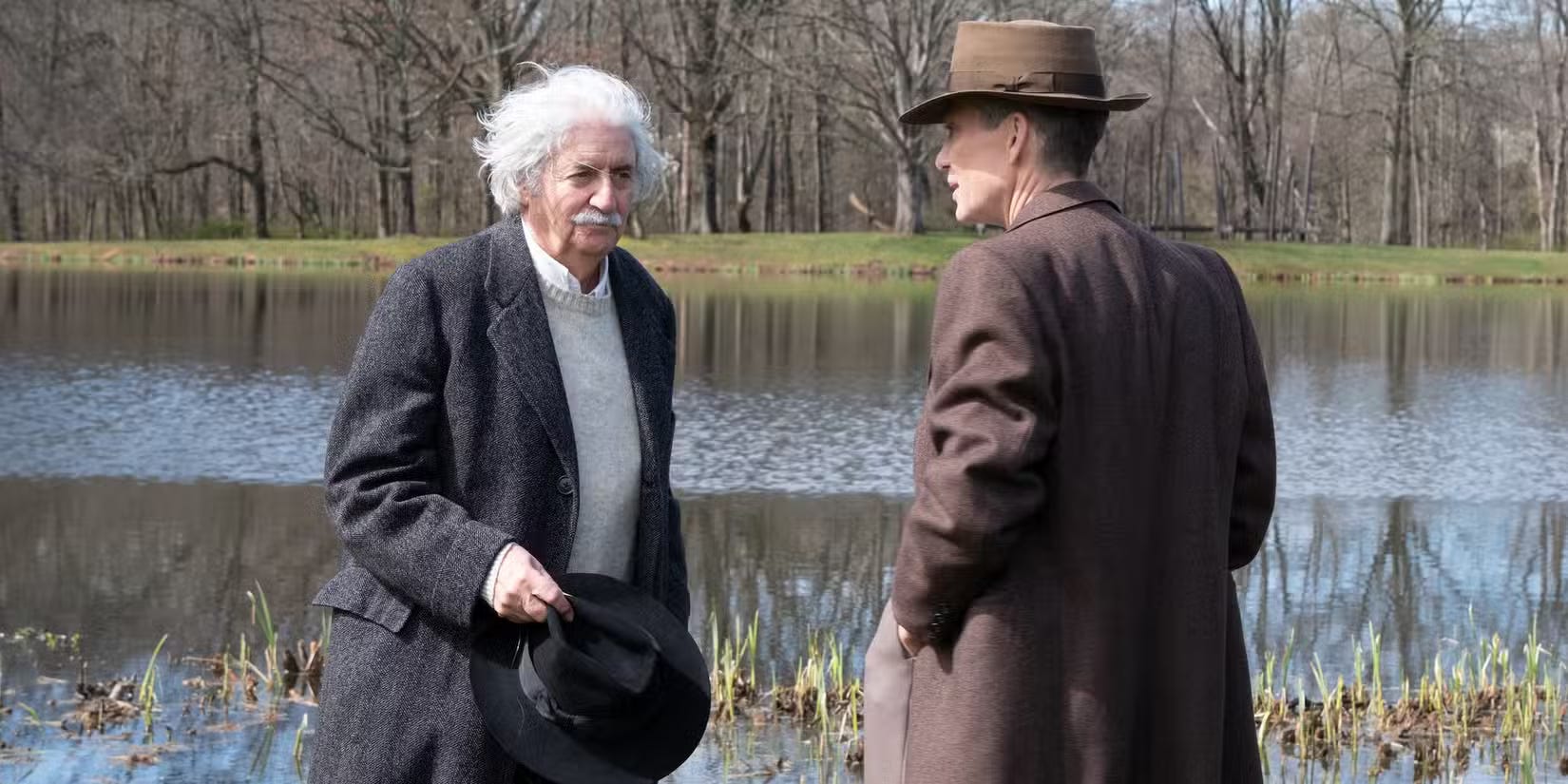
A conversation between Oppenheimer and Einstein provides us with the clearest miniature of this method. We see it early from Strauss’s distant perspective but cannot hear what is said. He watches Einstein leave the conversation looking troubled and constructs his own explanation: Oppenheimer has turned Einstein against him.
When Nolan returns to the same encounter at the very end of the film, it serves both to expose the inadequacy of Strauss’s interpretation and to transform the scale of Oppenheimer’s story. For the first time, we hear their exchange:
Oppenheimer: “Albert? When I came to you with those calculations, we thought we might start a chain reaction that would destroy the entire world...”
Einstein: “I remember it well. What of it?”
Oppenheimer: “I believe we did.”
Those are the final lines of the film. Nothing about the conversation itself has changed. What has changed is our access to it, and therefore what we understand it to mean.
In Assassins, Sondheim and John Weidman perform a comparable act of reinterpretation. Across a nonlinear succession of scenes and songs, nine assassins and would-be assassins coexist, unburdened by chronology. The arrangement is sometimes playful, even vaudevillian, but its effect is cumulative: these characters look less and less like isolated aberrations, and more and more like expressions of the same recurring national impulse.
That argument comes most fully into focus on November 22, 1963, a date that occupies something like the place in Assassins that the Trinity test occupies in Oppenheimer. Kennedy’s assassination is not the show’s sole concern, any more than Trinity is the film’s. But each becomes a point of historical convergence, gathering everything the work has been exploring into one terrible, history-making act.
In the Texas School Book Depository, Oswald is urged to pull the trigger not only by those who preceded him, but by Fromme, Moore, Byck, and Hinckley, whose own crimes lie in his future. “Without you, we’re just footnotes in a history book,” Moore tells him. “With you,” Hinckley adds, “we are a force of history.”
The chronology is impossible. But the argument? The argument is exact. Oswald’s act reaches backward, gathering his predecessors into a recognizable lineage, and forward, providing his successors with a story to inhabit, to belong to. Through this temporal impossibility, decades of anger, isolation, thwarted aspiration, and despair collapse into a single moment. Here, as at Trinity, history reaches critical mass.
At Los Alamos, years of scientific inquiry, political compromise, personal ambition, and private dread acquire physical form in a single detonation. In Dallas, the disparate grievances of a potpourri of assassins acquire their own defining image. Neither event concludes its story. But in both cases, the event reconfigures everything around it. What came before seems to have led inevitably to that point; what comes after cannot escape its shadow.
And so we return to Nolan’s humbling encounter with Homer. Later in the same interview, he describes the structure of The Odyssey as “there for the taking.” (We’ll explore how Homer’s Odyssey resonates across Sondheim’s body of work in this week’s member-only essay.) Its flashbacks and stories-within-stories are already intrinsic parts of the form in which this ancient story reaches us.
Sondheim’s own formulation, (almost) needless to say, was “Content dictates form.” It was the first of three principles that he always stressed were, above all, “in the service of clarity.”
And clarity matters here. Are the films and shows we’ve looked at today structurally adventurous? Sure. Formally ingenious? Thrillingly so. But in each case, the complexity exists not for its own sake, but to make the work legible.
A chronological Memento could tell us that Leonard is disoriented; the film Nolan made makes disorientation our experience. A chronological Merrily could show relationships deteriorating, but its backward journey makes every hopeful moment ache with foreknowledge. The ghosts that haunt the stage of Follies make the past impossible to suppress or ignore. And both Oppenheimer and Assassins force us to grapple with the history itself, sure, but also how that history acquires its shape.
The best nonlinear storytelling makes us newly, thrillingly conscious of narrative itself. Wide awake long past bedtime, or awestruck at the IMAX, or heartsick at the theatre, we crave the total immersion of great storytelling. And we do not think in sequence. Our memory, our recall, certainly isn’t linear. So why should stories be?
The Sondheim Hub is a reader-supported publication
Thank you for reading! If you find The Sondheim Hub valuable, consider becoming a paying subscriber.
You’ll receive an exclusive essay each week, access to our full, paywall-free archive of 300+ essays, interviews & features, more from each interview, and a weekly Sondheim crossword.
In this week’s member-only essay, we’ll look at how Homer’s Odyssey, and Nolan’s film, resonates across Sondheim’s body of work…
Paid subscriptions make our work possible. 📚