
The Very Model: Sondheim, G&S, and the Grammar of Imperial Wit
Plus, a B-ing Alive crossword, and more from our conversation with Ian Axness
Last Sunday, we explored how the British Admiral in “Please Hello” talks Abe into submission rather than marching over him. We identified Britain’s mode of conquest as linguistic and bureaucratic where America’s is percussive and theatrical. What we didn’t linger on is the specific musical tradition Sondheim reaches for to make that happen, and why that tradition is so precisely, almost maliciously, right for the job.
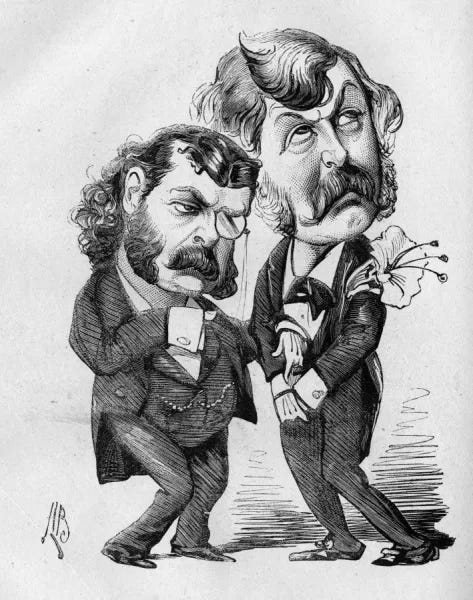
Enter, stage right, a pair of Victorian gentlemen. One is breathing rather heavily; the other mops sweat from his brow. W.S. Gilbert and Arthur Sullivan stand before you, each the very model of their breathless brand of patter song.
Today, let’s explore Gilbert and Sullivan’s patter mode as both formal mechanism and cultural technology—and find out exactly what Sondheim made of it.
If you’re currently a free subscriber, consider upgrading to a premium subscription for full access to The Sondheim Hub: an exclusive essay, crossword, extended interview & more each week, plus our complete, paywall-free library of 250+ essays, features & interviews.
What the patter mode actually does
The patter song achieves three things simultaneously, and they are all, on close examination, versions of the same thing.
The first is the foreclosure of interruption. The tempo and rhyme density of a true Gilbert patter number create a rhetorical seal: there is no gap wide enough to insert an objection before the next clause arrives. The formal relentlessness can produce something close to panic in the listener, a sensation of being talked at faster than comprehension can follow.
The second is the naturalization of authority. When every rhyme seems to land with flare, with panache, the speaker appears to inhabit a universe where things arrange themselves in their favor. The rhymes feel more discovered than worked-for, as if the language itself is endorsing the proposition being made.
The third is the performance of intelligence as dominance. The elaborate architecture of a Gilbert patter lyric implies, at all times: we are witty, sophisticated, masters of language and logic. What is perhaps less often remarked upon is how frequently this formal dazzle is deployed in service of circular or near-contentless propositions. The Major-General is the very model of a modern major-general? Well, sure! The content, stripped of its formal clothes, barely exists—but the clothes are so beguiling that questioning the content feels like missing the point.
Ko-Ko’s list song from The Mikado makes the circularity almost explicit: the targets are so interchangeable that Gilbert eventually abandons them altogether, leaving blanks for the audience to fill in themselves. It doesn't matter who goes on the list. It never did. The form of having a list—authoritative, taxonomic, delivered with total confidence—is the entire point. The content has quietly evacuated, and the dazzle of the container is so complete that almost nobody notices.
These three functions become a single mechanism: a form that moves too fast to be questioned, sounds too inevitable to be doubted, and looks too clever to be challenged.
An unacquired taste
In Finishing the Hat, Sondheim devotes a short essay to Gilbert—titled, with characteristic directness, “W. S. Gilbert: An Unacquired Taste.” It is a document of almost forensic ambivalence.