The Real Dot, Forever With That Mirror
And Seurat's hidden self-portrait…
Look at the top left-hand corner of Georges Seurat’s Young Woman Powdering Herself. What do you see? A vase of flowers in a bamboo picture frame, right? Right.
Ah, but underneath…
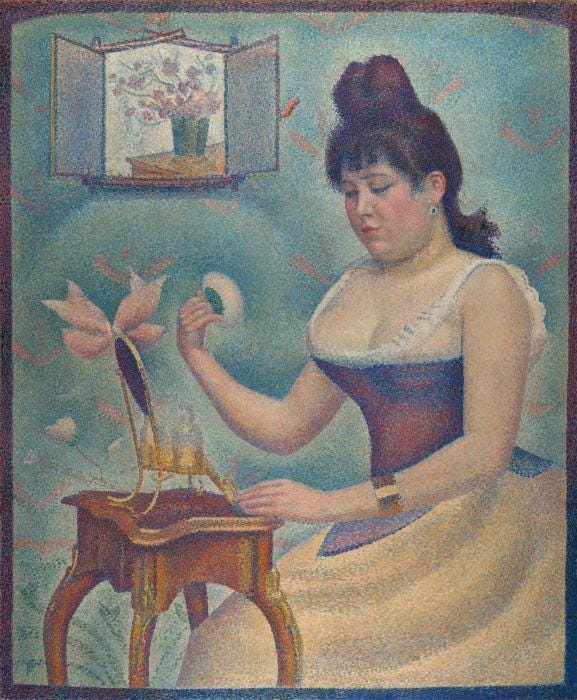
In 2014, a scanner developed by the Italian Institute of Optics revealed that the vase was once something else entirely: Seurat himself, at his easel, watching. The picture frame had been a mirror. It would have been Seurat’s only self-portrait. He painted over it.
“I am not hiding behind my canvas. I am living in it,” insists Sunday in the Park with George’s fictionalized Seurat. And the real artist was living in his canvas, hidden from view for more than a century. It’s almost unbearably poetic.
Seurat had, briefly, painted the fact of painting. I am here, the original reflection seems to say. I am making this. What remains is a trace, an absence that technology has now made visible. In Sunday, George’s mother sees towers where there were trees; here, we see flowers where once there was a watching face.
The canvas remembers what the surface tried to forget:
Thank you for reading! Upgrade to a premium subscription for full access to The Sondheim Hub: an exclusive subscriber-only essay, crossword, extended interview & more each week, plus our complete, paywall-free archive of 200+ essays, features & interviews.
But what do we know of the woman being painted?
She is Seurat’s mistress, the mother of his children, the great secret of his short life. She is the closest thing we have to a real-life Dot. Her name is Madeleine Knobloch. Beyond that, we know remarkably little—and that absence is itself part of the story.
Madeleine Knobloch was twenty when she met Seurat in 1889, shortly after his return from Belgium. She was an artist’s model: working-class, in sharp contrast with Seurat, whose father’s wealth afforded him a degree of independence uncommon among artists of his generation. Marriage between them was out of the question, given the social divide.
When Madeleine became pregnant with their first child, they moved from his studio at 128 bis Boulevard de Clichy to a room in a quiet courtyard off the Passage de l’Élysée-des-Beaux-Arts. The room was tiny, just five meters square. Seurat acknowledged paternity of their son, Pierre-Georges, and entered the child’s name in the civil registers. Yet somehow, he kept both Madeleine and the boy completely hidden from everyone who knew him. Even Paul Signac, his closest artistic collaborator, had no idea.
What must it have been like to be Madeleine Knobloch? To live with a man whose very existence seemed divided into sealed compartments: his bohemian artist friends here, his bourgeois family there, and you, with your child, in a five-meter room, invisible to all of them.
We know Madeleine existed. But beyond the scant facts above, we have only what Seurat chose to show us: the painting.
Young Woman Powdering Herself is unlike anything else in Seurat’s oeuvre, the classical monumentality of the figure rubbing up against the flimsy Rococo frivolity of the setting. Madeleine sits at her toilette, powder puff in hand, caught in a moment of private self-adornment. Her figure dominates the canvas; she is dressed in a form-fitting bodice, her hair piled high, applying powder to her face. Form and content merge: she powders herself as he “powders” her image, stroke by stroke, dot by dot. The painting itself seems dusted with the same powder she applies.
“More rouge…” says Dot in “Color and Light,” at her own mirror. She is, on stage, that same Young Woman Powdering Herself:
At the 1890 Salon des Indépendants, Seurat exhibited his painting of Madeleine. Yet his family and close friends remained completely unaware of her existence. The painting hung on public walls while the woman it depicted remained his secret. When viewers asked who she was, he could simply say: a model. Which was true, and also a lie.
Madeleine Knobloch didn’t leave Seurat. There was no baker named Louis to cherish and adore her. She stayed in that tiny room, raising her son, invisible to the world, while Seurat worked obsessively on Le Chahut and then Le Cirque.
In early 1891, Madeleine was pregnant again. On March 26, Seurat fell suddenly ill with a fever. The following day, Good Friday, accompanied by a pregnant Madeleine and the thirteen-month-old Pierre-Georges, he moved to his mother’s apartment. This was when he first introduced Madeleine and his son to his mother: two days before his death. Two days.
“I cannot divide my feelings up as neatly as you,” says Sunday’s George to Dot. But the real Seurat had been living a life of breathtaking compartmentalization.
Georges Seurat died on March 29, 1891—Easter Sunday—at the age of thirty-one. The cause was likely diphtheria, though some sources suggest meningitis or pneumonia. Two weeks later, Pierre-Georges died of a similar illness and was buried alongside his father at Père-Lachaise. Shortly after, Madeleine’s second child died at or soon after birth.
Three deaths in two months. Madeleine, all of twenty-three years old, was left alone.
On May 3, 1891, just over a month after Seurat’s death, Madeleine gathered with his brother Émile, Paul Signac, Maximilien Luce, and Félix Fénéon at the studio to inventory its contents. She was given some of Seurat’s paintings as an inheritance, but cut off all communication with his family.
Madeleine died of cirrhosis of the liver in 1903. She was thirty-five, just four years older than Seurat had been when he died. Of the twelve years by which she outlived him, we know almost nothing. Did she model for other artists? Did she remarry? Did she ever look at Young Woman Powdering Herself and see herself immortalized, forever with that mirror?
Like Seurat from his own painting, Madeleine Knobloch vanished almost entirely from history. She lived, and loved, and lost, leaving almost no trace. But perhaps that hidden self-portrait is the best summary we have of her relationship with Seurat. It’s proof that before he made himself invisible, he had wanted to be seen—at least by her, at least in paint. It’s tender and cruel, all at once. Seurat painted himself watching the woman he loved, then decided he couldn’t let anyone else see him there.
“Look at her looking,” George says to himself in Sunday, contemplating Dot, “Forever with that mirror. What does she see?” And underneath those flowers, Seurat is still there, watching Madeleine, watching us, eternally present in his absence. And beside him, in countless carefully placed dabs of color: Madeleine Knobloch, powdering herself in a moment of privacy that was never truly private, watched by a man who would make himself disappear rather than let the world know he’d been there at all.
✍️ Please support our work by upgrading to a premium subscription:
The Sondheim Hub exists solely thanks to the generous support of our readers. Please consider supporting our work for a few dollars each month. A premium subscription gives you full access to The Sondheim Hub: an exclusive, subscriber-only essay, crossword, extended interview & more each week, plus our complete, paywall-free library of 200+ essays, features & interviews. 📚
Other essays you might enjoy:


Beautifully written telling of previously unknown info, especially for those who approach Seurat via Sondheim/Lapine rather than studies of his life and works. This deserves a wider audience.
So poignant💔