
In D. A. Pennebaker’s remarkable documentary Original Cast Album: Company, Stephen Sondheim says something irresistible to any fan of his work:
I try to put a South American piece in every show I write.
Heard now, with every one of his scores available to us, Sondheim’s words seem to invite a kind of treasure hunt. But he was speaking in 1970. Most of those scores had not yet been dreamt up, and we should be careful about conflating his words on that day with a promise governing another half-century of work.
The most important of those words, I think, is “try.”

Sondheim was describing an impulse, a musical world he liked to find room for whenever he could, rather than a pattern. Nearly three decades later, speaking to Mark Eden Horowitz, he admitted there were “not a lot of bossa novas” in his shows.
Our question, then, is not whether we can find a “South American” piece in every Sondheim show. That’s not a promise he ever actually made. The more interesting thread to tease out, I think, is what Sondheim understood by “South American,” and what it sounded like when that impulse, that fondness, did find its way into one of his scores.
Four years before Company, Sondheim contributed “The Boy From…” to the 1966 Off-Broadway revue The Mad Show: a wonderfully straight-faced parody of “The Girl from Ipanema,” performed by Linda Lavin. The music is not Sondheim’s — it was written by Mary Rodgers — so we should resist claiming it as an early example of his own South American compositional impulse. But his lyrical contribution alone tells us that, by the mid-1960s, this particular Brazilian sound-world was already somewhere in his creative orbit.
Our first (and perhaps clearest) example of South American Sondheim, though, lies not in Tacarembo la Tumbe del Fuego Santa Malipas Zacatecas la Junta del Sol y Cruz — lovely though that boy’s hometown undoubtedly is — but in the show being recorded on that long, exhausting day in 1970. In Company, Joanne’s “The Ladies Who Lunch” is, explicitly, a bossa nova.
A bossa nova for Joanne
Bossa nova emerged in Brazil in the late 1950s, principally through the music of Antônio Carlos Jobim and João Gilberto. Its great trick is one of compression (how very Sondheimian!): it takes the rhythmic life of samba and makes it intimate.
At its most recognizable, a steady bass pulse anchors the music while chords arrive syncopated — on, just before or just after the beat. The subdivision is generally straight rather than jazz-swung. Harmonically, bossa novas (bossas nova? bossa novae?) tend to luxuriate in major sevenths, ninths, altered dominants and chromatic passing chords. Smooth voice-leading prevents those chords from sounding clunky: light dances on the harmonic water, but the surface barely ripples. Above all this, the melody is a dragonfly — skimming the surface, seemingly untroubled by the accompanimental waters beneath, delivered with conversational ease.
So: we have a pared-back samba-derived groove made up of a steady bass, syncopated upper chords, sophisticated but supple harmony, and a fairly free-roaming, conversational melody. Bear all that in mind as you look at a little of “The Ladies Who Lunch”:
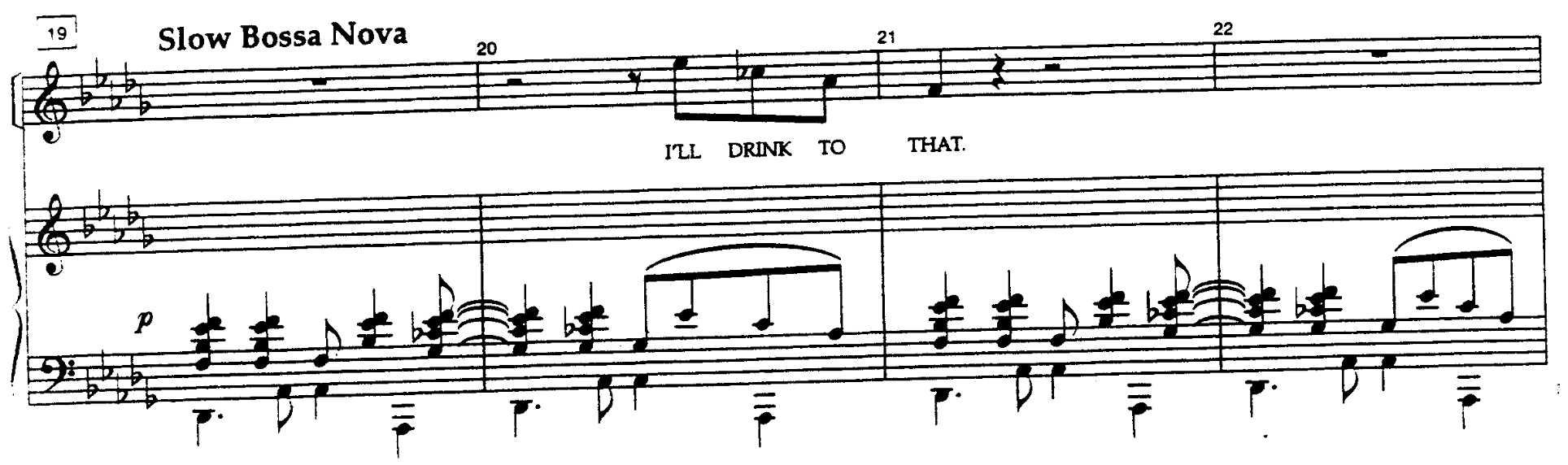
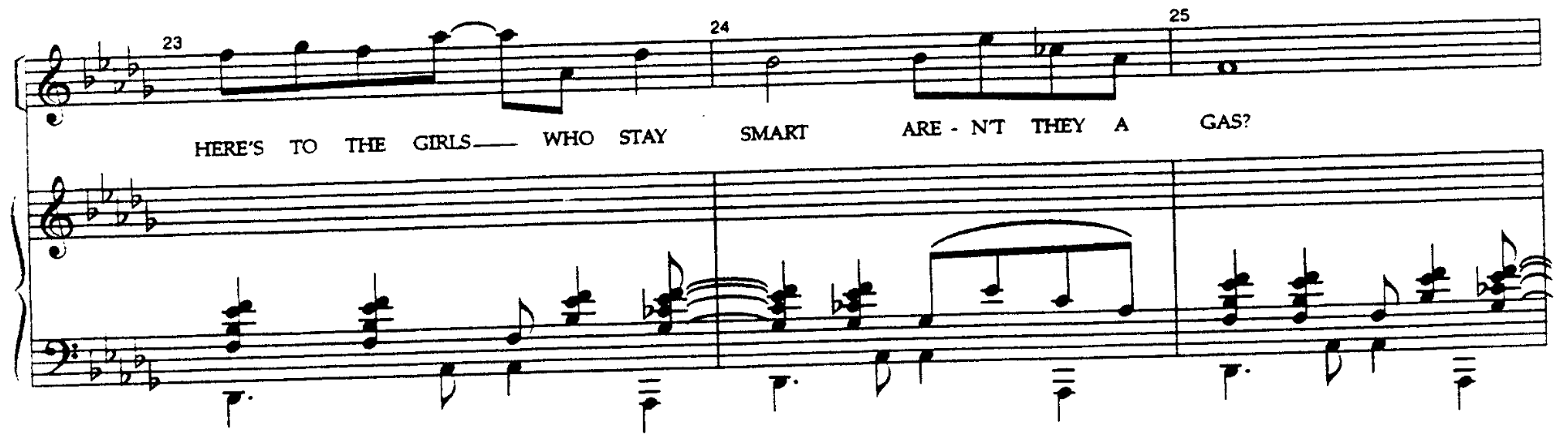
It’s interesting to consider what this bossa nova chassis is offering Joanne dramatically. The poised, grounded tread of the bass… The straight, supple syncopation… Sondheim’s accompaniment, holding its own vodka stinger aloft, might sway from side to side a little, but it remains always on its feet. As Joanne’s performance becomes increasingly abrasive, the music that surrounds her never spills its drink.
And by remaining sleek, elegant, and (relatively speaking) unruffled, the music of “The Ladies Who Lunch” mimics precisely the world of caftans, fittings, and brunch Joanne attacks with such aplomb. Remember, she’s attacking that world from within. This, it would seem, is as true musically as it is dramatically.
What is South America doing in Victorian England?
Discussing “Wait” from Sweeney Todd in 1997, Sondheim said the following to Horowitz:
I always fall into South-American rhythms. I don’t know why. In every show, and quite often, whether the songs are relevant or not.
If the Pennebaker quip (“I try to put…”) describes something conscious, “I always fall into” describes a habit. By Sweeney Todd, South America would seem to be a direction in which his music naturally leans.
“Wait” is an especially odd place for this tendency to surface. If we instead could hear South America in “By the Sea,” we could (at a stretch) toy with the idea that it served as sufficiently un-London to feed musically into Mrs Lovett’s escapist seaside fantasy. But in “Wait,” Sondheim said, the rhythmic idea had “crept in” unconsciously.
The harmony had a longer, more traceable journey. Sondheim explained to Horowitz that the chord structure was influenced by a South American lullaby: Xavier Montsalvatge’s “Lullaby to a Negro Baby.” Listen to the passage below by clicking here.
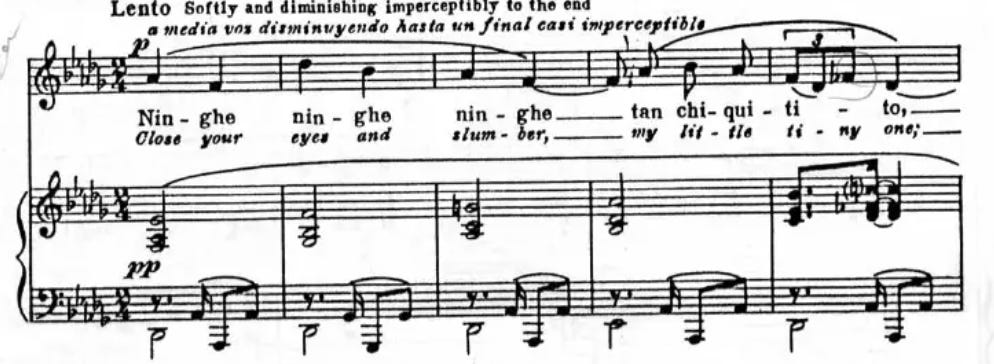
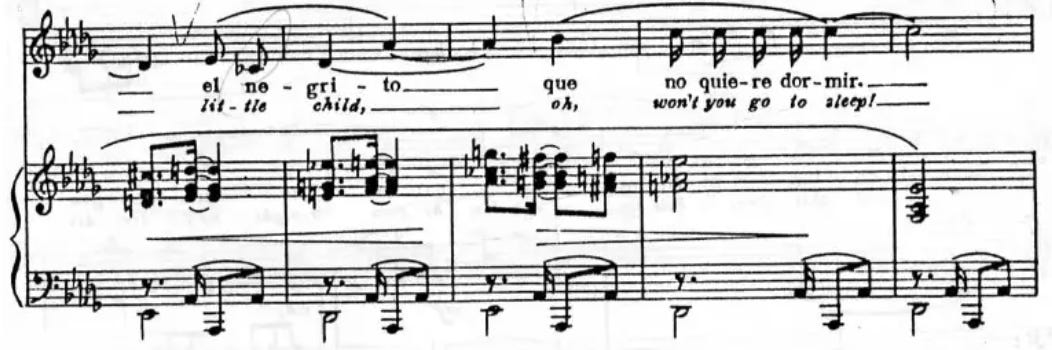
Sondheim said he had first used those chords for “Don’t Look at Me” in Follies, and then returned to them in “Wait”:
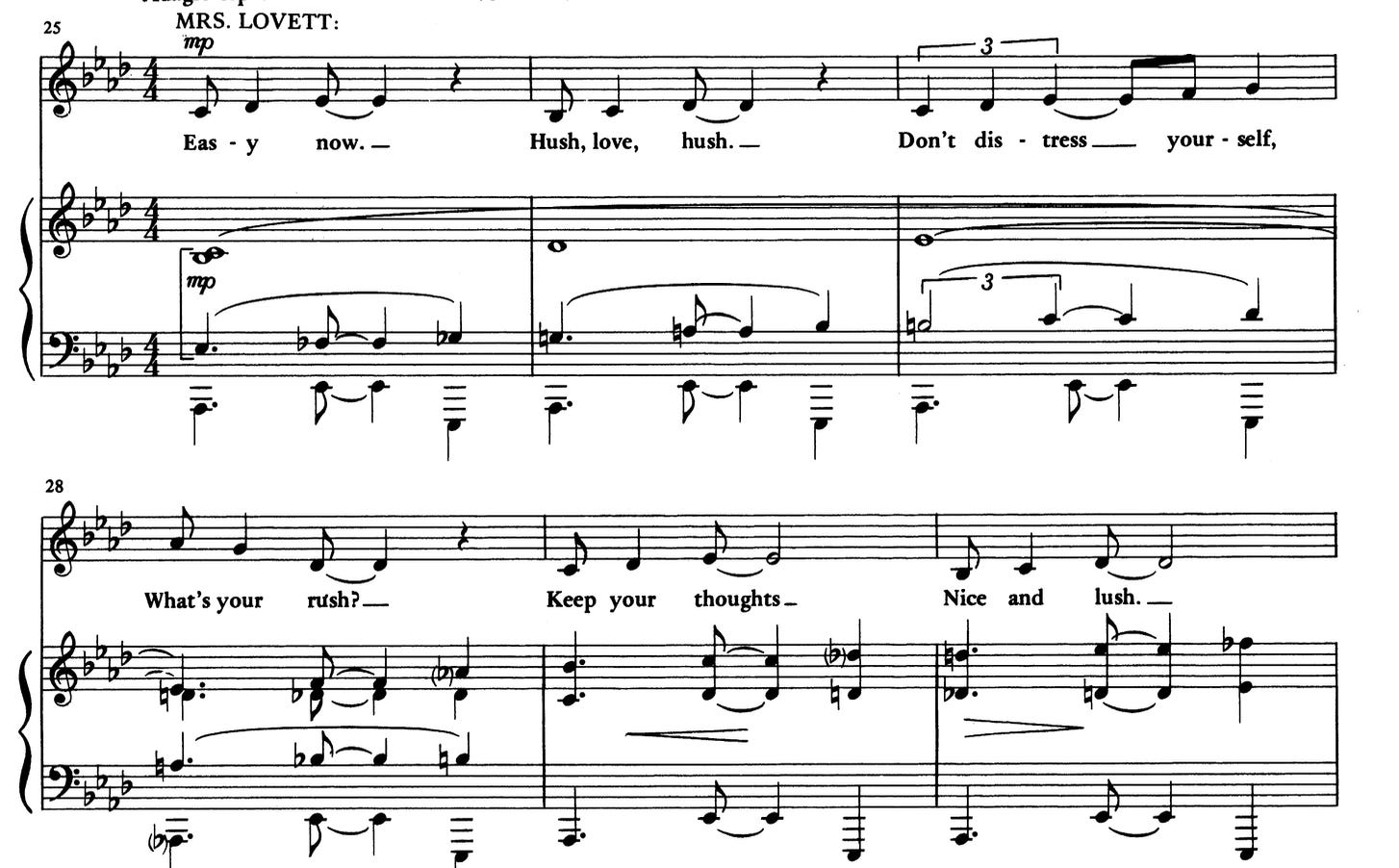
What in Follies belongs to Sally’s nervous exposure, in Sweeney Todd becomes coaxing, circling, faintly hypnotic. What persisted was something, a kind of harmonic pathway, that Sondheim had picked up and then held close.
The “South American” label is being applied very broadly here, it’s worth emphasizing: Montsalvatge was a Catalan composer, and that lullaby carries with it Cuban and Caribbean associations. Meanwhile, bossa nova is Brazilian, while tango, for example, belongs principally to Argentina and Uruguay. These are not interchangeable traditions, however readily people might once have blurred them together beneath overbroad and imprecise labels. But we are, after all, simply rifling through a drawer in Sondheim’s musical imagination: a loose collection of syncopations, bass patterns, harmonic colors and remembered sounds whose origins were themselves various and sometimes tangled.
✍️ Consider supporting The Sondheim Hub by becoming a member. Unlock our full archive & exclusive member-only material each week:
an exclusive weekly member-only essay
an extended edition of each of our interviews
full, paywall-free access to our archive of 300+ essays, features, and interviews
a weekly Sondheim crossword
Here We Are… in Moranda?
And perhaps the last glimpse into that drawer comes, fittingly, at the very end.
Raffael in Here We Are descends directly from Don Rafael Acosta in Buñuel’s The Discreet Charm of the Bourgeoisie: ambassador of Miranda, a fictional South American republic. David Ives makes an important change. Miranda becomes Moranda, and Raffael’s country is relocated across the Atlantic: in Here We Are, Colonel Martin describes it as a “Mediterranean rathole.”
Even the change of name has an intriguing resonance. Miranda is a Latin form derived from mirari: to wonder at, marvel at, admire — something, approximately, “to be wondered at.” Moranda, wonderfully, echoes morari: to delay, tarry, linger, remain. Whether deliberate or not, for a musical in which the characters spend one act endlessly delayed on their way to dinner, and another unable to leave once they have arrived, isn’t that delicious? Buñuel’s country of wonder has become, by the alteration of a single vowel, a country of lingering.
And yet something of Miranda may have crossed the ocean with Raffael. His recurring “I have to have you…” interventions threaded through the various “The Road” sequences — and especially his attempted seduction of Marianne (“Don’t you know that you are Versailles to me?”) — retain, to my ear, something distinctly tango-like: the rhythmic insistence, the seductive push and pull... I would not assert with conviction that Sondheim was consciously preserving Buñuel’s original geography in music, but the thought is worth pondering. Indeed, reviewing Here We Are at the National Theatre, Dominic Cavendish heard in “The Road” a “Latin American shuffle.”
That leaves us with a possibility rather than a conclusion. The finished musical has quite deliberately made the previously South American Raffael Mediterranean. Yet some trace of that earlier geography seems, perhaps, still to flicker in the music Sondheim gives him. Listen to Raffael whenever he surfaces in those sequences and see whether you hear it too.
If this belongs in Sondheim’s South American drawer, then it does so pretty abstractly: a remembered sound attached to a character whose country has changed both its name and its continent. Still, it’s worth considering.
Let’s end, then, with that drawer still ajar. Sometimes we can name Sondheim’s “South American” music precisely; sometimes a rhythm simply “creeps in.” Elsewhere, the trail leads us to music remembered from another place, another time… And sometimes, as in Here We Are, perhaps the most we can responsibly say is we hear something there.
But with that drawer invitingly ajar, I’d love for this to be the start of a discussion. Where do you hear South America in Sondheim’s work? All suggestions are warmly encouraged below…
Great article!
It was very much in the musical air in the 60s. A lot of what was revolutionary about the Bacharach/David songs were experiments in harmonies and rhythms very similar to what bossa nova brought. One of the most bizarre phenomena is how all of that stuff came to be classified as "easy listening" when in reality it was anything but easy musically...
Fascinating article! I just wrote a book for Bloomsbury/Methuen Drama called LATINIDAD IN MUSICAL THEATRE and while I definitely talk about the prevalence of the “Latin number” in American musicals going back to the early 1900s w Berlin, Porter and Gershwin I didn’t include Sondheim for a more modern example! Bravo!