
Sondheim at the Tony Awards
What Sondheim's acceptance speeches teach us
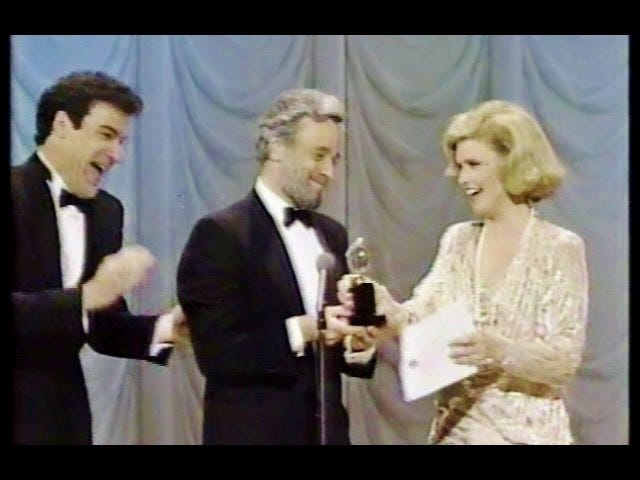
Lifetime achievement has a deadly sound to it. A ring of finality. A faint whiff of “you’ve outlived your usefulness.”
Those words were written by Stephen Sondheim for the 2008 Tony Awards, where he received a Special Award for Lifetime Achievement in the Theatre. He wasn’t there to deliver them himself — Mandy Patinkin stood at the podium in his place — but they say much about the strange experience of being celebrated.
With the 79th Tony Awards taking place today at Radio City Music Hall, it’s a good moment to look back at Sondheim’s own relationship with Broadway’s highest honors — beyond the record of wins and nominations, looking at what he actually said when he stood at that podium. Taken together, his acceptance speeches form something like a miniature portrait of the man: generous to his collaborators, subversive in an understated kind of way, and always more interested in the work than the prize.
The Crusade
If you listen to Sondheim’s Tony Award acceptance speeches, one thing above all shines through. At the 1971 ceremony, accepting for Company, he says: “It’s odd how there’s never been a Tony Award for an orchestrator, and there’s no score on Broadway that exists without orchestration. In my opinion, the most brilliant orchestrations ever made in musical theatre are those of Jonathan Tunick for Company, and I want to share this with you.”
He returns to the same theme in 1972, accepting for Follies: “I’d like to thank two people who weren’t nominated because there were no categories for their nominations: the orchestrator Jonathan Tunick and the musical director Harold Hastings. I pray that next year the Tony Awards will reinstate those two categories.”
And in 1979, for Sweeney Todd, he says: “I must of course share this with Jonathan Tunick, who orchestrated two hours of music in 23 days, and did it better than anybody who’s ever done it.”
Three wins. Three variations on the same theme. Sondheim used his platform, again and again, to make a structural argument about how the Tony Awards failed to recognize the people who made his music possible.
The Tony Award for Best Orchestrations was finally introduced in 1997. The named beneficiary of Sondheim’s advocacy, Jonathan Tunick, was its inaugural winner.
The Collaborators
Sondheim’s orchestration crusade is expressive of an almost systematic insistence that his awards belonged to other people.
At every ceremony, Sondheim names names. Conductors Harold Hastings and Paul Gemignani. Tunick, relentlessly. Rehearsal pianist Paul Ford, described in the 1988 speech as “the world’s most tireless rehearsal pianist and a walking memory bank of every song that has ever been written for any musical on any continent.” Ingmar Bergman, whose Smiles of a Summer Night made A Little Night Music possible. Hal Prince, of course. And James Lapine, his chief collaborator on Sunday in the Park with George, Into the Woods and Passion, thanked warmly and consistently.
Sondheim’s 1972 speech for Follies goes furthest in articulating why this matters. After his thank yous, he says the following:
✍️ If you’re enjoying this piece, consider supporting The Sondheim Hub and unlock our full publication:
an exclusive subscriber-only essay each week
a weekly crossword and extended interview
access to our archive of 250+ essays, features, and interviews
A small percentage of readers currently support the Hub with a premium subscription. If you’re able to help sustain this work, please consider upgrading for the full experience! 📚
I just thought, as I was sitting there tonight, of something that a young playwright named David Trainer said about the theatre. He said, “It’s the only medium that acknowledges the presence of the audience, and that’s why it will never die. If you laugh at a movie screen or boo at a movie screen or anything, the actors go right on. They do exactly what they want to do. Same thing with the television. But not the theatre.” And that’s why I’m proud to be in it.
It’s abundantly clear that Sondheim’s gratitude at the podium was not cursory, nor performative. He was thinking out loud about the collaborative form he’d devoted his life to, and the people without whom his own work would exist in a vacuum.
1988 and the Ghost of Anyone Can Whistle
There’s a fun added ingredient in Sondheim’s 1988 speech (where he was accepting for Into the Woods) that sets it apart from the others.
The presenter that evening was Lee Remick, who began her remarks by recalling her first Broadway musical. She did not name it at first, only describing the exhaustion of rehearsal, the endless changes, the songs going in and out, and the eventual reward: “the run of that show was six of the happiest days of my life,” she said.
That show was, of course, Anyone Can Whistle.
Sondheim, accepting the award, pounced on the reference at once. “This is a double pleasure,” he said, “because, as most of you know, the show that Lee was referring to, her baptism in musical theatre, was Anyone Can Whistle — and I’m responsible partly for that running only six performances.”
It is a very Sondheim joke: dry and self-puncturing. Here he was, winning Best Score for Into the Woods, and he begins by bringing the room back to one of the most bruising failures of his early career. The path to the esteem in which he was held in the late ‘80s, we are reminded, did not run in a straight line.
Sondheim’s reflection feels especially apt in an acceptance speech for Into the Woods. It is, after all, a musical about the folly of simple progress toward your goal, about the more complex, more honest, more human paths that splinter away from the straighter, smoother road. Sondheim’s self-effacing joke about Anyone Can Whistle seems somehow to carry that same knowledge.
The rest of Sondheim’s speech returns to the pattern of his earlier acceptances, now even warmer and more crowded. He thanks the producers “for the courage to put on Into the Woods,” then the ensemble cast, then James Lapine — “not only for this show, but for Sunday in the Park with George.” And then, as ever, he turns to the people who make the score sound: Paul Gemignani, Jonathan Tunick, and Paul Ford, “the world’s most tireless rehearsal pianist and a walking memory bank of every song that has ever been written for any musical on any continent.”
It’s a touchingly extravagant tribute. Sondheim, surrounded by glitz and glamor, is thinking about rehearsal rooms, pit musicians, collaborators, the nightly shared labor of performance.
The Final Word
We end where we began, in 2008, with the speech that Mandy Patinkin delivered on Sondheim’s behalf.
He begins, characteristically, by giving the award away. Not first to composers, not to lyricists, not even to directors or performers, but to playwrights: Julius Epstein, Arthur Laurents, Burt Shevelove, Larry Gelbart, George Furth, James Goldman, John Weidman, Hugh Wheeler and James Lapine. These, Sondheim wrote, were “the men who created the characters that sang the songs, the situations that gave rise to the songs and the criticism that improved the songs.”
There is then a joke, of course. “I would also share this award with Hal Prince,” Patinkin read, “but he has one already.”
And then it turns:
Lifetime achievement has a deadly sound to it. A ring of finality. A faint whiff of “you’ve outlived your usefulness.” And as you get older, you start to believe that. At least some writers do, including me.
This is such a direct admission — that the honor itself, from Sondheim’s perspective, carried something almost like a threat. To be celebrated for a lifetime’s work is also to be placed, however lovingly, at a kind of endpoint.
His answer to it is wonderfully Sondheimian: “Nevertheless, buoyed by your encouragement, with more lifetime, I — or rather we — promise you more achievement.”
“I — or rather we.” It’s the smallest of revisions, but an immensely revealing one. Across nearly four decades of Tony speeches, Sondheim kept turning the solitary award into a collective object. He shared it with orchestrators, conductors, musicians, actors, directors, producers, pianists, librettists, playwrights. He used the podium not to polish the myth of individual genius, but to complicate it.
This Sunday, as the Tony Awards unfold again at Radio City Music Hall, it is worth remembering Sondheim not simply as the composer with a mighty haul of trophies, but as the winner who refused, again and again, to stand alone.
✍️ Please support our work by upgrading to a premium subscription:
The Sondheim Hub exists solely thanks to the generous support of our readers. Please consider supporting our work for less than the price of a vodka stinger. A premium subscription gives you full access to The Sondheim Hub: an exclusive essay, crossword, extended interview & more each week, plus our complete, paywall-free library of 250+ essays, features & interviews. 📚
A truly great man. ♥️