
Sondheim & Sousa: America on the March
Plus, our latest crossword and more from our conversation with Eric Price
Last Sunday, we looked at the American Admiral’s role in “Please Hello”—how, in a handful of lines, he establishes a grammar of imperial encounter. We traced his language, his tactics, his condescension, his threats.
Today, our focus turns to Sondheim’s music. Before the Admiral threatens, before he offers gifts or fires a “salute,” he arrives in a particular sound-world. The coercion is already under way in the score. Let’s take a closer look at the American march idiom Sondheim draws on and why it matters theatrically.
If you’re currently a free subscriber, consider upgrading to a premium subscription for full access to The Sondheim Hub: an exclusive essay, crossword, extended interview & more each week, plus our complete, paywall-free archive of 250+ essays, features & interviews.
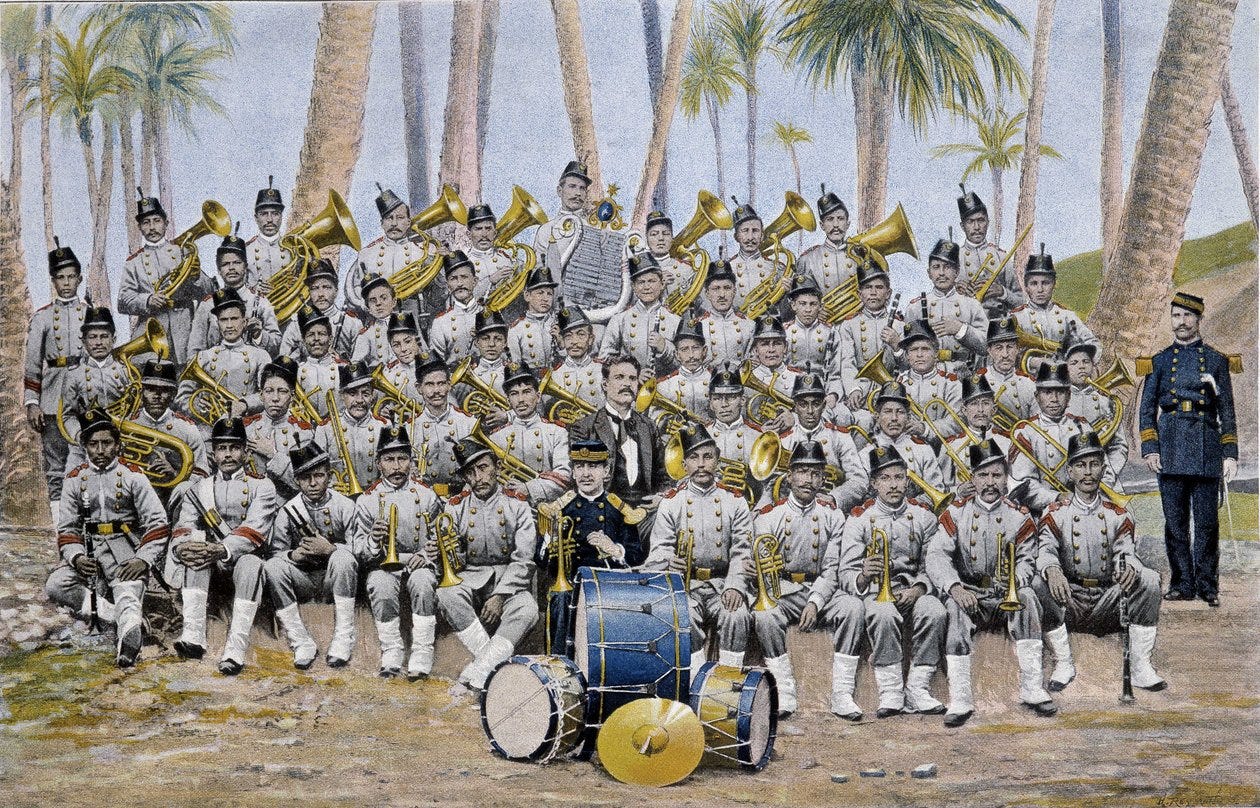
To hear what Sondheim is doing, it helps to step out of Japan for a moment and into a very particular American sound-world: the late-nineteenth-century American march, in the orbit of John Philip Sousa, the “March King” composer whose music became a kind of portable civic ritual.
1) What a Sousa march is for
A Sousa march is designed to move bodies together, both literally (in parades) and socially (in shared time). It’s public music: music for streets, bandstands, ceremonies, contests, fairs. It’s the soundtrack of a nation staging itself.
A march can feel like celebration even when it’s doing something else. It’s a musical form that naturally wears a grin: bright major-mode sheen, forward motion, clean cadences. Even when it’s martial, it can sound like community rather than threat. And that doubleness—festivity with a spine of force—is exactly the Admiral’s rhetorical method.
So when Sondheim gives the American Admiral a Sousa-ish march, he’s giving him not just “American style” but a whole mode of arrival: organized, upbeat, self-justifying. A march, like the Admiral, doesn’t ask permission to be heard.
2) How march form manufactures confidence
Most of us can identify “march-ness” within seconds, even if we’re not steeped in its context or fluent in its vocabulary. That’s because march form is built from immediately graspable contrasts and returns, an architecture of certainty.
A “typical” American march is often described in sections. Let’s break these down:
First, a short introduction, then one or more repeated strains. Next, a contrasting trio section (frequently marked by a key change and a sudden drop from loud to soft). Then, a more turbulent break strain (often nicknamed the “dogfight”). Finally, a return that can expand into a grander close.
Three features are especially relevant to how this style reads dramatically: