
Sunday, Sagrada Família, and the Art of Incompletion
On towers, trees, and sacred works in progress
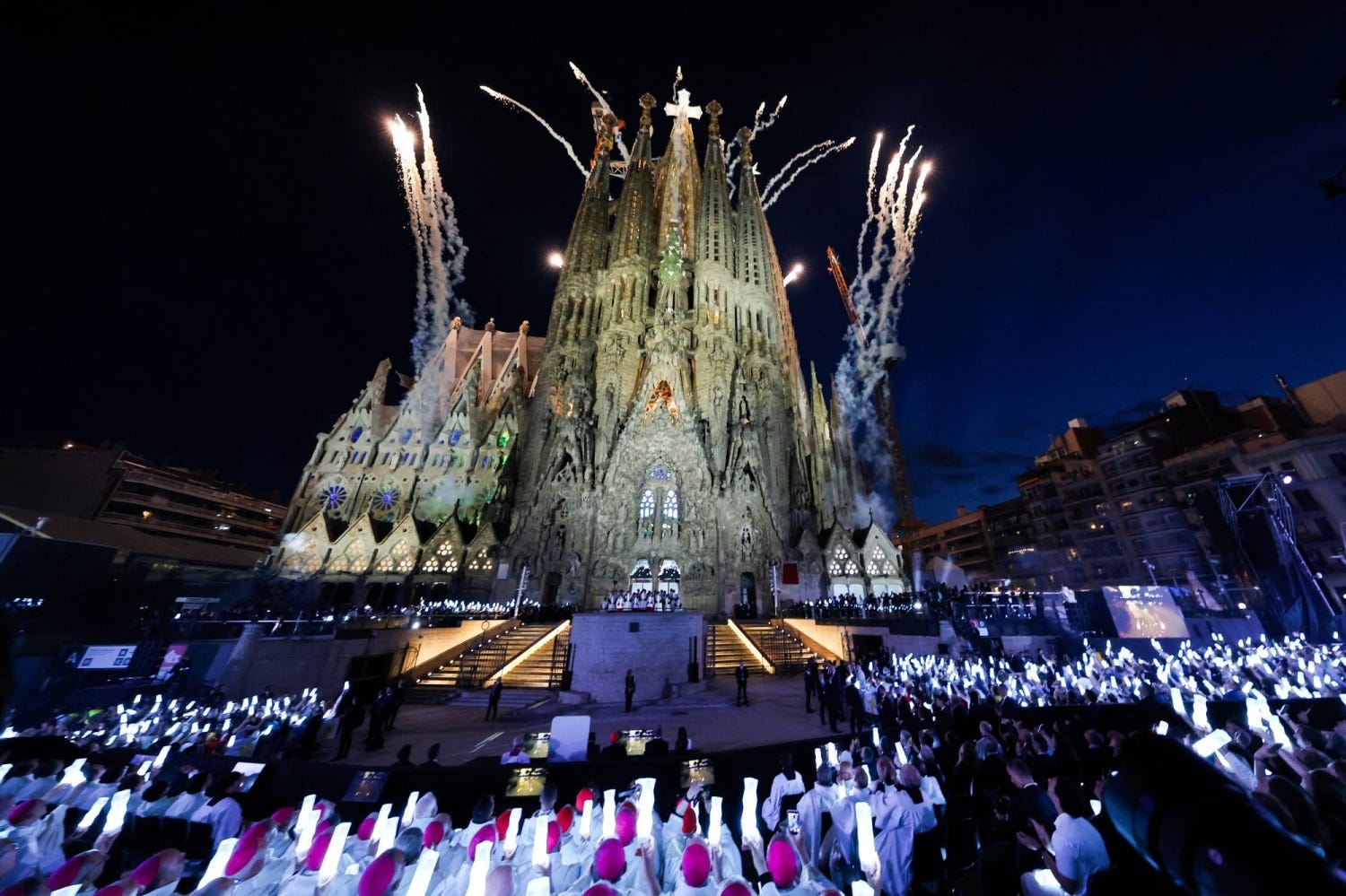
Barcelona’s Basílica de la Sagrada Família is a church 144 years in the making. On June 10th, at a ceremony to mark its structural completion, Pope Leo XIV blessed its central tower.
Sagrada Família’s cornerstone was laid in 1882. The church-in-progress survived a civil war, the burning of its creator’s plans, decades of mockery, and the death — struck by a tram, dressed so shabbily that passersby assumed he was a vagrant and did not come to his aid — of the man who dreamed it. Antoni Gaudí died of his wounds on June 10th, 1926. Precisely 100 years later, tens of thousands of people lined the streets to see his magnum opus blessed by a pope.
A story of creation that begins in the 1880s. A 100-year leap forward in time. Are you thinking about Sunday in the Park with George yet?
Thank you for reading! If you find our work valuable, consider upgrading to a paid subscription for the full Sondheim Hub experience. ✍️
In his June 10th homily, the Pope said something remarkable:
Much more than a monument, the Basilica of the Sagrada Familia remains a work in progress today. The fact that it is incomplete is not a flaw, for it bears witness to a desire; it does not signify a shortcoming, but rather expresses a promise that we wish to honor with consistency.
What a thrilling, even radical thing to say at such a ceremony.
We are accustomed to thinking of completion as the goal of any act of creation: look, I made a hat. A monument, it might follow, is to be celebrated as the pinnacle of creative accomplishment: look, my hat survives me, survives forever, beyond revision. Pope Leo inverts that. A monument, he suggests, is the lesser thing. What sanctifies Sagrada Família is ambition. Gaudí’s church is a promise carved in stone, renewed by each new generation, honored by the very fact of its reaching. Desire, here, is the sacred thing, not its satisfaction.
We don’t often think of buildings in this way. We tend to think of marble, granite, bronze. We think public, we think permanent, we think durable forever. But a building that still aspires, that still wants something, remains alive. Incompleteness is an active state, and all the more thrilling for it.
To Sunday in the Park with George, then. In Act 2, the first George’s masterpiece has, for the second George, become a monument. And like a vast church, it casts shadows. Every direction this 20th-century George might move in seems a dead end; he is a cornered king facing checkmate, paralyzed by his inheritance. “I’ve nothing to say,” he says. “Well, nothing that’s not been said.”
What rescues him, and what Sondheim and Lapine offer as their answer to that paralysis, is Dot’s notebook. Her writing. Her voice from the previous century, guiding him back not to the monument but behind it, or perhaps inside it, to the original impulse, to the desire that preceded the form. “Said by you, though, George,” Dot replies.
Consider her words in Act 1, too:
You are complete, George,
You are your own.
We do not belong together.
You are complete, George,
You all alone.
I am unfinished,
I am diminished
With or without you.
This, again, is Pope Leo’s language of completion and incompletion. The first George’s work, Dot recognizes, has made him self-sufficient, sealed, complete (though, crucially, not whole). He is the monument, she the work in progress — and that, their relationship cannot survive.
The story of Sagrada Família points us in another Sunday direction too. Late in Act 1, George’s elderly mother sits in that small suburban park, staring across the water. “All those beautiful trees,” she says, “cut down for a foolish tower.”
In the distance, she can see where they are planning to build something: a vast iron lattice, 300 meters tall, taller than anything ever built. The plan has been published; the outrage has begun. A petition is circulating among the city’s leading artists and writers (it will gather names including Guy de Maupassant and Charles Gounod) declaring the proposed structure an abomination, a blot on the Parisian skyline, a “truly tragic street lamp.”
George is unmoved by his mother’s words, and precise in his reply. “I do not think there were ever trees there,” he says. “I am quite certain that was an open field.” He is right about Paris. And, as it happens, he would have been right about Barcelona too. When the Association of Devotees of Saint Joseph purchased the plot on which the Sagrada Família would be built, they were buying a bare rectangle of undeveloped land: not yet built on, not yet anything. No trees were cut down for Sagrada Família. It, too, rose from an open field.
Still, George’s mother begins to sing:
Changing.
It keeps changing.
I see towers where there were trees.
Going,
All the stillness,
The solitude…
Her sense of loss is real, even if the trees were not.
And real, too, was the unease provoked as Gaudí’s towers began to alter the skyline. Sagrada Família attracted something of the hostility that had greeted the Eiffel Tower: mockery, aesthetic outrage, the suspicion that this particular vision had no business imposing itself on a city that had not asked for it. Many Noucentista and rationalist critics recoiled from Gaudí’s organic profusion, from façades that looked as though the building were erupting from the earth rather than being constructed upon it. George Orwell declared it “one of the most hideous buildings in the world.” Like Eiffel’s iron tower, it was, to its detractors, an affront: too strange, too much, too insistently itself.
George, responding to his mother, does not dismiss or belittle her perspective. Instead, he adopts her language, meets her on her own terms. He speaks, as it were, in her voice:
All things are beautiful, Mother.
All trees, all towers beautiful.
That tower beautiful, Mother, see?
A perfect tree.
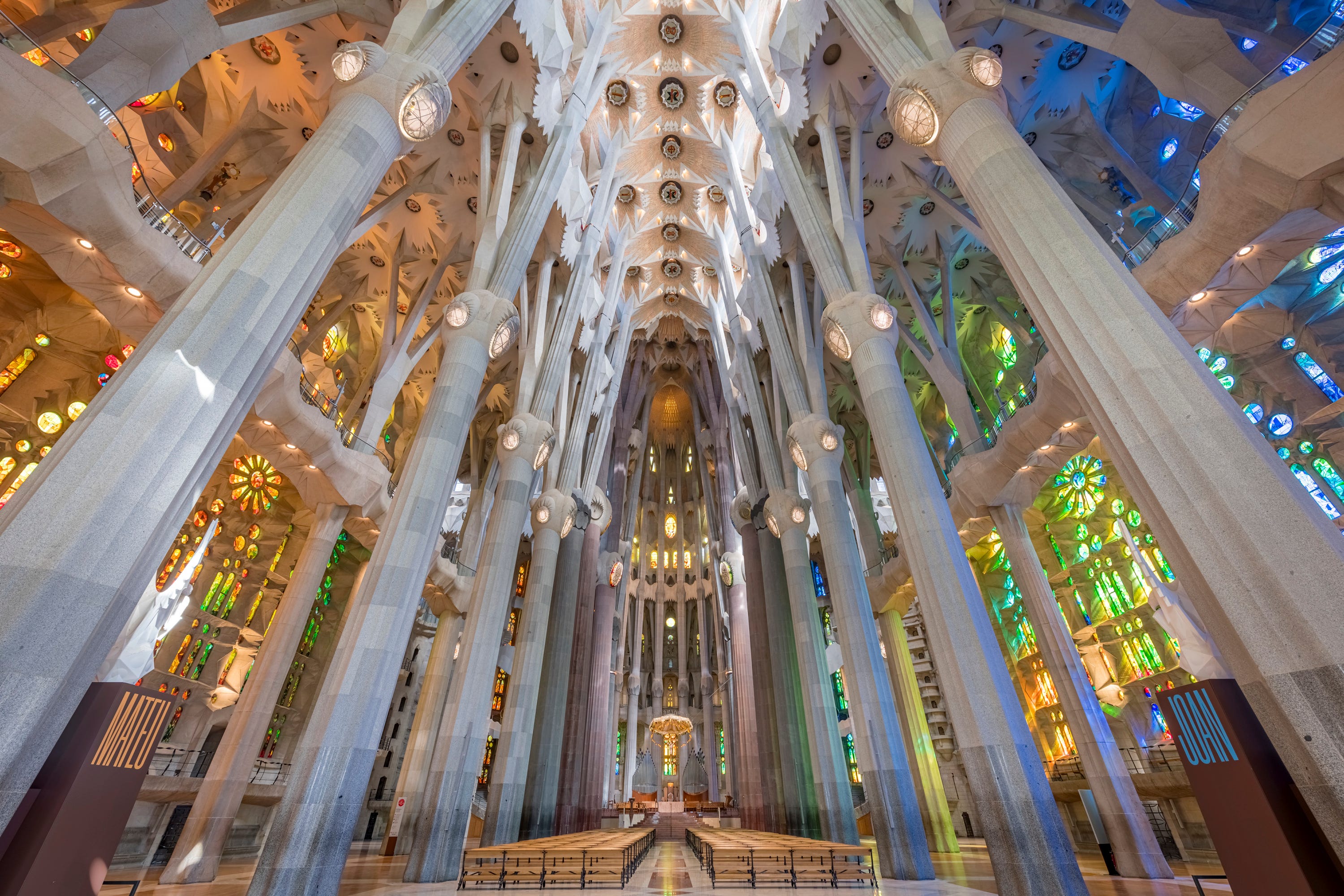
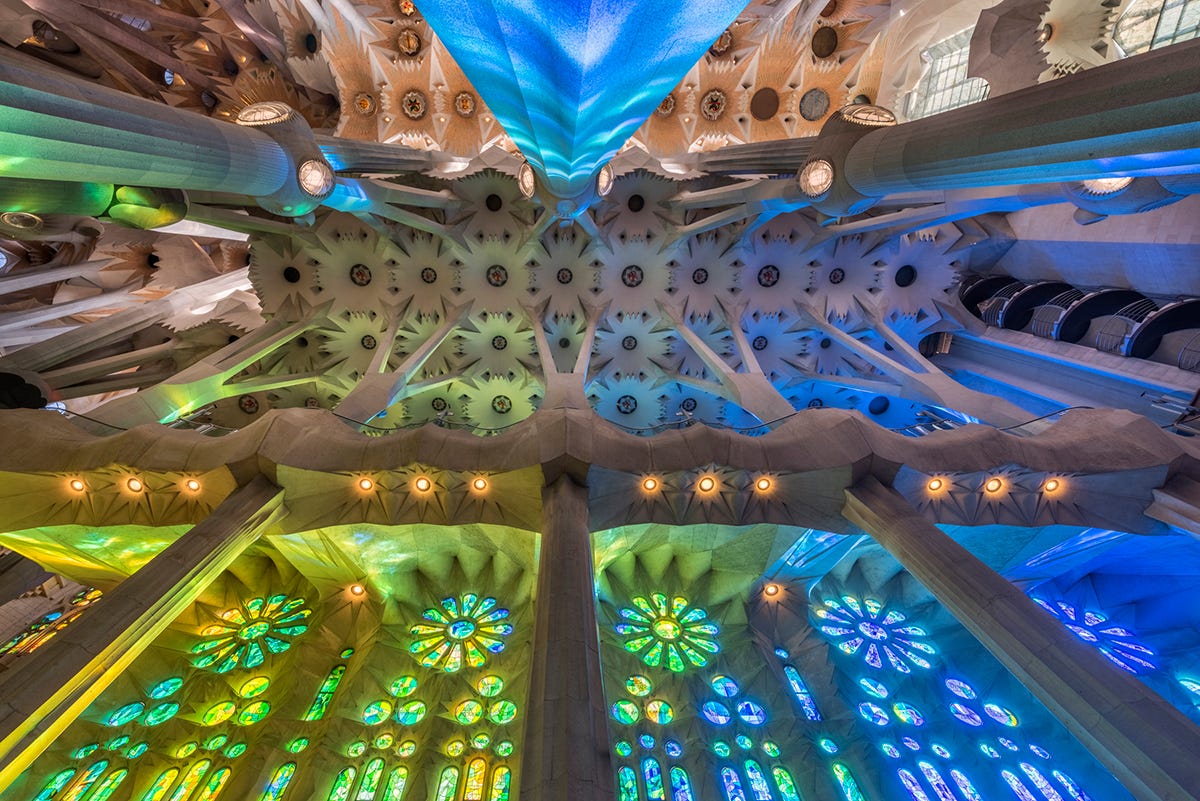
A perfect tree… Inside Sagrada Família, the columns branch. They spread upward and outward from their trunks as trees really do. Gaudí’s vaulted ceiling is a canopy; light filters in as if through leaves. This is deliberate: Gaudí spent years studying the way trees bear weight, the way branching geometry distributes force so efficiently that no column needs a capital, no arch needs a flying buttress.
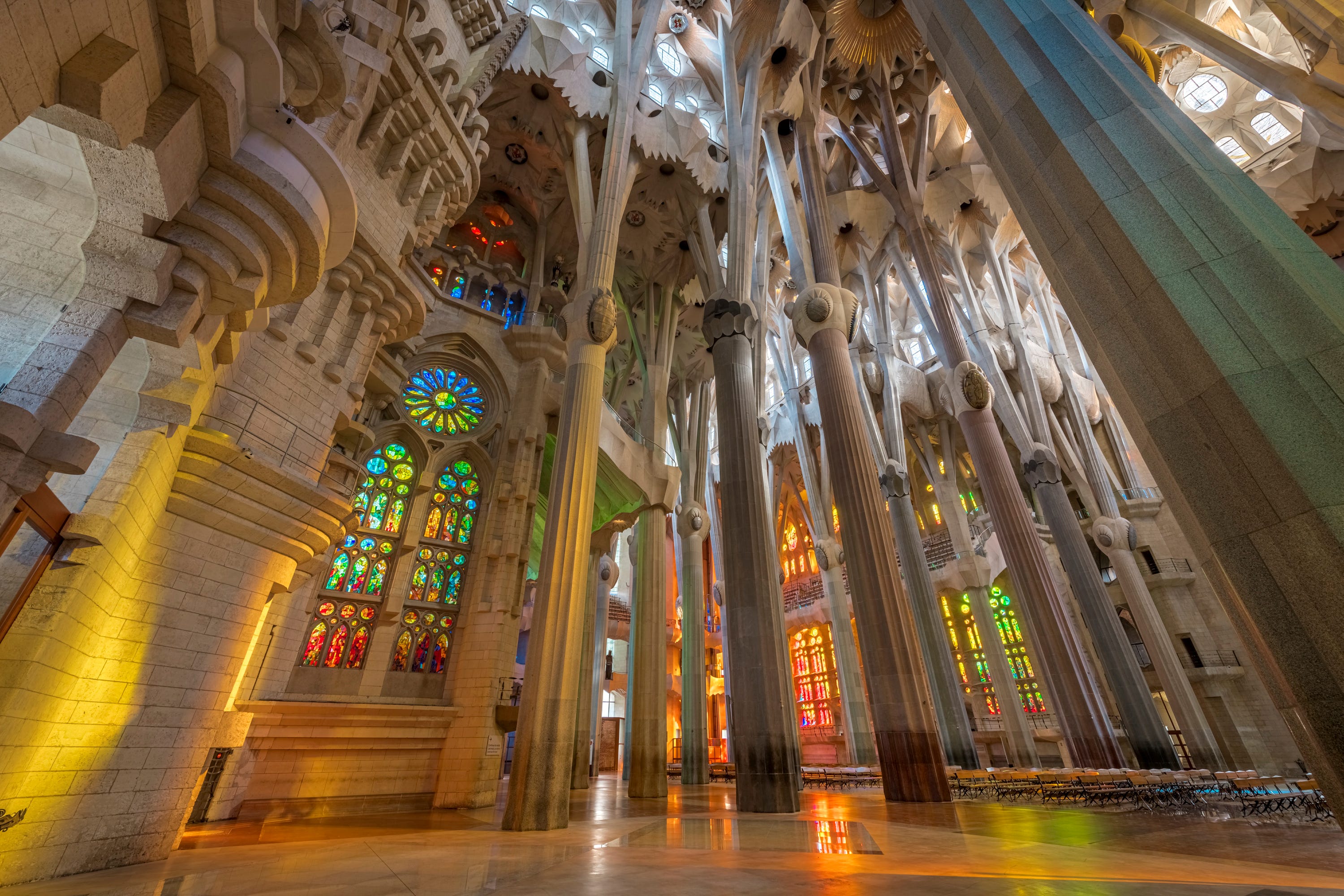
George’s mother sees towers where there were trees. To step inside Sagrada Família is to see trees within a tower. It is to see a forest translated into stone and then, astonishingly, converted back.
On June 10th, Pope Leo XIV stepped out of the Basílica and blessed its tallest tower. In his words, an idea that Sondheim and Lapine had already understood: that great art lives most fully in the act of its creation. In the work, the desire, itself. In the limitless possibility of that blank page or canvas.
Sagrada Família is not finished. It will not be finished for another decade at least; the Glory façade still awaits, and Gaudí’s grandest ambitions for the entrance remain unrealized. The building being blessed is still becoming. And that, the Pope reminds us, is not a flaw. The desire is the sacred thing.
George’s great-grandson learns this on the island in 1984. You cannot inherit a monument. You can only find your way back to the impulse behind it, to that first exquisite reaching, and begin again from there. Dot shows him how. And the final image of Sunday in the Park with George is not the painting, fixed and framed and finished, but the desire inside it, alert, alive, reaching towards the verticals of trees forever.
The Sondheim Hub is a reader-supported publication
If you find our work valuable, consider becoming a paying subscriber.
You’ll get access to our full archive of 250+ essays, interviews & features, an exclusive essay each week, more from each interview, and a weekly Sondheim crossword. Paid subscriptions make our work possible. 📚
A perfect tree! Beautiful, inspiring piece
In reference to the petition, I suppose de Maupassant‘s candor may cause us dismay?