
Putting It Together: Rewritten Lyrics
A guide to what changes
Putting It Together presented both a challenge and an opportunity: to create a cohesive narrative without dialogue using existing songs while simultaneously reimagining their meaning through lyrical rewrites and dramatic recontextualization. In this compelling piece, Richard Putorti, Jr. examines how Sondheim’s strategic lyrical changes — sometimes as simple as substituting a single word — completely altered the emotional landscape of his songs.
From the transformation of “Unworthy of Your Love” into an even more twisted romantic duet to the clever repurposing of “Everybody Ought to Have a Maid” as a tool of seduction and jealousy, this analysis explores how context can be as powerful as content in shaping our understanding of a song’s emotional truth.
Thank you for reading! Upgrade to a premium subscription for full access to The Sondheim Hub: an exclusive essay, extended interview, crossword & more each week — plus, our complete, paywall-free library of 250+ essays, features & interviews.
Putting It Together: Rewritten Lyrics
“Invocation and Instructions to the Audience” — The Frogs
Original meaning: Please don’t be one of those audience members
PIT meaning: Please don’t be one of those audience members (but also, in case you haven’t noticed, this is a Sondheim show)
Putting It Together begins its litany of Sondheim canon with the opening number of The Frogs, “Invocation and Instructions to the Audience”. While the two shows have completely different plots, both utilize the song to break the fourth wall, explaining how to be a decent audience member. “Instructions” was no stranger to alternate lyrics; Sondheim had already written two different versions for contrasting presentations of The Frogs (water versus dry land, it’s a long story…). Like the original “Instructions”, a dig at disrespectful audience members (“Don’t go ‘Oh’/Each time you see an actor that you know”), the newer version alludes to the concept of PIT being a revue with changed songs while continuing to poke fun at audiences: “Don’t go ‘Oh’/Whenever there’s a song you know/And when you hear the verse, don’t whisper low/’They cut that out of town, I saw the show’/’I don’t recall the tempo being quite that slow’.”
Sondheim even swaps out a line mocking Aristophanes’ lewdness for one that seemingly elevates his own notoriety: “The author’s reputation isn’t based/On taste”, which pokes fun at the Greek playwright, is replaced with “The author has a reputation based/On taste”, an almost over-the-head reminder of the method to the musical’s madness.
“Putting It Together” — Sunday in the Park with George
Original meaning: The art industry is difficult to navigate, but never forget your vision
PIT meaning: The world of theater is ever-changing; any detail can be altered at a moment’s notice
This is the second of three revisions that Sondheim penned for his mammoth ode to art from Sunday in the Park With George. The original lyrics focus on “having to plead for the opportunity to do what you want to do…” in terms of the art business. An update for Barbra Streisand changed the theme to describe the difficulties of recording an album, and a later adaptation for the Academy Awards focused on making movies. Most importantly, for PIT, the show’s namesake was changed to detail the world of acting and performance. The first two verses of the song remain the same (“Bit by bit…ounce by ounce…”), not changing until the third verse (“Link by link/Making the connections” becomes “Note by note/working on projection”).
Each verse is sung by a different actor when they enter, with instrumental breaks in the score allowing for audience applause, especially highlighting the leading ladies of the three mainstage productions (Diana Rigg, Julie Andrews, and Carol Burnett). Whereas Sunday’s “Putting It Together” is mainly George’s rationale for his glibness as an artist, the purpose of PIT’s “Putting It Together” is to fill the audience in on all of the behind-the-scenes stuff that they never see: “Dealing with producers’ interference/Waiting for the author’s disappearance/Filling up the holes with animation/Covering up the flaws in the construction…” When the actors ultimately proclaim that “that is the state of the art,” it bookends the show’s fourth wall-breaking setup, and the musical’s plot, albeit a loose one, begins.
“Rich and Happy” — cut from Merrily We Roll Along
Original meaning: Oh, so money CAN buy you happiness
PIT meaning: There are only two groups of people in the world: the haves and the have-nots
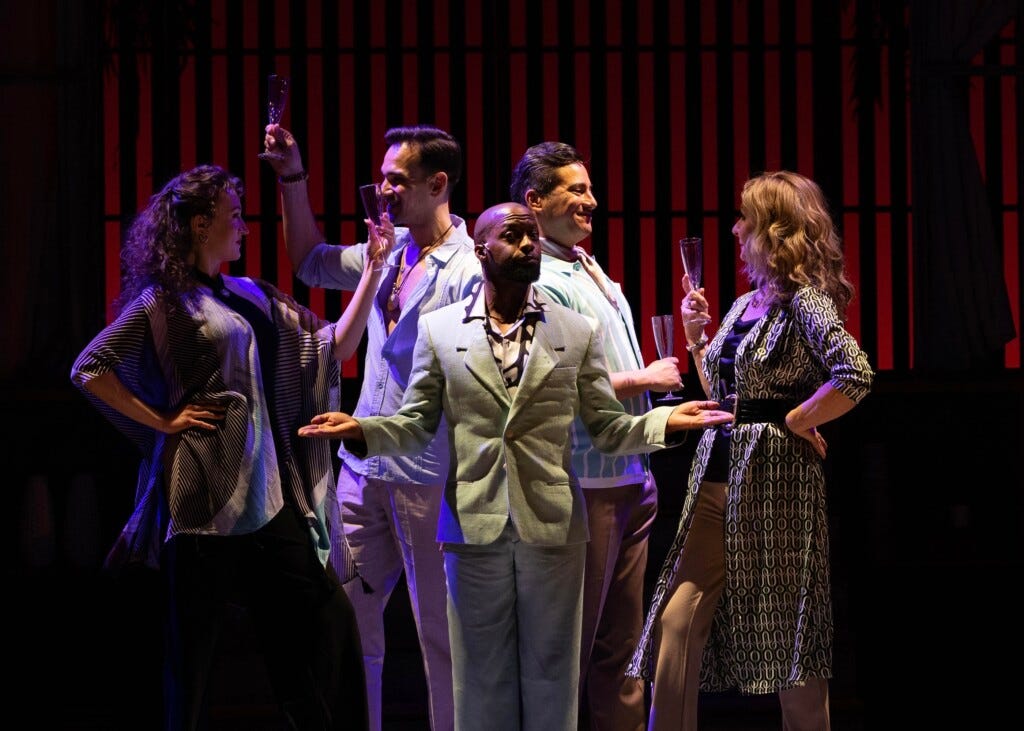
A James Lapine-directed performance of Merrily led to Sondheim revisiting and revising this infamous flop; from 1985 onward, “Rich and Happy” was replaced with “That Frank” for the opening scene of Franklin Shepard’s Hollywood party. Two mainstage performances of the revised Merrily had been staged before the creation of PIT, so it’s worth noting that the song remains in its original, discarded form. The song’s original context, a kid’s idea of a Hollywood party, fits PIT’s very loose dramatic framework with their shared cocktail party setting; the rough plot is structured around the relationships of five characters during a dinner party as they go through bouts of self-reflection. The subtext of the song, while still about living life as a member of high society, no longer discusses movie producing (“When you see a movie that bad,/What on earth can you say?”), but twists words for characters to describe each other: “When you see a facelift that bad,/What on earth can you say?” Comments about the quality of Frank’s movie (“Terrible/Wasn’t it just terrible?”) become jabs at characters: “Terrible/Doesn’t she look terrible?” The Husband and The Wife, being the rich and happy ones, sing about how wonderful their life is (“Who says, ‘Lonely at the top’?/I say, ‘Let it never stop’”); The Younger Man and The Younger Woman can only gaze longingly at what their lives could be (“This must be what happy means”). Only the mysterious Observer sees the scene for what it truly is, addressing the audience directly: “These are the movers/These are the shapers/These are the people/Who fill the papers”.
“Unworthy of Your Love” — Assassins
Original meaning: When does a crush become an obsession?
PIT meaning: When does a relationship become an obsession?
The unorthodox ‘romantic ballad’ of “Unworthy of Your Love” is unassumingly dark and twisted, originally focusing on the obsessive and murderous natures of would-be presidential assassins John Hinckley, Jr. and Lynette ‘Squeaky’ Fromme. Despite the anachronistic staging of the two as a “loving couple,” they are actually ‘singing’ to their hearts’ desires, Jodie Foster and Charles Manson, respectively. Hinckley and Fromme both claim to be “unworthy’ of their infatuations’ love, yet their firm beliefs that they are owed that love become the motivation for their assassination attempts:
HINCKLEY: I did it to prove to her my everlasting love … I did it so she’d pay attention… Because she wouldn’t take my phone calls…
FROMME: I did it to make them listen to Charlie… I did it so there’d be a trial, and Charlie would get to be a witness, and he’d be on TV, and he’d save the world!...
Sondheim turns this parody on its head by changing only one word; the names “Jodie” and “Charlie” are changed to “darling”, suddenly shifting the song into an actual romantic, yet still horrifying, duet. Framed as a moment of afterglow between The Younger Man and The Younger Woman, “Unworthy of Your Love” becomes a confession rite – admittance of past guilt paired with penance and forgiveness. This relationship is incredibly unhealthy; the couple no longer see themselves as equals working together for the sake of the relationship. Hardened by their life experiences, The Younger Man and the Younger Woman can only see themselves as worthless, yet they revere their partner as a God. In changing one word, Sondheim completely transforms the meaning of his twisted duet. In Assassins, it’s a disturbing anthem of devotion by unbalanced, obsessed individuals. Out of context, it can become a powerful declaration of affection & ardor between two lovers.
Changed Context
“Hello, Little Girl” — Into the Woods
One of the most sexually charged songs in Sondheim’s canon, “Hello Little Girl” is originally sung by The Wolf as he tries to distract Little Red Riding Hood from visiting her grandmother so he can eat them both. The already tense nature of the ‘predator-prey’ song becomes heightened within the context of PIT as the song morphs into one of seduction and carnality. In this context, The Husband attempts to get with The Younger Woman/The Maid merely as a way to satisfy his sexual appetite, aiming to add “something fresh on the palate” to his list of conquests, which presumably already includes his wife that very same day. The manipulation of the song remains the same, as The Husband eventually wears The Younger Woman down, bending to his will and insinuating that the two of them run off to a different room. The connotation of ‘little girl’ and ‘wolf’ in this context completely deviates from their fairy tale inspirations, instead changing into dark, sexual tones as the audience, like The Wife in her next number, are helpless to do anything other than watch.
“Everybody Ought To Have a Maid” — A Funny Thing Happened on the Way to the Forum
Sondheim didn’t think too highly of this witty ditty, considering it not much more than a list song, but still heavily rooted in plot. Funnily enough, when used in PIT, the song functions within the plot similarly to its use in A Funny Thing Happened on the Way to the Forum. Unlike most songs in PIT, “Everybody Ought To Have a Maid” is special in that its context and usage change depending on the version of the revue. For the West End and Off-Broadway versions, the context of the song remains the same as its original, with the main male characters ogling over a maid they can’t seem to stop fantasizing over. In the Broadway version of PIT, the song is given to The Wife as she tries to seduce The Observer as a way of getting back at The Husband for “Hello Little Girl”. The words remain the same, but Sondheim has The Observer (working as a servant for the couple) sing with The Wife, turning it into a comedic, yet consensual tryst, which serves its purpose in making The Husband jealous. Technically, the Broadway version is slightly rewritten, changing the subject from “working girl” to “working boy”, but this rewrite doesn’t change the intention of the song at all. Given the frilly little apron The Observer is forced to wear, one could argue that the word change isn’t necessary to get the point across.
“Pretty Women” — Sweeney Todd
Within the context of Sweeney Todd, “Pretty Women” presents itself as one of Sondheim’s most chilling songs, masking the dramatic tension and situational irony as Sweeney distracts Judge Turpin as he attempts to murder him. Considering that there is no murder plot in PIT, the use of “Pretty Women” allows for its lyrics to be interpreted at complete face value. Some irony does still exist, however, as The Husband has just (unsuccessfully) attempted to seduce The Younger Woman, with The Younger Man completely unaware of this betrayal. Fear not, The Husband will indeed get his comeuppance heavily doled out on him later by his wife. Answering the question of “What do you want to get married for?” (posited from the previous “Have I Got a Girl For You”), The Younger Man and The Husband sing through their reasons of why they indeed would want to get, or have been, married. “Pretty Women” in this context then functions as a truer list song, with the virtues and characteristics of women extoled, sounding more like A Little Night Music’s “In Praise of Women” rather than a murder plot. Gone is a scene fraught with irony and suspense - the song becomes a tender duet between two characters who shared very little in common before a moment of bonding.
“Getting Married Today” — Company
Originally sung by bride-to-be Amy as she gets cold feet, Sondheim cleverly crafts a new perspective on this song in PIT by having The Wife (also known as Amy in some productions) sing the entire thing by herself, taking over the parts usually sung by Paul and a Choir Member. This solo performance becomes a retrospective look at getting married (for the first time; both versions of PIT call The Husband Charlie, meaning he is her second marriage), with The Wife frantically reliving her nervous breakdown. The fear and anxiety associated with the song remains, but the context shift lies in the change from present moment to flashback. Regardless of any version, having “Getting Married Today” as the last song of the ‘party games’ and ‘self-reflection’ sections allows for The Wife to become bigger and more frantic than the other solo songs, as the fear isn’t resolved like it is in Company - there is no actual wedding occurring; instead, the song becomes a reliving of past trauma. While Company resolves the issue with Amy willingly accepting her upcoming marriage, PIT can’t directly resolve the issue with the song stuck in the past. The Wife’s culmination of emotion triggers the fight-or-flight reflex she felt on her first wedding day, resulting in the panic attack we witness onstage. Once the pain has been rehashed, the memory settles down and dies away, allowing The Wife to feel confident and secure that her marriage to Charlie was the right choice for her all along.
✍️ Please support our work by upgrading to a premium subscription:
The Sondheim Hub exists solely thanks to the generous support of our readers. Please consider supporting our work for a few dollars each month. A premium subscription gives you full access to The Sondheim Hub: an exclusive essay, crossword, extended interview & more each week, plus our complete, paywall-free library of 250+ essays, features & interviews. 📚