Please Hello: America Back
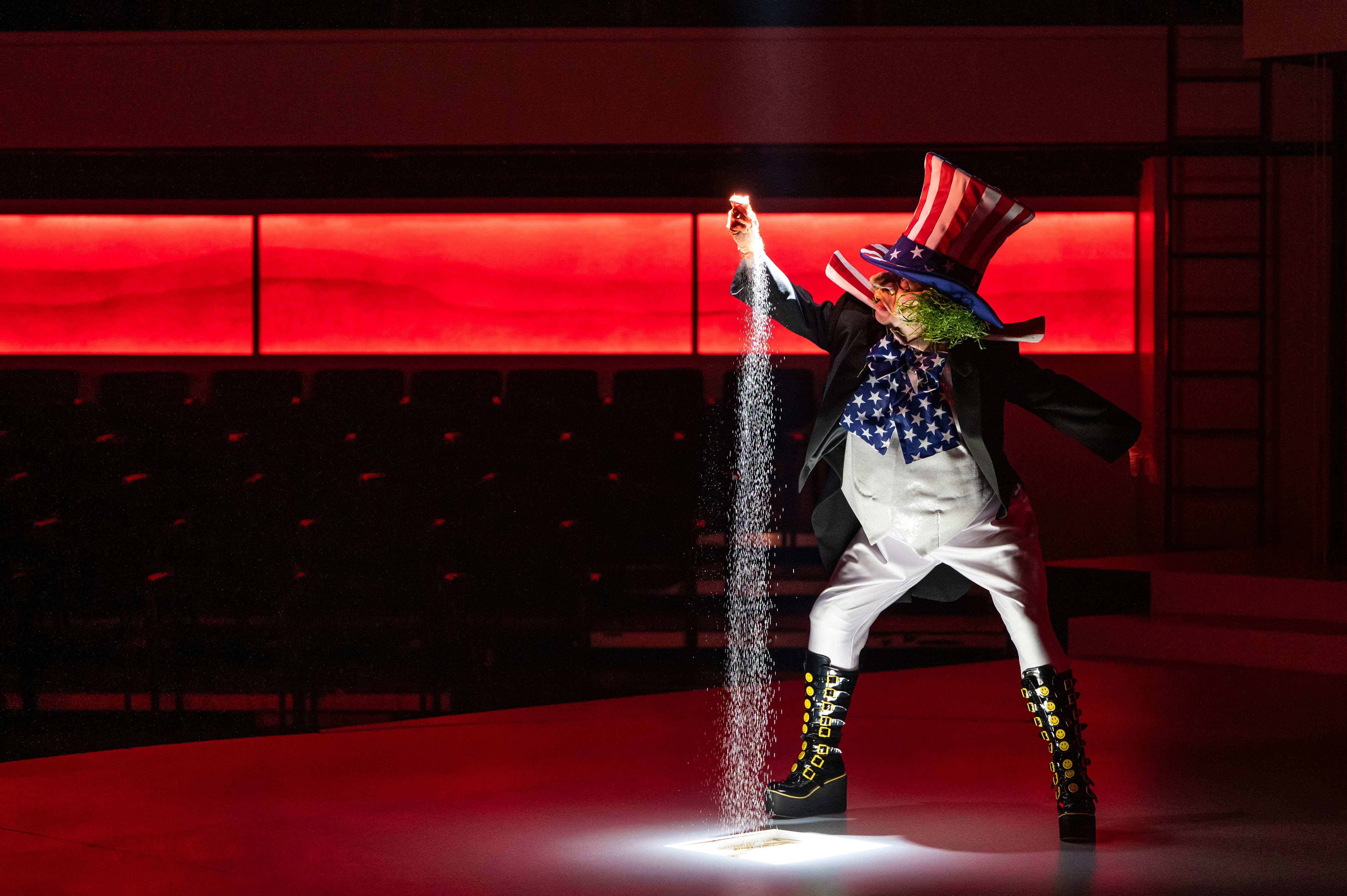
Pacific Overtures' American Admiral 🇺🇸
“Please Hello” opens with an act of extraordinary compression: in roughly forty lines, the American Admiral condescends, threatens, bribes, and ultimately coerces the Japanese First Councilor Abe into signing away his nation’s sovereignty.
Today, in Pacific Overtures’ 50th anniversary year, we begin a series of essays on this extraordinary number. We’ll meet each of its ambassadors in turn, one essay per month, exploring what each power is doing, what it pretends it is doing, and what it cannot stop itself from revealing. First, the United States…
Thank you for reading! Upgrade to a premium subscription for full access to The Sondheim Hub: an exclusive essay, crossword, extended interview & more each week, plus our complete, paywall-free library of 250+ essays, features & interviews.
The Language of Empire
Please hello, America back,
Commodore Perry send hello.
Also comes memorial plaque
President Fillmore wish bestow.
The American Admiral’s opening gambit is an astonishing act of linguistic mimicry, a portrait of cultural imperialism delivered through the syntax of condescension. This was, as Sondheim points out in Finishing the Hat, John Weidman’s conceit:
The Japanese would speak elegant, formalized King’s English, whereas all the foreigners would speak a pidgin form of their native language.
In the Admiral’s broken, childlike English we hear the arrogance of a nation that assumes the world writ large should accommodate its presence. The simplified syntax mirrors this view of international relations: we want something, you give it to us, everyone’s happy.
The Admiral, as well as dropping articles and using an infantile present tense, sets rhetorical trap after rhetorical trap:
Emperor read our letter? If no,
Commodore Perry very sad.
Emperor like our letter? If so,
Commodore Perry very merry,
President Fillmore still more glad.
This is a particularly chilling example of manipulation through faux-naïveté. The Admiral presents American disappointment as if it were a natural disaster to be avoided rather than a diplomatic position to be negotiated. The childlike language masks an adult threat: make us sad, and there will be consequences.
These lines also establish a pattern of what we might call bureaucratic bullying. The Admiral doesn’t introduce himself; instead, he name-drops his superiors—“Commodore Perry send hello,” “President Fillmore wish bestow”—transforming what should be diplomatic courtesy into a display of institutional power. The mere mention of an American title should, he assumes, inspire deference.
The Technology of Civilization
But we bring many recent invention:
Kerosene
And cement
And a grain
Elevator,
A machine
You can rent
Called a “train”—
Here’s one of the most insidious arguments for imperialism: technological supremacy as moral justification. Sondheim’s chosen items are brilliantly pointed: not luxuries, but infrastructure. Fuel. Building material. Storage and supply. Transport. In other words, the physical systems through which a nation’s resources are extracted, moved, and monetized. (The historical Perry expedition did in fact bring gifts of American technology, including a working model train that circled a track in front of amazed Japanese officials.)
Abe repeatedly attempts to interject: “But you can’t—,” “Maybe later—.” But he is steamrolled by the Admiral’s enthusiastic catalogue, and “no” is not for one moment acknowledged as a possibility. Abe cannot so much as finish a sentence in his own country.
We can see in this exchange the circular logic of 19th-century expansionism. We have trains, therefore we are advanced. We are advanced, therefore we have the right to impose ourselves on you. Once imposed, you will need our trains. The fact that you need our trains proves we were right to impose ourselves. It’s a closed system, a perpetual motion machine of justification powered by industrial output. Create the need, control the supply, ensure perpetual dependency.
Gunboat Diplomacy
Also cannon to shoot
Big loud salute,
Like so:(He gestures toward the sea; an enormous explosion offshore)
Say hello!
(Another explosion)
The running gag of increasingly large explosions throughout “Please Hello” begins here. The explosions are presented as “salutes,” celebrations, friendly gestures—yet everyone in the theater understands that they’re threats. This is the essence of gunboat diplomacy: violence disguised as festivity, the barrel of the gun wrapped in red, white, and blue bunting.
The real Commodore Perry’s 1853 expedition to Japan included a deliberate demonstration of American naval power. His “black dragons” were steam-powered warships, a technology Japan had never encountered, and Perry made sure to conduct gunnery exercises visible from shore.
Treaty meet approval? If no,
Commodore Perry very fierce.
Disregard confusion below—
President Fillmore now named Pierce.
Here the mask slips entirely, the threat no longer implied but stated. More fascinating is the casual mention of the presidential transition. The timeline matters: Fillmore authorised the expedition; Pierce took office in March 1853; Perry arrived in July 1853 and secured the Convention of Kanagawa in March 1854. Sondheim compresses that sequence into a single shrug. Administrations change, policy persists, and Japan is expected to keep up, without being granted the dignity of treating any of it as negotiable.
Abe signs. Sondheim does not linger on his internal decision-making—and that, too, is part of the point. The decision has already been removed from him. The explosion is the end of debate.
The Admiral continues:
Good! At last agreement is made,
Letter will let us come again.
First result of mutual trade:
Commodore getting letter letting,
Councilor getting fancy pen!
Perry gets what he came for: access, return rights, an opening. Abe gets stationery. The comedy is clean, and the structure is bleak: the expansionist power gets a future; the coerced official gets a souvenir. It’s a reminder that “trade” is a story often told with symmetrical vocabulary (“mutual”) disguising asymmetric outcomes.
Competitive Empire: America after America
Crucially, the American Admiral doesn’t vanish once he’s “done.” He keeps interrupting the rest of the number, and those interruptions tell us what America wants when it is no longer the sole actor.
When the British arrive and secure an ambassador, the American Admiral snaps:
British get ambassador sent,
President Pierce get extra clause!
That “extra clause” maps onto something real. The 1854 Convention of Kanagawa contained a most-favoured-nation clause: if Japan granted any other nation privileges not in the U.S. treaty, those privileges would automatically extend to the United States. America writes itself into Japan’s future dealings. Even when another power speaks, America wants the benefit.
This is an important refinement of the “template” idea. The American grammar is not only gun + gift + signature. It’s also law as a time-bomb: a clause that sits quietly until someone else negotiates, and then springs open to claim the same reward “without any consultation or delay.”
Then come the escalating demands, as the Admirals compete:
Dutch getting too many seaports,
President now wanting three ports—
This is textbook mission creep. Once the principle is accepted (a port can be demanded), the numbers become a haggle, and the haggle becomes an arms race. That’s another structural truth: imperialism rarely stops at its first stated aim because the first aim was never the whole aim. A “coaling station” is a foothold; a foothold is leverage; leverage generates appetite.
And then, later, when extraterritoriality enters the song through the Russian Admiral, America’s reaction is blunt:
U.S.A. extremely upset!
President Pierce say solid “No!”
In context, it reads as American outrage not at injustice, but at precedent—at the idea that Japan might have to universalize a concession (legal immunity) in a way that dilutes America’s relative advantage.
The Permanent Invasion
By the time “Please Hello” reaches its chaotic conclusion, with all the admirals singing over each other in a cacophony of demands, the American Admiral has become just one voice among many, his specific identity dissolved into the general roar of imperialism. Yet his opening remains definitive. He has established the rules: speak down to the “natives,” bring impressive technology, fire your cannons, force the signature, pretend it’s friendship, complain when others get more than you, demand revisions. Never, ever stop demanding.
After America has spoken, we are primed to notice the pattern inside each nationality’s style:
the British turn coercion into etiquette and bureaucracy;
the Dutch turn it into hucksterism and commercial greed;
the Russians turn it into legalistic menace;
the French turn it into rhetoric about détente that collapses into open territorial fantasy.
If “Please Hello” is a parade of caricatures, it is also a set of national self-portraits painted in acid. America’s begins with a grin and ends with an explosion. It calls itself friendly, modern, reasonable. It makes even its threats sound like party tricks. And it leaves behind, as its “first result of mutual trade,” something more lasting than a port: a pattern that others will repeat, and that Japan—once forced to learn it—will eventually find ways to answer, resist, and recompose.
Next month, we’ll follow the voice that bursts in as America says “Please goodbye.” We’ll meet the British Admiral, with his letters from Her Majesty Victoria…
✍️ Please support our work by upgrading to a premium subscription:
The Sondheim Hub exists solely thanks to the generous support of our readers. Please consider supporting our work for a few dollars each month. A premium subscription gives you full access to The Sondheim Hub: an exclusive essay, crossword, extended interview & more each week, plus our complete, paywall-free library of 250+ essays, features & interviews. 📚


Another brilliant, essay!
Excellent! Looking forward to more in the series!