
Our Time: The Future Tense of For Good?
Sondheim Supplement #41
Something is stirring, shifting ground… In this week’s Supplement, we take a closer look at Merrily’s “Our Time” through the lens of Wicked’s “For Good.” Plus, your latest Sondheim Hub crossword, and more.
✍️ The Sondheim Hub is an entirely reader-supported publication. If you’d like full access to every Sondheim Supplement, click here to explore our various subscription options. ✍️
🎁 Give the gift of a Sondheim Hub subscription! Surprise a loved one, schedule the arrival date, no wrapping required. What’s not to like? Click here for more details. 🎁
“Our Time”: The Future Tense of “For Good?”
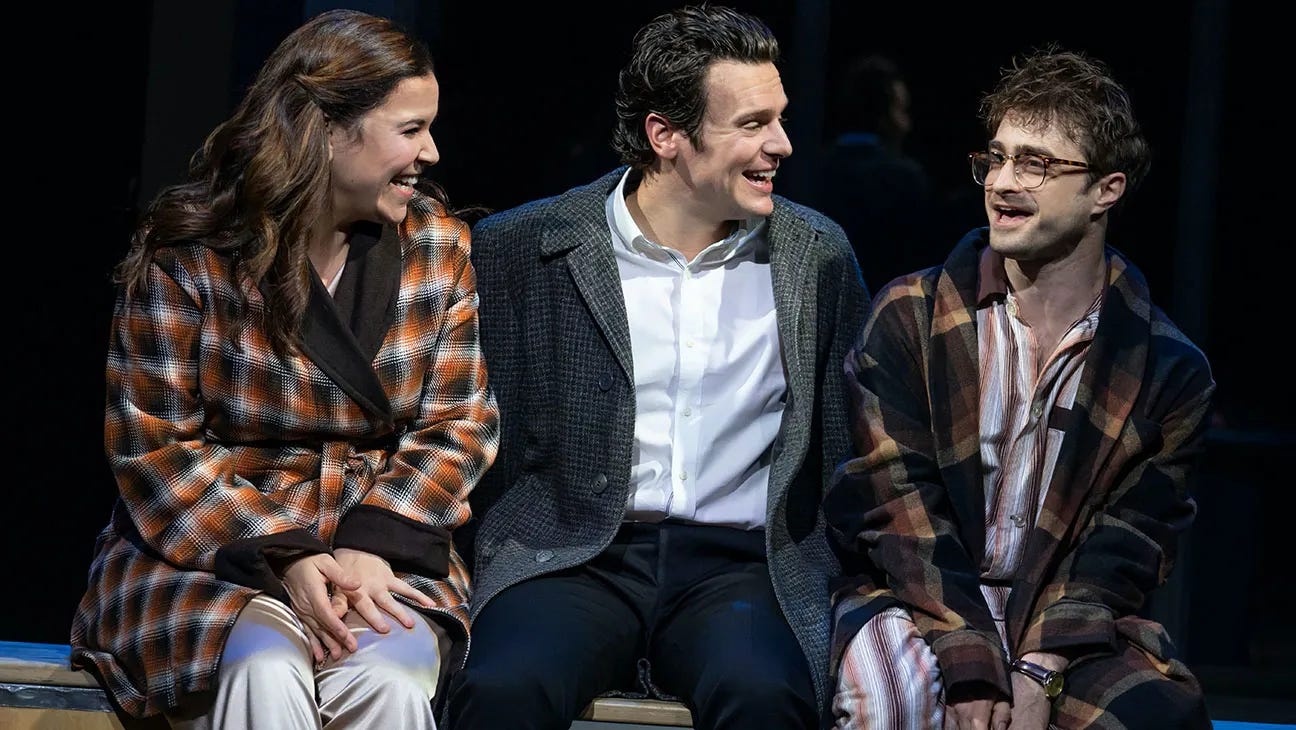
If “For Good” speaks in the present perfect—I have been changed—“Our Time” speaks in the future perfect—we will have changed. One blesses the mark a friendship has left; the other drafts a friendship into being.
Because Merrily We Roll Along runs backwards, “Our Time” arrives as a final embrace as it dramatizes the first pact. To quote Merrily directly, it “feels like an ending, but it’s really a beginning.” That dislocation, between last song and first promise, is perhaps the show’s fiercest honesty about influence.
“Our Time” is declarative, its grammar contagious: “We’re what’s happening.” This is influence in its recruiting phase. J. L. Austin might have called these utterances performative: to say them is already to try to make them true. “Feel the flow, hear what’s happening…” The song creates a climate in which belief becomes plausible. If “For Good” is a benediction spoken at parting, “Our Time” is a binding oath.
The Architecture of Promise
Sondheim lets the self-mythology gleam and then places a price tag on it. “Years from now, we’ll remember and we’ll come back, buy the rooftop and hang a plaque.” Permanence, in this mood, is public and commemorative: names in tomorrow’s papers, metal fastened to brick. Compare this to the imagery of “For Good”: “handprint on my heart,” and so on. Plaque versus heart-print: one commemorates the external what we did together; the other records the internal what we did to each other.
The plaque represents what philosopher Charles Taylor calls the “social imaginary”—the way we collectively construct narratives that make our lives legible to ourselves and others. Frank, Charley, and Mary are bringing into being a mythology that will either sustain or devour them. The rooftop becomes what Pierre Nora would call a lieu de mémoire—a site of memory that anchors identity. But Sondheim knows what Nora knew: such sites are constructed because lived memory is fragile, because the flow they claim to capture is always already slipping away.
✍️ Next, we’ll take a closer look at that rooftop oath as we explore natality, the end-of-history illusion, and the ethics of co-authorship. To keep reading, and for full access to The Sondheim Hub, consider upgrading to a paid subscription. ✍️