
No Place Like London
A musical tale of two cities
It was the best of Londons, it was the worst of Londons.
As Sweeney Todd and Anthony Hope disembark the good ship Bountiful and take their first steps on dry land, Stephen Sondheim writes his own tale of two cities.
Through Anthony’s eyes (and ears), we experience a London of wonder and possibility, rendered in broad, expansive phrases that seem to reach ever upward. Through Todd’s music, we sense a darker metropolis, compressed into tight, chromatic figures, suggestive of barely contained fury. Today, let’s attend this tale of two radically different musical cities.
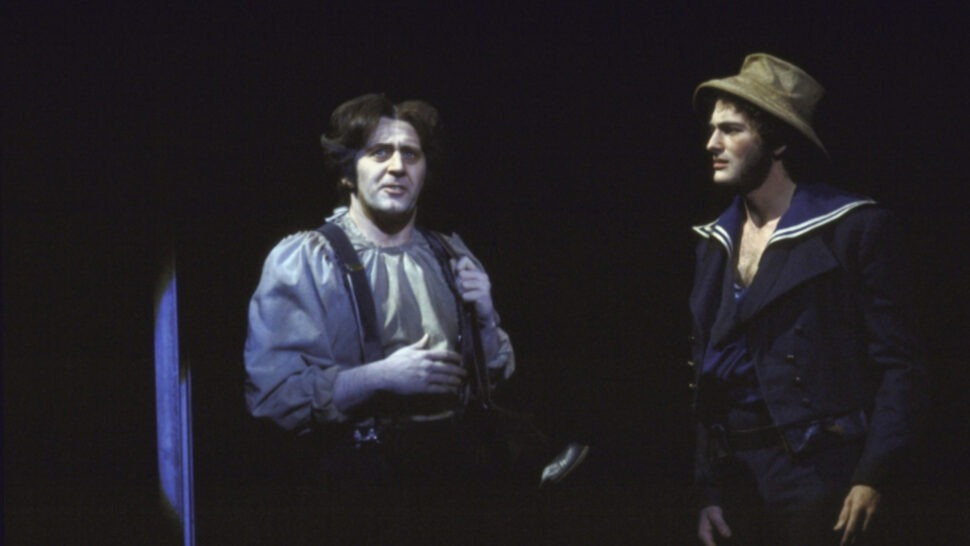
Here are the opening lines of Christopher Bond’s 1973 play, upon which Sondheim and Wheeler’s Sweeney Todd is based. If you know the musical, you will recognize several of these turns of phrase:
ANTHONY: I have sailed the world, beheld its fairest cities, seen the pyramids, the wonders of the east. Yet it is true—there is no place like home.
TODD: None.
ANTHONY: What’s the matter?
TODD: You are young. Life has been kind to you, and fortune smiles on your enterprises. May it always be so. My heart beats quicker, too, to find myself in London once again, but whether out of joy or fear I cannot say.
In the introductory measures of “No Place Like London,” Sondheim quickly establishes a musical language that seems to accommodate both of these visions of the city. The opening orchestral gesture is set in an undeniably open-sounding D♭ major, moving mostly by 3rds and 5ths, and colored by added 7ths and (especially) 9ths. This is Anthony’s sound-world: wide-eyed, warm, aspirant. The bass line descends stepwise, though: first to G♭, and then to F♭, which sits sourly outside the key (highlighted in green). Is that you, Mr. Todd? Descending into darkness already?
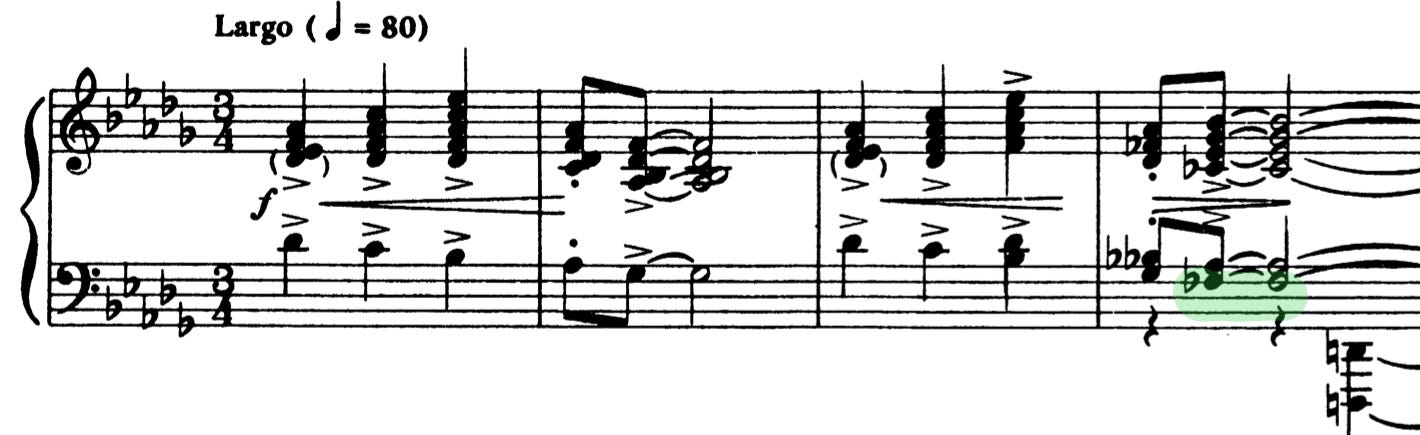
By the time we reach the end of the fourth measure, we are already impossibly far, harmonically speaking, from our D♭-major home—or so it would seem. This harmonic murkiness, of course, is a great analogue for the London fog that Anthony will soon romanticize, but that Todd will associate with moral corruption.
In the measures that follow, church bells chime. This is, in fact, a specific musical quotation. “The Westminster Quarters” is a 16-note melody originating in the late 18th century and designed to mark each quarter-hour (we hear four notes at a quarter past the hour, eight notes at half past, 12 notes at a quarter to, and all 16 notes to mark the full hour). Here, we hear eight notes of this melody, in our home key of D♭ major (look at the upper note of each pair highlighted in yellow below). In the real Palace of Westminster, incidentally, these notes sound in the key of E. But below each of these “melody” notes, we hear different, often dissonant pitches—including, twice, that sour F♭ again (in green):
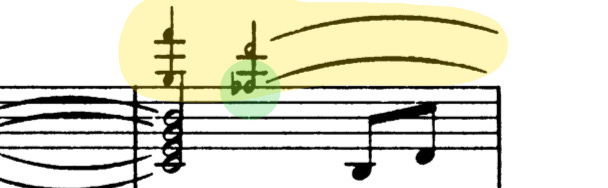

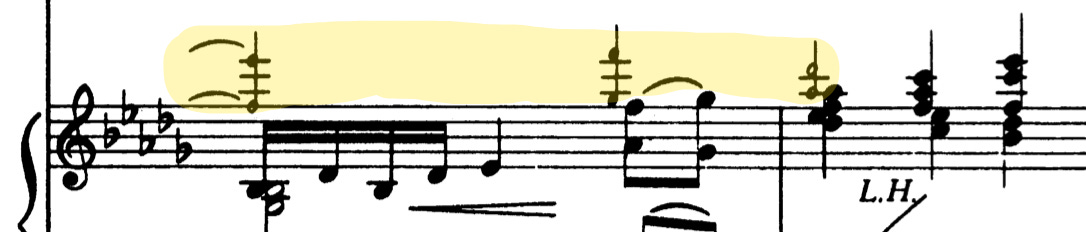
In the upper voice, then, pleasing consonance; in the lower voice, something darker and more jarring. Might these chimes themselves prefigure the characters we’re about to hear from?
Anthony now begins to sing. Though the young man speaks of having “sailed the world,” he mostly inhabits a relatively contained melodic space. There is a certain irony here: waxing lyrical about the various places he’s traveled, Anthony is in fact musically somewhat anchored. For the most part, he circles around a handful of comfortable pitches in the middle of his range. Look at these measures, for instance:

This musical restraint makes his ecstatic outburst on “There’s no place like London!” all the more striking. His melody soars to new heights, breaking free of Sondheim’s established boundaries—and we thereby understand London as a thrilling new frontier. When Anthony follows this with “I feel home again,” the melody settles back into its original tessitura, as if physically enacting a return to familiar territory. It’s a masterful bit of text-painting from Sondheim: Anthony may have sailed the world, but London represents something special, something that literally makes him reach higher than before. Anthony, of course, will soon stand beneath a window in Kearney’s Lane, reaching higher still.
When Todd enters, he seems to try on Anthony’s optimism like an ill-fitting mask. Anthony’s refrain had sparkled with genuine wonder; in Todd’s hands, it becomes something bitter, almost mocking:
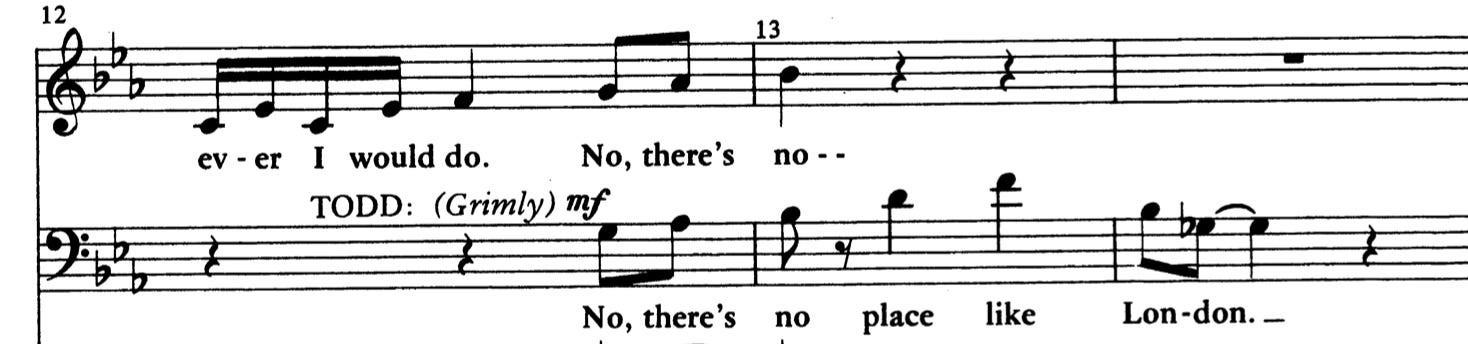
This is surely a coincidence, but isn’t it fitting that Todd takes over from Anthony at measure 13…?
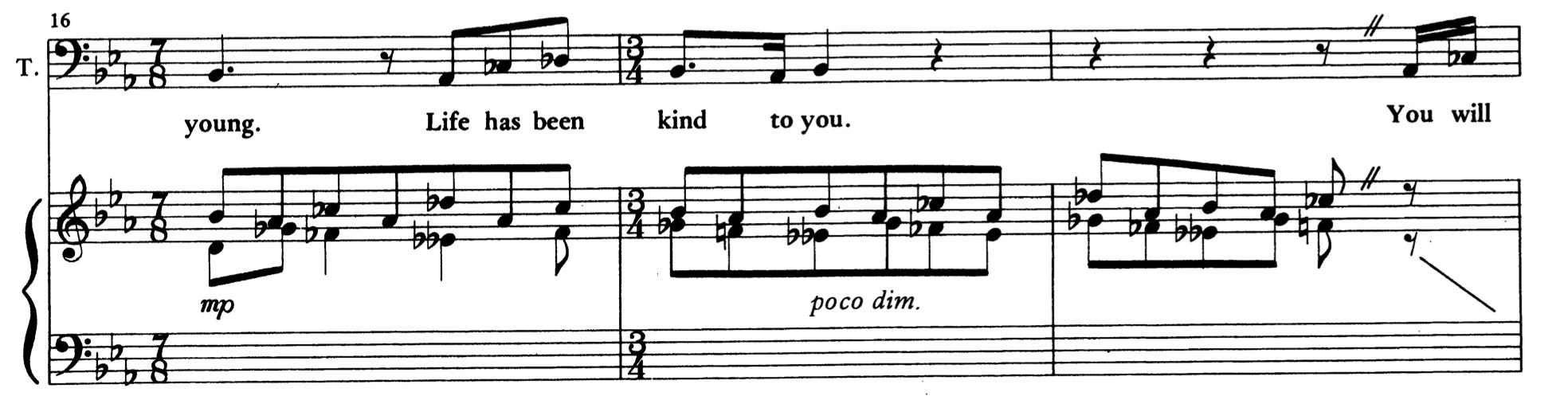
When Todd later describes London as “a great black pit,” his vocal line abandons all pretense of Anthony’s buoyant melody, becoming increasingly confined, rarely moving more than a step in either direction. But that melodic confinement begins early, at “You are young. Life has been kind to you. You will learn…” It’s as if the very city itself is closing in around our title character. London, whose systemic corruption curtailed Todd’s freedom, now constrains him melodically too.
When Todd later speaks of “the vermin of the world,” the melody becomes almost monotonous, hammering away at single pitches with the grim persistence of someone who has had years in exile to nurse his grievances. London, viewed through the lens of bitter experience, becomes a place of musical claustrophobia—suffocation, even.
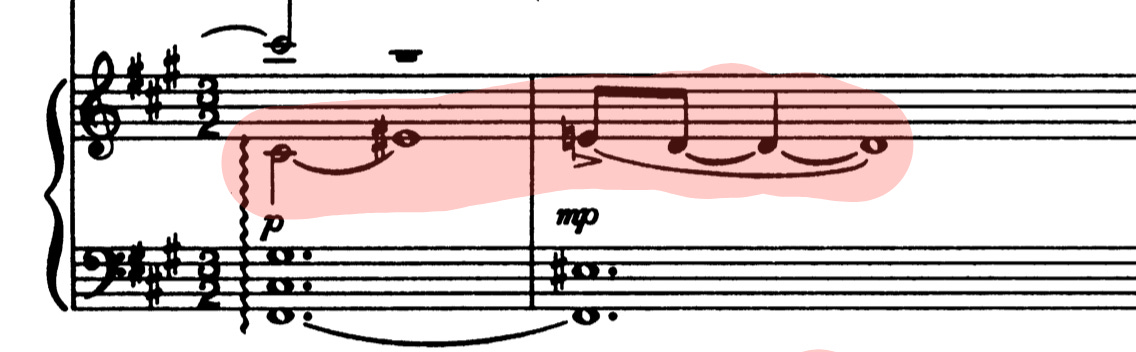
Consider the accompanimental figure below. This is what we hear beneath Todd’s various “There’s a hole in the world…” lines. What do you see? A rising, hopeful major third—then a falling step. An E♯, which in F# minor desperately wants to resolve upward to its home note of F#—but is instead pulled down to that accented E♮. “It’s the hope that kills you,” say fans of underdog sports teams the world over. Here, in microcosmic form, we see how easily hope (in the first measure) can be crushed (in the second). In this two-measure figure, perhaps we are also seeing Anthony (whose surname, lest we forget, is Hope), followed by the despondent Todd.
If Anthony and Todd represent opposing visions of London, what are we to make of the Beggar Woman who interrupts their discourse? Her entrance brings a third musical perspective that seems to exist somewhere between their two Londons—or perhaps beneath them both. Her “Alms! Alms!” rings out in a new metrical world (12/8), her melody weaving unpredictably between notes as if searching for surer footing. She is neither trapped in Todd’s obsessive patterns nor lifted by Anthony’s soaring optimism. Instead, she seems to float, untethered, through London’s darker spaces.
But perhaps the Beggar Woman doesn’t so much complicate our tale of two cities as reveal the secret passages between them. Hers is a London of perpetual displacement, of melodies and harmonies that can find no home and so must wander.
As Todd begins to sing of “a barber and his wife,” Sondheim’s music takes on a dreamlike quality, as if caught between past and present. The accompaniment becomes more fluid, and Todd’s confined melodic world begins to open up into something more lyrical, more vulnerable. Sondheim’s writing here is harmonically seductive, twisting and turning as it pushes ever forward. We are never quite allowed to settle into a regular pulse: not only is this section marked molto rubato, but the time signature changes with (literally) every new measure.
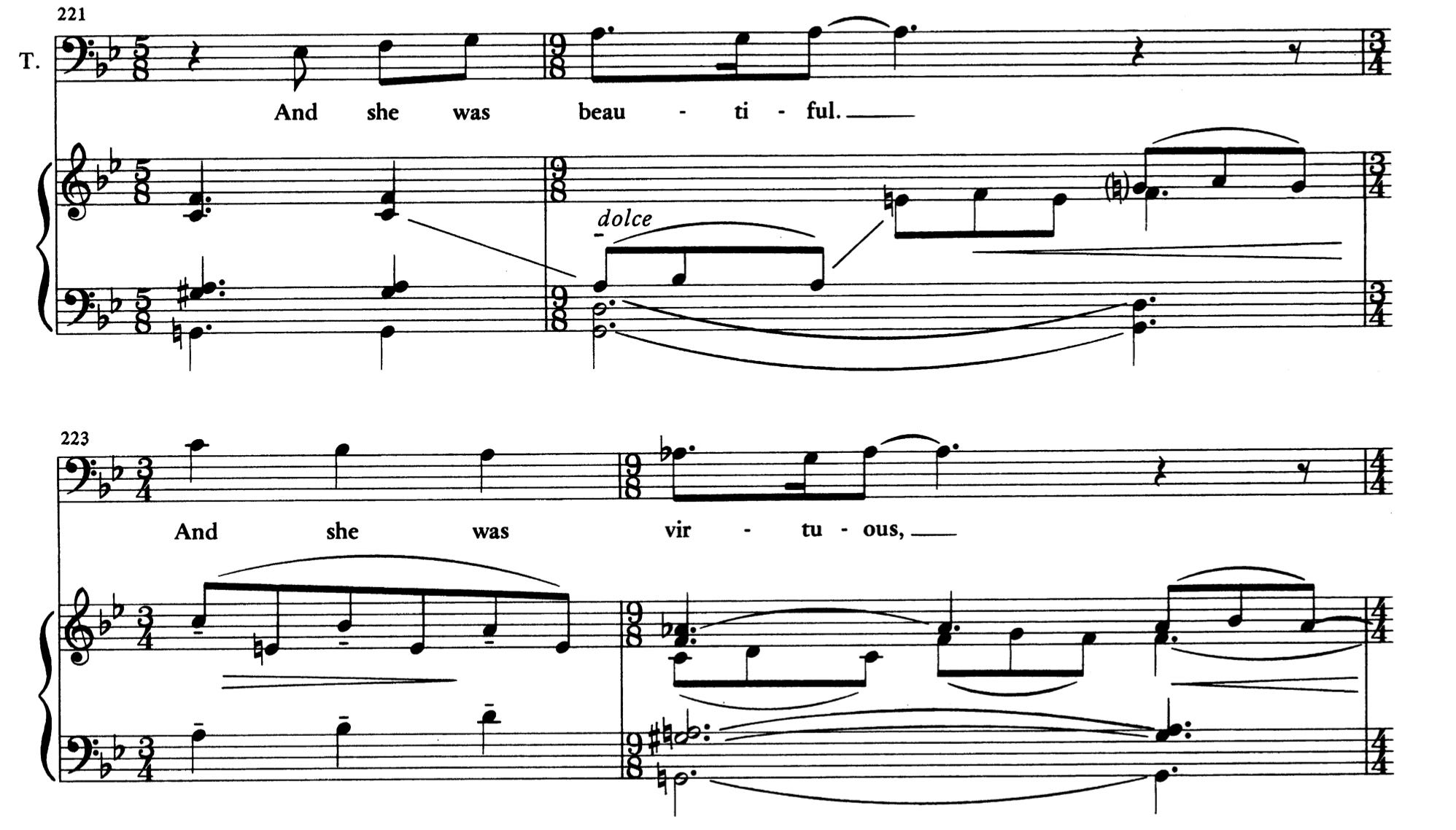
Crucially, Sondheim keeps oscillating between simple time (like 4/4 and 3/4), in which each beat naturally divides into two parts, and compound time (like 9/8 and 6/8), in which each beat divides into three. “And she was virtuous” is a perfect example of that. Count within each beat in measures 223 and 224, following the right hand of the piano, and you’ll see it’s divided 1,2 1,2 1,2 | 1,2,3 1,2,3 1,2,3:
In Bond’s play, the equivalent passage begins like this:
ANTHONY: What was your crime?
TODD: My wife was beautiful.
ANTHONY: Why, if that be a crime…
TODD: A heinous one in this same town you call home. For here there are men who cannot look on beauty, and not defile it: who scratch and tear at virtue’s shining face with fumbling hands till they have made it ugly as their own.
As Todd begins to tell his tale, we might think too of a character from the real A Tale of Two Cities whose sense of time fractures under the weight of memory. Dr. Alexandre Manette was imprisoned in the Bastille for 18 years before the story begins—and when he is finally released, he struggles to maintain his grip on the present. Manette frequently relapses into behaviors from his prison days, particularly making shoes (a skill he learned to maintain his sanity while imprisoned). His sense of time becomes distorted: sometimes he’s fully present in London with his daughter Lucie; other times he mentally returns to his prison cell in Paris.
Sweeney Todd, transported to a penal colony in Australia for life on false charges orchestrated by Judge Turpin, would no doubt sympathize. For Todd, as for Manette, London is a place where past trauma and present reality intersect.
By the end of “No Place Like London,” we understand that Sondheim, like Dickens before him, has shown us not just two cities, but two Londons that exist in the same space: one London of infinite possibility, the other of infinite corruption. Anthony and Todd walk the same streets, breathe the same fog-laden air, hear the same Westminster chimes. But where one hears opportunity ringing out, the other hears only the tolling of revenge.
And yet, as we’ve seen, these two musical Londons are inextricably linked. Even that simple accompaniment figure we examined earlier—a rising third followed by a falling step—seems to contain both cities at once: hope and its destruction, aspiration and its defeat, Anthony Hope and Sweeney Todd.
In Sondheim’s hands, as in Dickens’s, London becomes a place where the best of times and the worst of times coexist, where beauty and barbarism share the same streets, and where the past forever haunts the present.