
Kiss Me
Passion, panic, and parallel plots in Sweeney Todd
First comes the nervous energy of two lovers plotting escape. Then a measured pavane of predatory calculation. Finally, a whirlwind of desire, desperation, and counterpoint. Welcome to Sweeney Todd’s “Kiss Me” sequence.
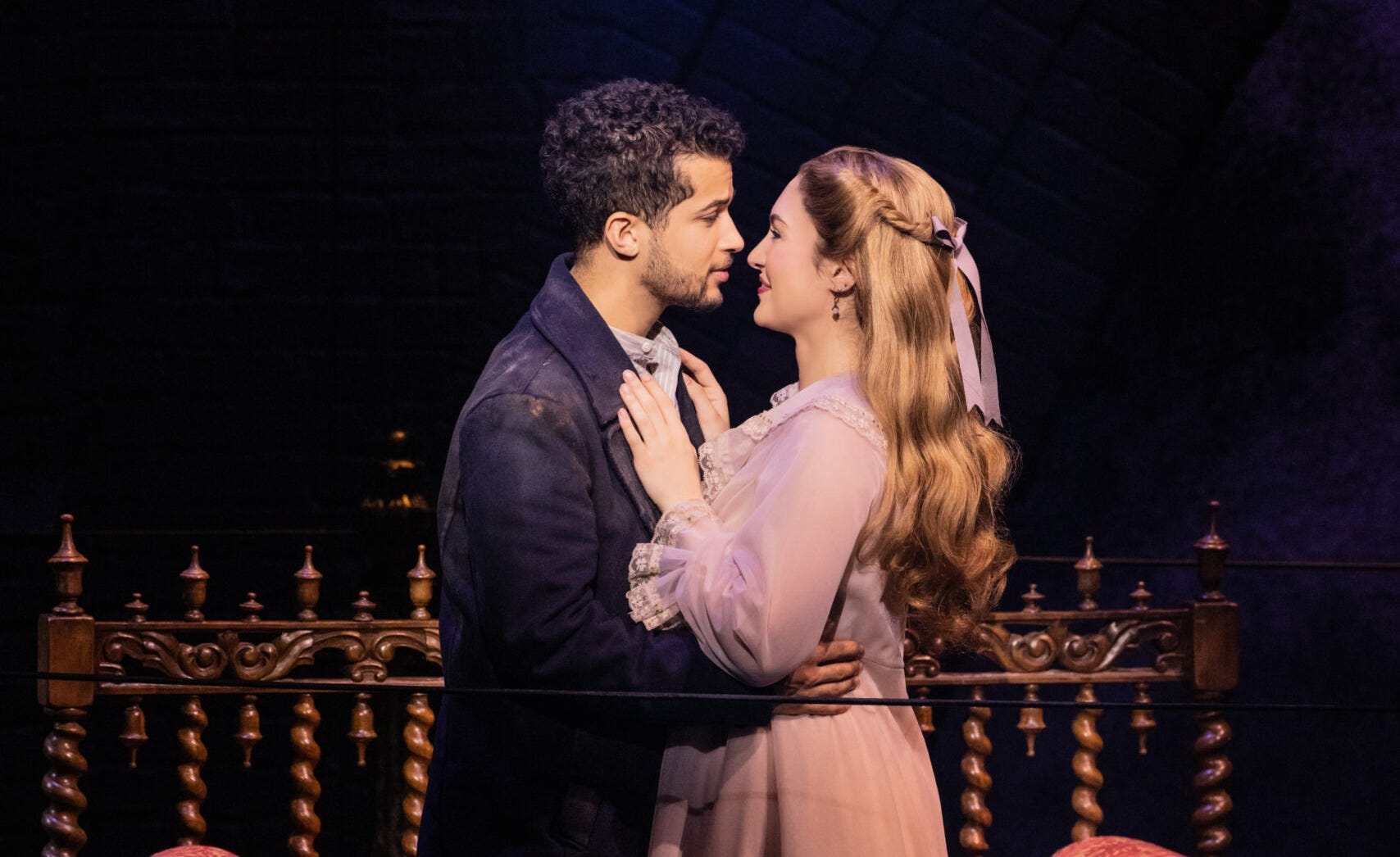
Judge Turpin’s ward Johanna and the young sailor Anthony have fallen hopelessly in love. But their romance faces a grotesque obstacle: Turpin himself means to marry Johanna. Anthony, therefore, must somehow spirit Johanna away before the Judge can claim her.
In Christopher Bond’s 1973 play, this exchange begins with stark simplicity. Anthony sets both the stakes and the tone: “Forgive my boldness. Believe me when I say I’d rather suffer hell and all its torments than harm your honour.” Johanna’s words in this scene are equally direct: “Oh, sir, my honour was in pawn to you the moment that I saw you. I am yours to deal with as you will. For though it ill becomes a maid to speak thus, I did love you even as I did look upon you.”
As Anthony sneaks into Johanna’s room to plan their escape, Turpin seeks advice from his obsequious companion, the Beadle, on how to make himself more appealing to his unwilling bride. In Sondheim’s hands, these parallel urgencies become an intricate and exhilarating study of love, power, and time running out.
“Kiss Me (Part I)” pulses with barely contained panic. Sondheim’s restless accompanimental figure, a pattern of sixteenth notes that seems to trip over itself, introduces the harmonic tension that will be central to this sequence. Articulated throughout this figure are the third and seventh degrees of the scale—G♯ and D♯, since we’re in E major. You can see these below in the upper voice, highlighted in yellow. These are the very notes used melodically for every single instance of the actual words “kiss me” in this number—a descending fifth, from D♯ to G♯ (see below).
Beneath this bright, open-sounding harmony, though, we hear something tighter and more dissonant. This particular melody (highlighted in red below) is like a snake threading venom through its fangs, coiled around the second scale degree and the minor third. Its bites—those three accented F double-sharps—pierce the harmonic surface, like fangs through skin:
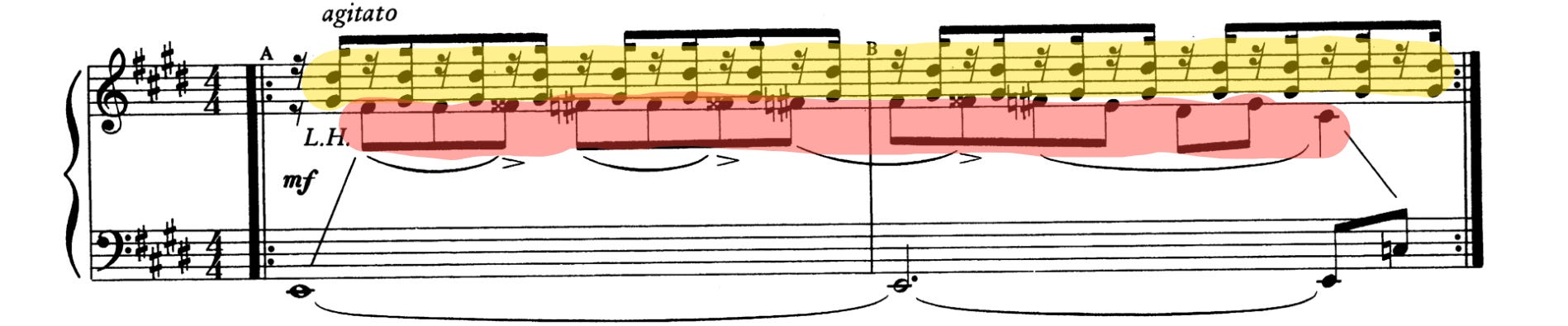

In these opening measures, then, Sondheim establishes the harmonic character of the sequence as a whole. But, brilliantly, he seems to show us its actual characters, too. Above are our two young lovers (the “kiss me” notes), agitated and trapped in a single place; below, perhaps, are the men who would poison their plans to elope. Look again at those measures. Is that not precisely what we see?