
It's Hot Up Here, There and Everywhere
Musical theatre heat, from Sunday to In the Heights
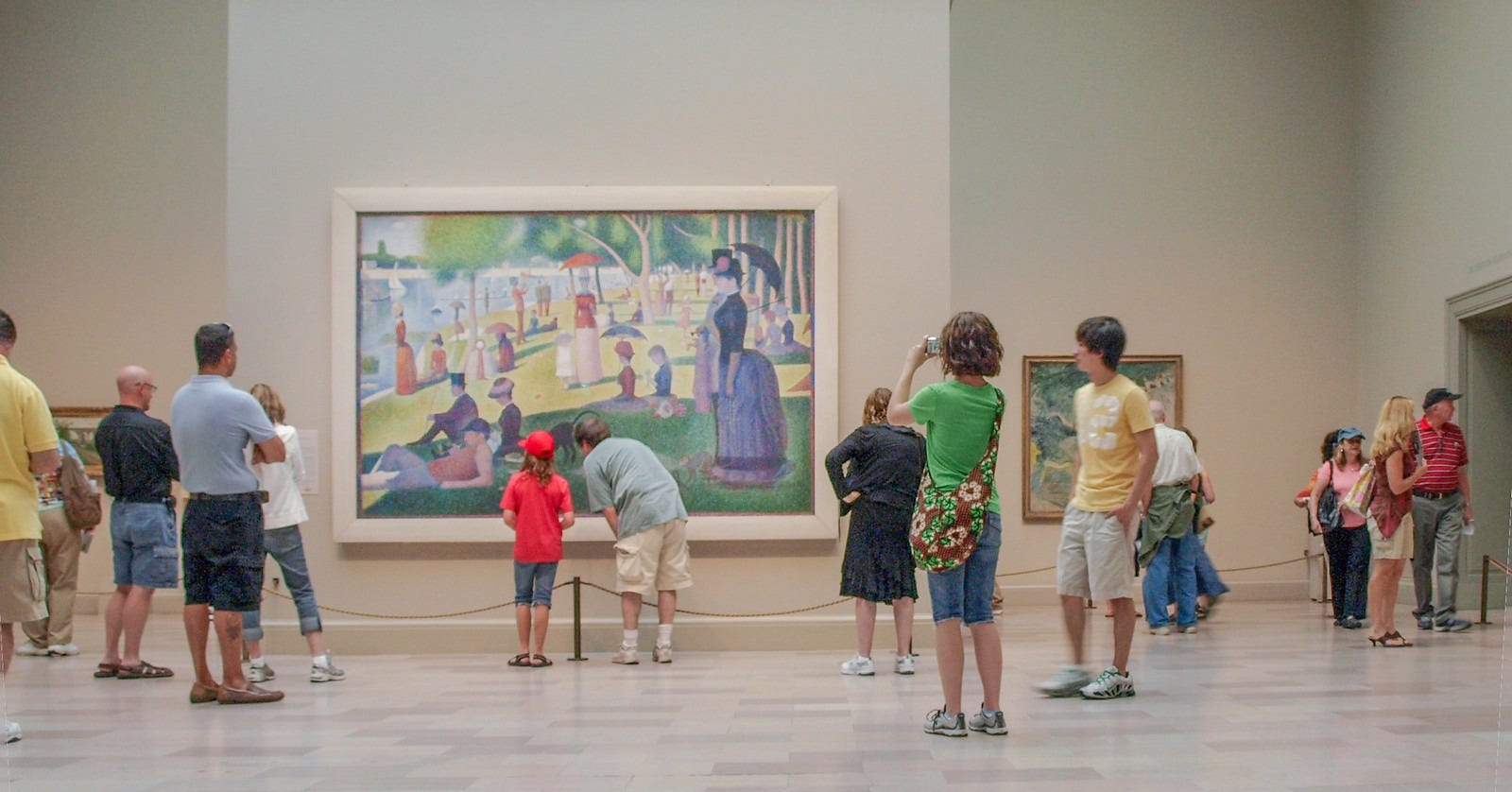
Sunday in the Park with George, Act 2. Curtain up.
A hundred years have passed during the intermission. Seurat’s painting is complete, his subjects forever fixed in place. They appear just as they did 15 minutes (or a century) ago, arranged in their famous tableau. And they are not happy.
“It’s hot up here,” they tell us, before cataloguing their various grievances. Franz dislikes his profile. Louise wants her glasses. Celeste #2 is aggrieved that the soldiers have forgotten her; the soldier is more concerned by the weight of his helmet. While they sweat, we can marvel at Sondheim serving up two perfect rhymes for “It’s hot and it’s monotonous” in “The soldiers have forgotten us” and “These helmets weigh a lot on us.”
But when their separate complaints converge, Seurat’s subjects describe the true source of their torment: “No change up here / Forever.” Heat might be unpleasant, but heat without the possibility of relief is hell.
“It’s Hot Up Here” belongs to a long and surprisingly rich tradition. It is hot, too, in New York tenements and backstage alleys, in drought-stricken towns and congressional chambers, in Saigon bars and the streets of Washington Heights. And rarely, if ever, is musical-theatre heat merely heat. More often, it passes into the bloodstream of the drama.
In Kurt Weill, Langston Hughes and Elmer Rice’s Street Scene, the sweltering summer evening helps to create the titular scene itself. Heat pushes the residents of a Manhattan tenement into a shared dramatic space, a pressure cooker in which all encounter the tragedy to come. “I just take off my corset and let myself spread,” announces Mrs Fiorentino, the heat already serving to dissolve the boundary between private discomfort and something more public.
The opening of 110 in the Shade performs a similar piece of atmospheric scene-setting on a broader canvas. Three Point, a small town in the American Southwest, is caught in a drought. “Underneath, the earth is burning”; the crops are bad and the land is dry. Overhead there is “not a cloud across the sky,” nor even “a sign on the horizon.” In the opening number, “Gonna Be Another Hot Day,” the townspeople imagine “what a revelation” rain will be:
And the whole darn town
Will pour into the street
To feel it streaming down.
That opening number gives the whole show its condition of want: land waiting for water, Lizzie Curry waiting to feel beautiful and loved. Drought and longing are established as versions of each other, and a travelling con man will claim that he can summon rain. In 110 in the Shade, it’s the heat that makes the hope necessary.
Then there is the sweltering congressional chamber of 1776. The musical opens with John Adams demanding a vote for independence and the other delegates demanding that he sit down. “Someone oughta open up a window,” they cry: it is ninety degrees and “hot as hell in Philadelphia.” But the windows cannot be opened because there are too many flies. This is funny, but it also establishes the show’s central dramatic problem with remarkable economy. Everything is stuck: the air, the Congress, the independence resolution.
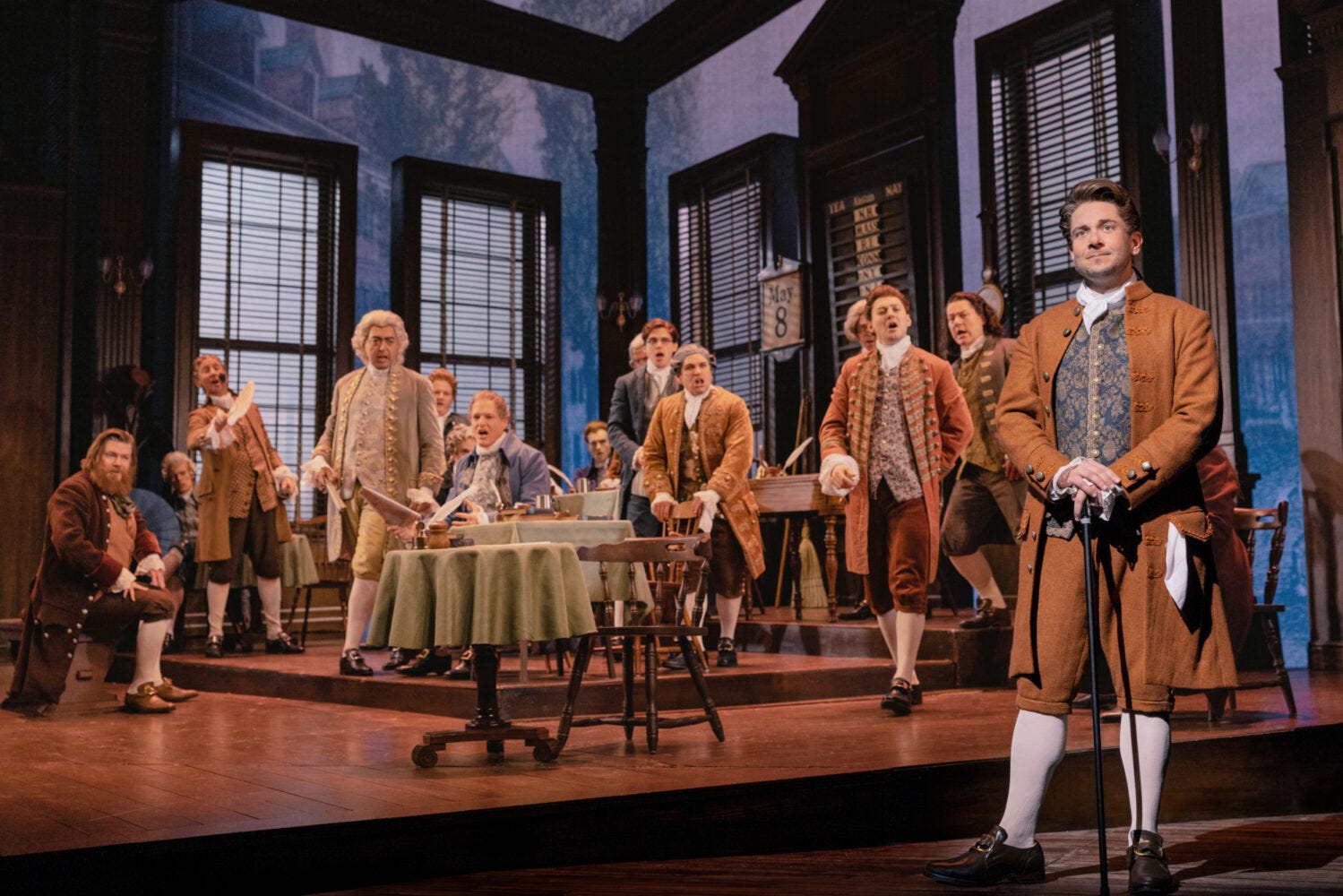
Jason Robert Brown’s Parade provides a less literal variation. In “How Can I Call This Home?”, Leo Frank goes to bed hoping that Atlanta will disappear like a dream. “But then,” he sings, “the sun rises in Atlanta again.” Brooklyn would mean freedom from “magnolia trees / And endless sunshine.” Whatever else the song reveals about Leo’s contempt and defensiveness, the brightness of Georgia is, in his eyes, a kind of punishment: the Southern sun sharpens his sense that he is living in a foreign land.
Heat does not only irritate, of course. Musical-theatre temperature has always carried a sexual charge.
In the 1933 revue As Thousands Cheer, Moss Hart and Irving Berlin built their scenes around the contents of a newspaper: political stories, society columns, comic strips and, in “Heat Wave,” the weather report. Ethel Waters introduced a song in which a heat wave blows into town from Martinique in the form of a woman whose dancing sends the temperature soaring. “Her anatomy / Made the mercury / Jump to ninety-three.” Its “tropical” fantasy belongs recognizably to its period, but the conceit has proved durable.
Cole Porter makes the relationship explicit in “Too Darn Hot.” As Act 2 of Kiss Me, Kate begins, the cast and crew of the show-within-the-show are spending their own interval in the alley behind the theatre. It is, we hear, too hot for romantic activity: Porter even calls upon the recently published Kinsey Report as corroborating evidence. Yet the greater the company’s insistence that the heat has made physical exertion impossible, the more physically spectacular the number becomes.
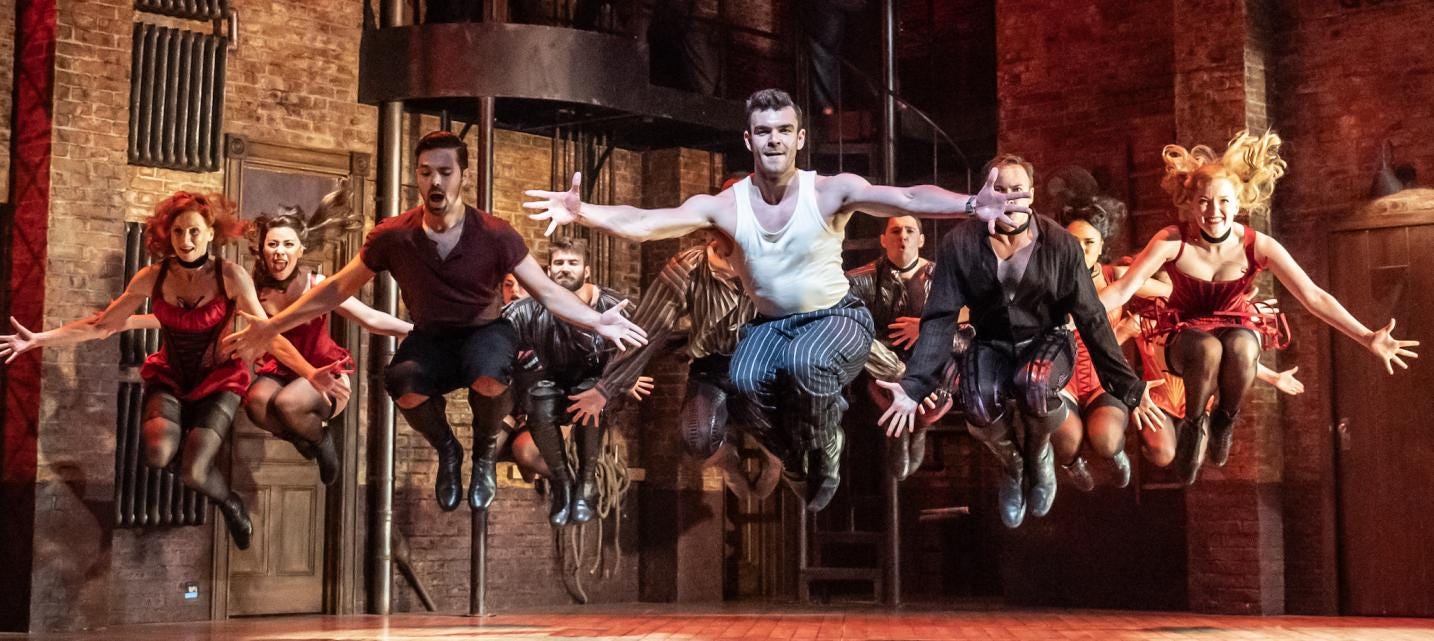
The lyric itself is anything but languid. Porter keeps pointing to new forms of frustrated activity: “call on my baby,” “give my all to my baby,” “play ball with my baby.” Paul would like to “coo” and “pitch the woo,” before conceding: “But brother, you pitch my baby tonight.” A song about the body’s refusal to perform becomes itself a feat of performance.
The contrast with Sunday is irresistible. Both songs begin Act 2. “It’s too darn hot up here,” they collectively say. Both songs are sung by figures who have been serving someone else’s artistic construction: the company performing The Taming of the Shrew; the parkgoers arranged forever inside George’s painting. Both allow those figures to complain about the physical cost of the spectacle. But where “Too Darn Hot” releases its bodies into dance, “It’s Hot Up Here” centers on bodies that are forever unable to move.
Sondheim had explored the meanings contained within the word “hot” decades earlier. In West Side Story’s “Tonight (Quintet),” Anita looks forward to Bernardo’s arrival:
He’ll walk in hot and tired,
So what?
Don’t matter if he’s tired,
As long as he’s hot.
Three decades later, “The Heat Is On in Saigon” makes that metaphor considerably darker. In Miss Saigon’s opening sequence, American soldiers enter the Dreamland club during the last days before the city’s fall. The heat is sexual, commercial and political, all at once: “If I’m your pin-up, I’ll melt all your brass,” says Gigi. Women are being sold, and danger presses in. “But still at midnight the party goes on. / A good-bye party in hell.” The heat is certainly on, and time is running out.
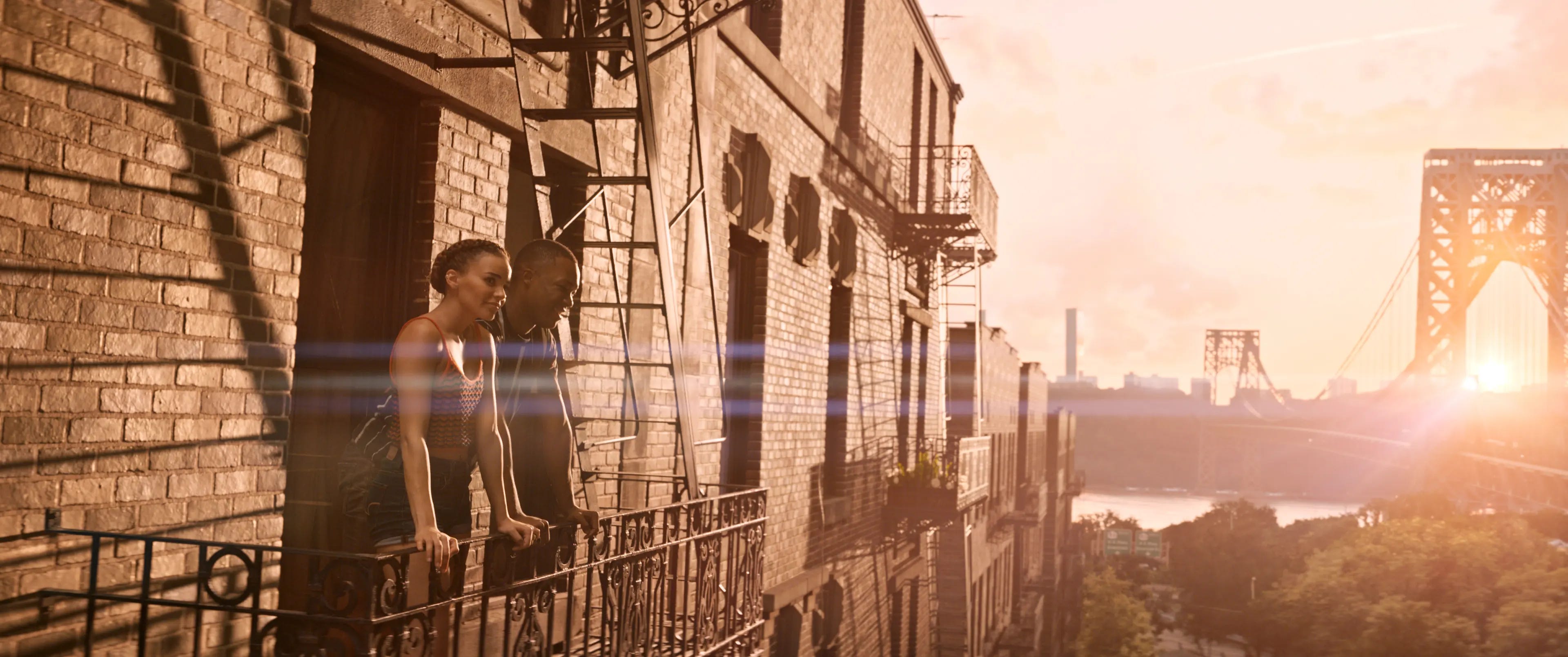
Perhaps the most heat-soaked musical of all, though, is In the Heights. Take “Piragua,” a vendor’s cry offering scraped ice and syrup to a neighbourhood in need of relief:
It’s hotter than the islands are today
And Mr. Softee’s trying to shut me down,
But I keep scraping by ‘til I can say:
“Hey, ‘pana! I run this town!”
The Piragua Guy’s livelihood rises with the temperature, even as he competes with his mechanically refrigerated arch-nemesis Mister Softee. When the power fails, the balance shifts. The same blackout that leaves the neighbourhood sweltering gives the man with a block of ice his commercial triumph.
But the Heights heat is not confined to that refrain. It hangs over the whole show: over its streets and stoops, its crowded rooms, its tempers and romances. During the blackout, the neighborhood becomes simultaneously more fragmented and more communal. People lose one another in the darkness; fireworks help them find their way.
In “Sunrise,” the morning after the blackout, Nina teaches Benny Spanish:
Calor.
Heat.
Anoche.
Last night.
Dolor.
Pain.
Soon they arrive at ámame: love me. Their courtship draws together heat, pain, and love into something real, earned, and precious — as indeed does In the Heights itself.
Back to Seurat’s subjects, on their eternal Sunday afternoon.
Dot, as ever, occupies a space slightly apart. While the others squabble, she addresses the absent George:
They’ll argue till they fade
And whisper things and grunt.
But thank you for the shade,
And putting me in front.
“Thank you for the shade” reaches back to Dot’s first lines in the show, when she asks why George always gets to sit in the shade while she must stand in the sun. At the time, he appears not to hear her. The finished painting suggests that he did.
It is a characteristically ambiguous act of love. George notices Dot closely enough to preserve what she wanted, but only inside the work for which he neglected her. He cannot put her first. But he can put her in front forever.
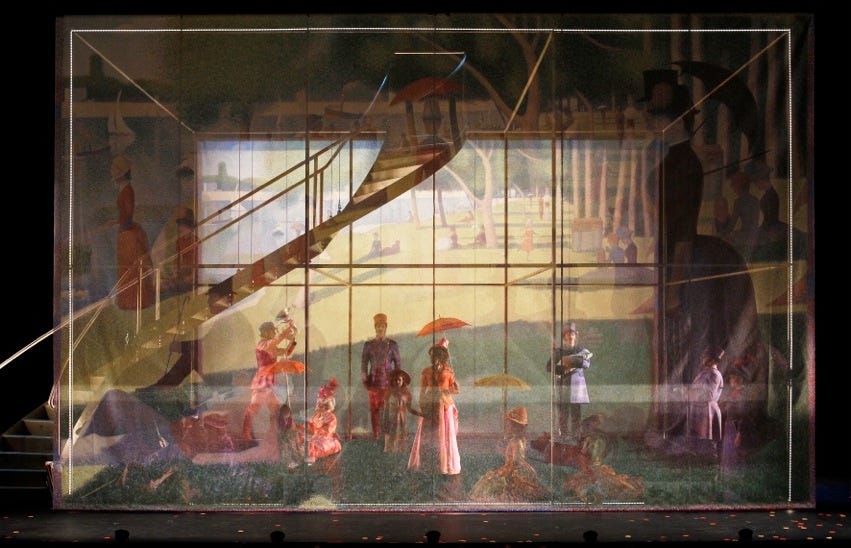
Musical-theatre heat usually contains the possibility, however remote it might seem, of change. Evening will come. Rain may fall. A window might finally open. The lights will return. Desire will either be consummated or cooled. There can be no such relief in the painted purgatory of La Grande Jatte. Seurat’s figures are simultaneously alive in their discomfort and dead in their inability to escape it. They have been blessed with immortality and doomed to a two-dimensional hell.
We should, at least, let them have the last word:
The outward show
Of bliss up here
Is disappear-
Ing dot by dotAnd it’s hot!
The Sondheim Hub is a reader-supported publication
If you find our work valuable, consider becoming a paying subscriber.
You’ll receive an exclusive essay each week, access to our full archive of 300+ essays, interviews & features, more from each interview, and a weekly Sondheim crossword. Paid subscriptions make our work possible. 📚