
Governor Bill Clinton, accepting his party’s nomination for president at the 1992 Democratic National Convention in New York City, ended his address with these words:
I still believe in a place called Hope.
Board a ship across the pond and back in time, and you might well meet a young man named Hope. As you sail together toward London, leaving all thoughts of Arkansas behind, ponder this: how much do you know of your companion?
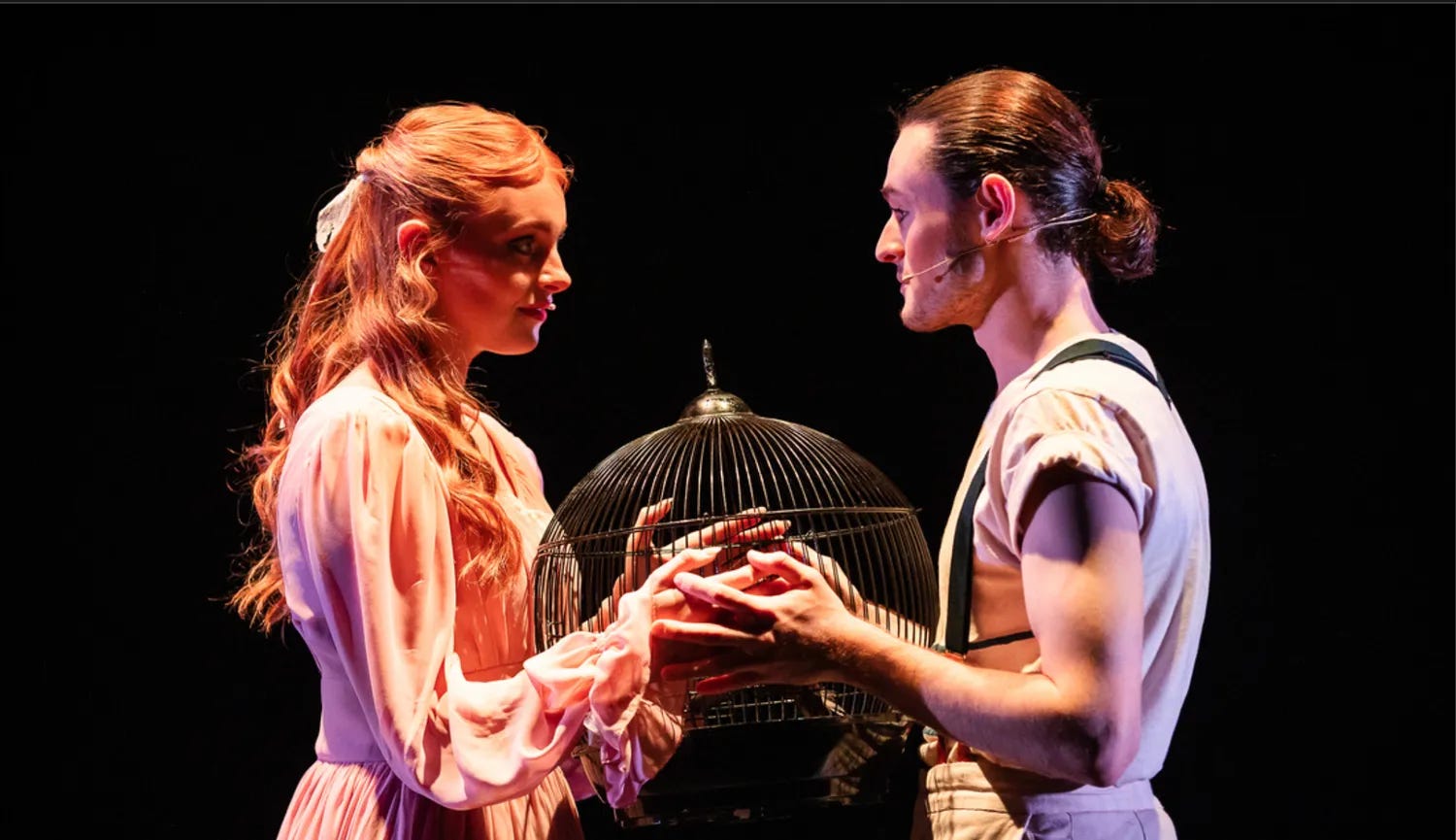
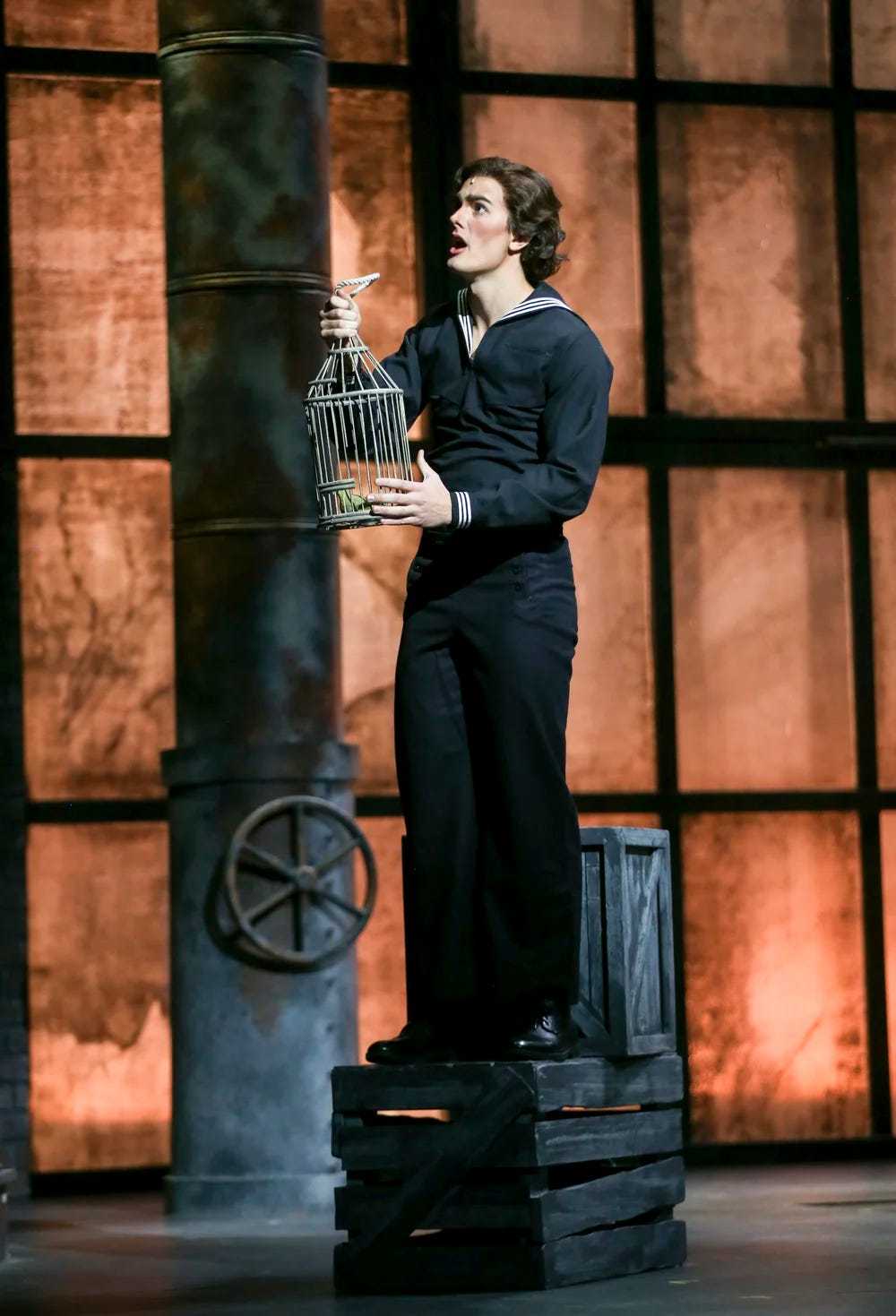
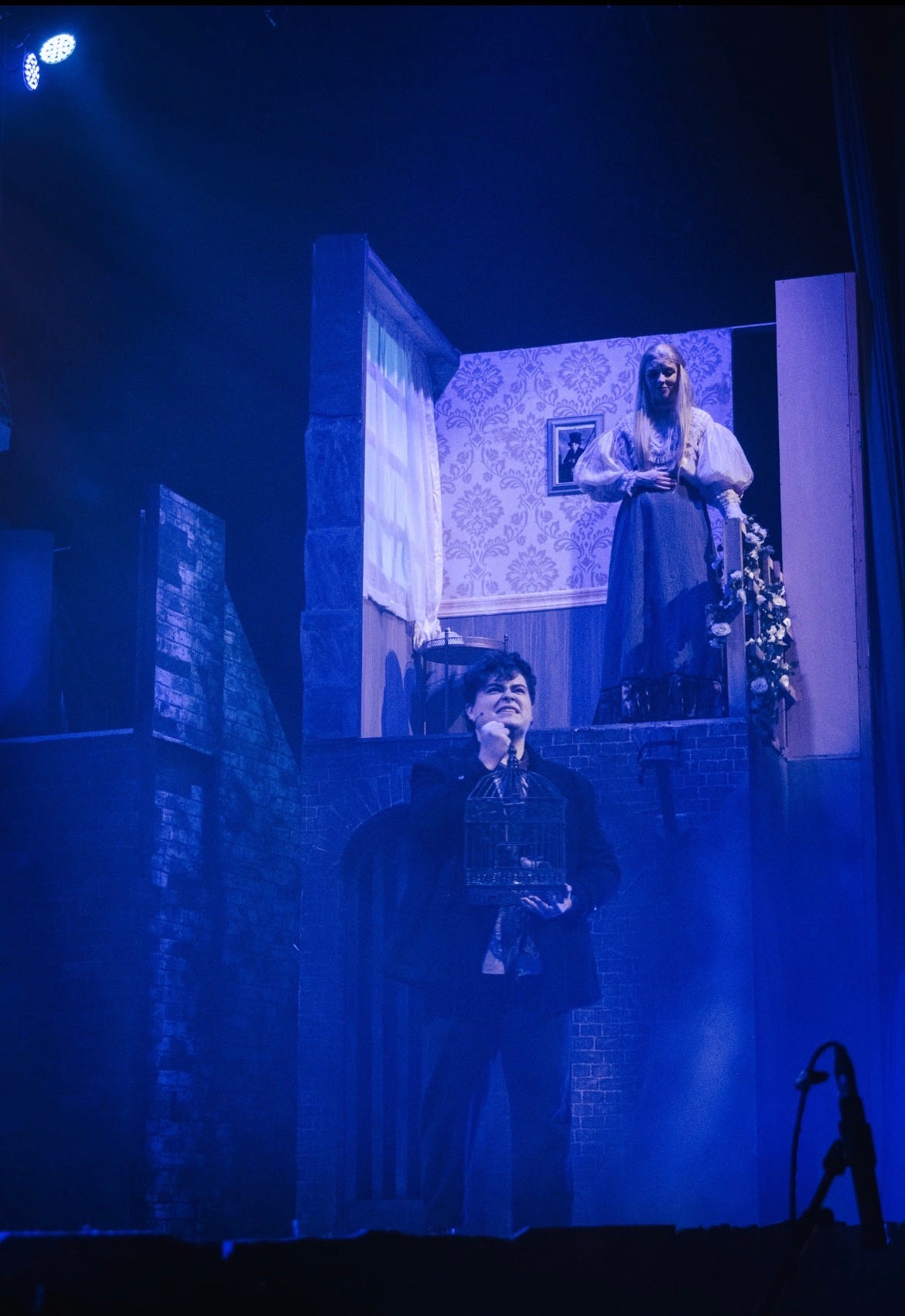
The Anthony Hope we come to know in Sweeney Todd seems simple enough: the sailor, the lover, the nice young man, the ardent tenor standing beneath Johanna’s window. (We explored that trope last year, in this essay.) In the oppressive darkness of a blood-soaked London, Anthony seems to bring light. Having rescued Sweeney from the sea, he falls in love with Johanna, and tries to rescue her too.
But in performance, this seeming innocence can become something more layered: hope, yes, but also urgency, obsession, entitlement, fear, moral clarity, naivety, resilience, and loss. Today, in conversation with seven performers who’ve played Anthony on stage, let’s look a little more closely at the young man named Hope.
Thank you for reading! If you find our work valuable, consider upgrading to a paid subscription for the full Sondheim Hub experience. ✍️
First impressions and assumptions
For several of the performers we spoke to, Anthony first appeared as exactly the type he is often assumed to be.
Patrick Mullen, who played the role at the University of North Carolina at Greensboro, remembers his first impression as “surface level”: Anthony was “simply this lover boy. That was his trope, and he stayed within it.” Mullen knew he fitted that type, but was interested in what might be found beyond it: “I wanted to see what I could do with something that was not already given to me in character terms.”
Quinn Welder, of Vanderbilt University’s Blair School of Music, says, “I knew Anthony as the man who sings ‘Johanna’, if I’m being honest. I didn’t know much about him beyond that.” For Welder, that very absence became part of the fascination: “I find it interesting that he is often left out of deep thought,” he says.
Others found the role unexpected because they did not see themselves in the archetype. Cathal Walsh, who played Anthony in an amateur production in Tipperary, Ireland, had assumed he would never play him. With a lower voice and a performance history that leaned more toward “Seymour-type characters, the nerdy character, or the sidekick,” he did not feel Anthony was in his wheelhouse. “I struggled for a long time to find a characterization and to assume that heroic type,” he says. The way in was not to impersonate a romantic hero, but to locate the part of himself that could understand hopefulness.
Aidan Dillen also began with the broad category of romantic lead. “He seemed broadly like a romantic hero to me,” he says. “I thought he was a Romeo type.” But that first impression quickly became frustrating. “I saw him as a very base-level character. I was a little frustrated with him at first because I didn’t feel there was much depth to him.” The work, then, became a kind of excavation: watching productions, skipping to “Ah, Miss” and “Johanna,” making notes, and looking for the edges beneath the apparent simplicity.
Declan Feldhusen, who played Anthony at the Elder Conservatorium of Music in Adelaide, entered the process without much prior attachment to Anthony, despite being, as he puts it, “very nerdy when it comes to musical theatre.” The callback room gave him his first warning. After singing “Johanna,” he was told: “You sound great, but you look far too nice. You’re far too happy to be there. There is no edge to it.”
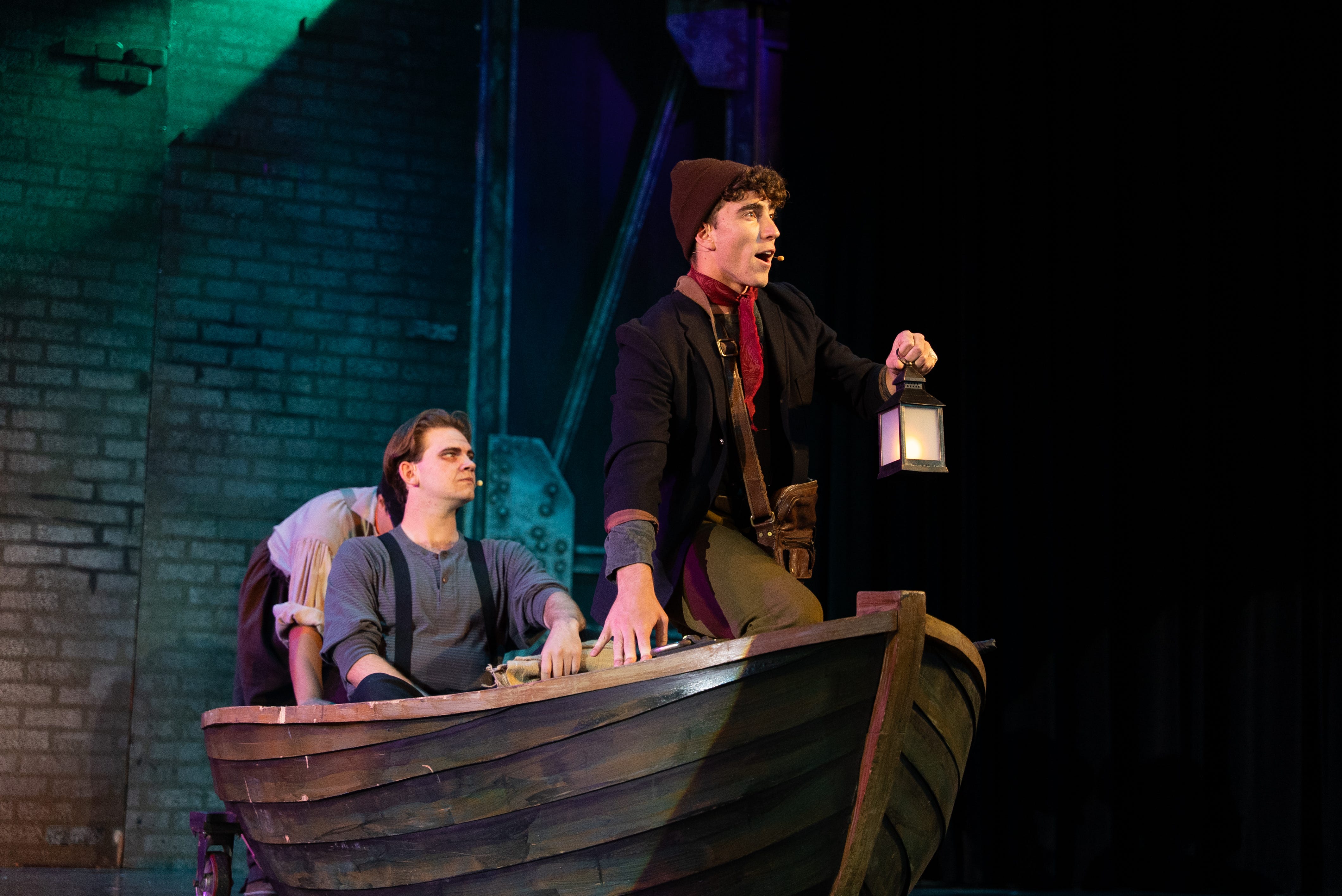
And for Lucius Wagner, who played Anthony at St. Augustine High School in San Diego, the role began as a simple idea and then deepened through rehearsal. He knew nothing about Sweeney Todd at first. Then, listening to Anthony’s music, he thought: “Wait, this is good music. This is really good music.” As he researched the show, one thing above all became clear: Anthony is “almost the only character who doesn’t do some kind of evil.” Even Johanna shoots Fogg. Anthony, by contrast, seemed to offer the audience “one hope — appropriately, given his name.”
Anthony Hope
The name is obvious. That does not mean it is easy to play.
Again and again, our Anthonys spoke about this character as a figure of light in a dark show. Wagner was told by his director “never not to be smiling” unless the moment demanded particular seriousness. His foundation for the role was “the really optimistic kid who has gone to a new school and is eager to make friends with everyone.” Anthony assumes Sweeney is his friend because, to Anthony, friendship is still a reasonable thing to assume.
Mullen also returned to the name. “Anthony Hope is such an inspiring name,” he says. In his version, hope took on a more resistant quality too. As a performer of color, he found himself thinking about what it means to move through a world that may not be built for you. “Empathy was what led me to the character,” he says. “Anthony chooses to be kind and to love rather than allowing the world, and all the evil of London, to get to him.”
Walsh admired Jay Armstrong Johnson’s Anthony in the Emma Thompson/Bryn Terfel production because the purity seemed to “radiate from him on a personal level,” rather than appearing as a performed idea of innocence. That was what Walsh wanted to find. “He is Anthony Hope; they did not hide what the character represents.” But the work was to make that hopefulness a living quality.
Nick Gundrum, who played Anthony at the University of Cincinnati College-Conservatory of Music, saw that hope as something gradually broken. His director, Vincent DeGeorge, had previously coached darker readings of Anthony — as a man whose desire to “steal Johanna” might not be wholly unlike the Judge’s desire to possess her. In this production, though, Gundrum found him “the sliver of hope in London”: genuine, youthful, naive. What interested him was the process by which that hope is knocked down.
He identified three blows. First, Anthony sees Sweeney shaving the Judge and realizes the Judge is still in the way. Then, at the asylum, he discovers that the system itself makes no moral sense: Johanna is not “mad,” and yet she has been locked away. Finally, when Sweeney gives him the gun, Anthony believes he can act — and cannot. “I really fucked up,” Gundrum imagined him thinking. “This isn’t fair. This isn’t what I grew up with. This wasn’t as easy as sailing. The world kind of sucks.”
Several performers were alert to the danger of making that hope too clean. Dillen made a deliberate decision that his Anthony was in the Navy rather than simply a merchant sailor. He was “not just this naive little boy.” That choice gave the character more steel, and it led Dillen to one of his central discoveries: “my Anthony was someone who hadn’t been told no a lot.” Not necessarily because he wanted everything, but because he was unused to failing to get the things he did want.
Hope, then, is not the same as harmlessness. Anthony’s optimism can be beautiful, but it can also be forceful. He believes in possibility. He also believes, very quickly, that possibility should bend toward him.
Love, rescue, and control
The central question with Anthony might be what kind of love the show permits him to have for Johanna.
Welder calls it “definitely a love-at-first-sight trope,” but immediately complicates the point. Anthony sees Johanna, buys the bird, gets her attention, and then, after witnessing the Judge’s treatment of her, begins to see himself as someone who can help. “I don’t want to call it a savior or hero complex,” Welder says, “but I think that is part of it.” Later, he goes further: “There is definitely some obsession in Anthony.”
Wagner received a similar note from DeAndre Simmons (who we interviewed back in 2024). Until “Searching,” Simmons suggested, it is not really love but lust. Anthony and Johanna do not know one another. “The most personal information he gives away is his name.” Only later, after the fantasy has collided with pursuit, danger, and loss, does something more mutual begin to emerge.
Dillen’s reading also centered on rescue, but with a sharper question underneath it. What compels Anthony may not be Johanna herself so much as Johanna’s situation. He sees someone trapped and imagines himself as the person who can save her. But Dillen was also struck by the parallel between Anthony seeing Johanna in her window and Judge Turpin seeing Lucy in hers. “A big part of my process,” he says, “was interrogating why those two events were different and why they were treated so differently.”
✍️ If you’re enjoying this piece, consider supporting The Sondheim Hub and unlock our full archive & weekly member-only content for a few dollars a month:
an exclusive subscriber-only essay each week
a weekly Sondheim crossword and more from each interview
full access to our archive of 300+ essays, features, and interviews
(every free post is paywalled after a month)
A small percentage of readers currently support the Hub with a premium subscription. If you’re able to help sustain this work, please consider upgrading your subscription. 📚
Anthony is not Turpin, of course. He does not have Turpin’s age, power, violence, or predation. But the echo is unsettling. Anthony’s gaze may be more tender, younger, more romantic — but it is still a gaze that becomes action almost immediately.
The beautiful melodies, Feldhusen argues, can disguise the fact that Anthony is also a man of his era. He may be a better option than the Judge or Sweeney, but that does not make him free of possession. “All of Anthony’s idealism, beauty, and way of seeing the world are true,” he says, while simultaneously his attitude can be understood as: “All these other men want to control you, so let me control you so that they cannot hurt you.”
That is the richest complication in the Anthony material. He is not the villain. He is not Turpin. He is not Sweeney. But the show’s world of male possession does not leave him untouched. He can be sincere and still controlling; loving and still presumptuous; hopeful and still naive about the violence embedded in rescue.
Mullen had to navigate another dimension of that rescue narrative. As a non-white Anthony, he thought carefully about how to make the character a sailor without implying a colonial or indentured position the text does not address. Dillen, too, found racial context newly present in the role, especially because his production coincided with the Broadway revival in which Jordan Fisher was playing Anthony. In a predominantly white production, he found himself newly aware of being a non-white lead in a role historically coded as white. Anthony was, for him, a role that did not announce itself as culturally specific, but still taught him something about who gets to occupy romantic centrality.
The role may look old-fashioned, then, but it keeps producing modern questions: who is allowed to be innocent, who is read as threatening, who gets to be a rescuer, and what rescue costs the person being rescued.
Sweeney, Anthony, and the younger man
One of Feldhusen’s sharpest observations was that Anthony’s relationship with Sweeney is often neglected.
“Sweeney is brooding and always has a million different things going on in his head,” Feldhusen says, while Anthony follows him “like a puppy dog.” Anthony assumes friendship. Sweeney, despite himself, responds. Before he even knows Johanna is his daughter, he helps Anthony.
That opening mattered particularly to Wagner, whose Anthony began from the assumption that Sweeney was his friend. This is part of the character’s hopefulness, but also part of his danger. Anthony trusts quickly. He takes people at face value. He enters London with an almost reckless willingness to attach himself to others.
Mullen found Anthony’s second act crucial for similar reasons. In the first act, Anthony arrives, sees Johanna, and centers himself on her. But when he loses her, the audience begins to see “what makes him tick and what he is fighting for.” In the “City on Fire” sequence, when Anthony and Johanna run into Sweeney’s barbershop, Mullen realized that Anthony had never been in a situation this intense. The task was to play him as “scared shitless” while still trying to be strong for Johanna.
Gundrum also saw Anthony as a younger version of Sweeney. Sweeney once had Lucy, a child, a home, a life; then his world was violently overturned. Anthony, by the end of the show, has also had his innocence shattered. The crucial difference may be the gun. Anthony cannot fire it. “The fact that he cannot fire the gun may be a sign that he will not lead the same life as Sweeney,” Gundrum says. “He may respond with dejection rather than vengeance.”
Anthony may be damaged by the events of Sweeney Todd, but the show does not turn him into another Sweeney. His failure to shoot may be weakness. It may also be salvation.
After the curtain
Nobody imagined an uncomplicated future for Anthony.
Walsh was perhaps the bleakest. In his production, the ending was played not as romantic escape but as desolation. During the final reprise of “and we’ll sail the world and see its wonders,” he felt that “perhaps it is completely a pipe dream.” Act One’s lovers had been placed into the real world. “For Anthony,” he says, “it is a death of innocence.”
He did not imagine the relationship lasting. The horrors Anthony and Johanna endure together might bind them, but not necessarily healthily. “Is there a trauma bond between them, and is that a good or bad thing? I do not think it is good.”
Gundrum imagined something more dutiful than romantic: Anthony taking Johanna back to Plymouth, trying to care for her, whether or not that was still love. “Saving and healing her was his goal,” he says. But survival changes him too. Anthony’s automatic trust is gone; he no longer takes everything at face value.
Dillen also found it difficult to imagine a clean romantic future. Johanna, he thought, would be profoundly traumatized by what she has experienced, and Anthony would not necessarily be equipped to handle that. He imagined that Anthony would not stay still for long — he is too well traveled, too restless — while Johanna might become more reclusive.
Wagner’s final theory was gentler but still marked by damage: they stay together, but both are deeply changed by the room full of bodies, the boy with the razor, and the machinery of horror into which they have stumbled. Welder, more logical than romantic, thought they probably make it out because neither has anyone else. Whether they are compatible is another question. “They have a great deal to unpack together,” he says.
Perhaps that is where Anthony finally lands: not as the opposite of Sweeney Todd’s darkness, but as one measure of its cost. His hope is real. His goodness is real. So are his naivety, his obsession, his need to rescue, his capacity for control, and the damage done to him by the end.
So, do we still believe in a man named Hope?
The challenge of Anthony is to preserve the doubleness we’ve explored: to play hope without emptiness, innocence without stupidity, romance without denying possession, beauty without ignoring danger. Anthony may look like the young man who carries light into the story. From the inside, he appears more complicated, more fragile than that: not simply hope, but hope under pressure.
This Friday, for paid subscribers, we’ll be digging deeper into one particular aspect of Anthony’s role: the hidden difficulty of singing him.
In “The Man Who Sings ‘Johanna’,” we’ll look at what Anthony’s music asks of the performer — from the deceptive simplicity of “Johanna” itself to the rhythmic traps of “Kiss Me,” and the “controlled chaos” of singing Anthony inside Sondheim’s larger musical machinery.
If you’d like to read that companion piece, along with our full archive of essays, interviews, crosswords, and weekly subscriber-only features, you can upgrade by clicking here. Your support helps sustain The Sondheim Hub and makes in-depth pieces like this possible.
Thank you, as always, for reading. 📚