
Green Finch and Linnet Bird
Johanna's doctrine of second freedoms
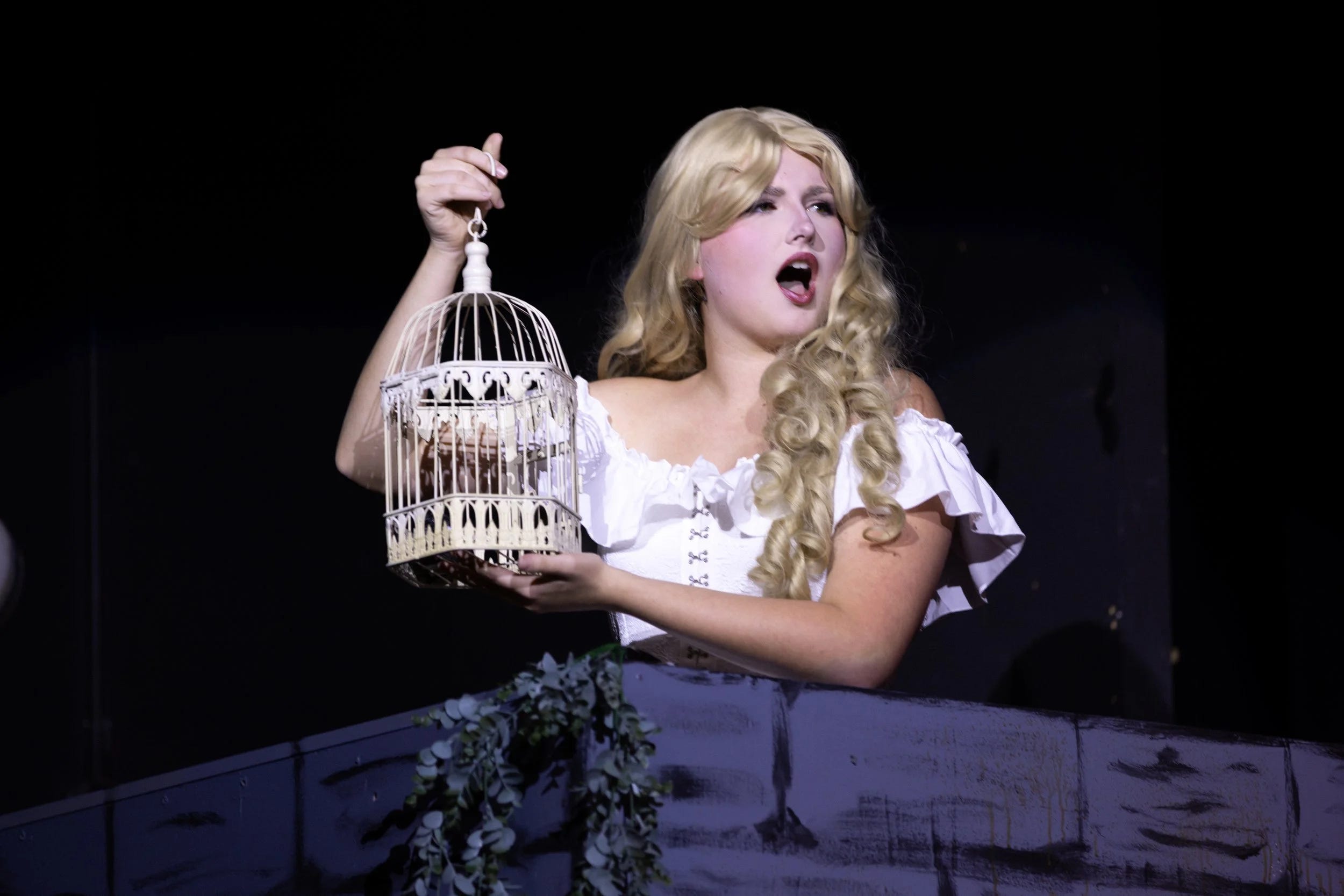
In a musical where others announce, proclaim, and insist, Johanna does something rarer: she questions. “Green Finch and Linnet Bird” is not a confession, a vow, or even a wish. It is an aria made almost entirely of unanswered queries.
How is it you sing?
How can you jubilate, sitting in cages, never taking wing?
How can you remain, staring at the rain, maddened by the stars?
Whence comes this melody constantly flowing?
Is it rejoicing or merely halloing?
The list goes on. Johanna lodges one question after another, pressing against the edges of her understanding as though that too were a cage. And these questions trace the awakening of a self that will come to be defined by inquiry.
✍️ Please support our work by upgrading to a premium subscription:
Thank you for reading! A premium subscription offers full access to The Sondheim Hub: an exclusive essay, crossword, extended interview & more each week, plus our complete, paywall-free archive of 200+ essays, features & interviews. 📚
Look closely at the kinds of questions Johanna asks, and a portrait emerges:
She begins with mechanism: “How is it you sing?” It is not why but how that interests her. Her opening question imagines freedom as a matter of engineering—something that might be studied, perhaps even imitated.
She moves on to endurance: “How can you remain, staring at the rain, maddened by the stars?” Here the birds are mirrors. Their continued capacity for song, despite confinement, poses an almost unbearable question for her own sanity.
Then comes origin: “Whence comes this melody constantly flowing?” Johanna longs to know the source of a beauty that can persist behind bars. Her question implies a desire for lineage, for a story that begins somewhere beyond Turpin’s house.
There is even a turn to economy: “Is it for wages, singing to be sold?” This is a startling leap. Johanna imagines her birds as commodities, singing not for joy but for profit. She intuits, perhaps, what her guardian has made of her: a possession of value, stored and displayed, with her future effectively sold.
Finally she tests risk: “Have you decided it’s safer in cages, singing when you’re told?” She ponders captivity as something calculated, decided upon. Perhaps the birds’ compliance is strategic. Perhaps it keeps them alive. Perhaps, Johanna seems to wonder, the same might be true for her.
Taken together, these questions trace the shape of a restless intelligence. They are attempts at explanation, small experiments in reasoning. Johanna has no action available to her, so she thinks in questions instead. Each one is a tap against the perimeter of her world, sounding out its weak points.
There is a paradox at the heart of Johanna’s questioning. On the surface, she sounds submissive. “Teach me,” she pleads, deferring to the creatures she addresses. But for Johanna, even the act of choosing whom to ask is an act of resistance. She does not look to Judge Turpin, nor to the prayer book he no doubt thrusts upon her. She seeks instruction instead from birds: captives like herself, whose authority nonetheless comes from a freedom she has never known. To say “teach me” here is to acknowledge an allegiance that lies wholly beyond the Judge’s jurisdiction.
Johanna’s questioning stands in quiet opposition to the world around her, in a musical otherwise driven by conviction. While she wonders and waits, others in Sweeney Todd declare, assert, insist. Consider Anthony’s “Johanna,” which follows soon after “Green Finch.” Every line of that song announces, claims, possesses. Even his less assured “I was half convinced I’d waken…” resolves into certainty (“Happily I was mistaken”). Anthony moves through doubt so quickly it barely registers as doubt at all. Most tellingly: “I’ll steal you, Johanna.” Here is pure futurity rendered as fact. Anthony presumes the legitimacy of his feeling, the relevance of his sensation, the validity of his claim on another person’s future. Johanna’s “How is it you sing?” presumes nothing. She must ask permission even to understand.
Todd, too, lives in the declarative mode. “There’s a hole in the world / Like a great black pit / And it’s filled with people / Who are filled with shit.” No hedging, no qualification. London is a pit; its people are shit-filled; the matter is settled. And then there’s “We all deserve to die.” Again, complete certainty, universal claim, no exceptions entertained. His certainty is, of course, the certainty of trauma calcified into ideology. Having been crushed by the world’s injustice, Todd responds by flattening complexity into a single, repeatable truth: everyone is guilty, everything is corrupt, all of London deserves the blade.
In this atmosphere of stifling certainty, Johanna’s questions are oxygen. But what answers could she possibly receive?
Birds do not reply. Anthony cannot yet hear her. Turpin would sooner marry Beadle Bamford than entertain such queries. Each unanswered question accumulates like testimony, building a case Johanna hasn’t yet learned to articulate: that she lives within a structure designed to prevent precisely this kind of speech.
Because what would answering require? It would mean someone, anyone, pausing to take her questions seriously. It would mean treating her curiosity as legitimate rather than ornamental, her intellect as active rather than decorative. It would mean entering into dialogue with her, which would necessarily grant her a kind of equality—however fleeting, however caveated. The ideal Victorian ward would not interrogate. She would absorb, reflect, embody. She would be a mirrored surface, not a searching mind.
Johanna’s relentless questioning refuses this role. She declines to provide the social lubrication of agreement; instead, she sustains uncertainty, holds interpretive space open, refuses to settle. “Is it rejoicing or merely halloing? / Are you discussing / Or fussing / Or simply dreaming?” Notice how she doesn’t pick one. “Are you crowing? / Are you screaming?” The radical act here is not the content of any particular question but the posture of questioning itself. By maintaining this stance, Johanna claims a kind of interiority that her circumstances are designed to prevent. She becomes ungovernable not through action but through thought, not through escape but through the sheer fact of sustained inquiry.
Johanna ends “Green Finch” by framing her own conditions: “If I cannot fly, let me sing.” It is a conditional statement, but it is also a decision. Flight may be impossible; song remains. The young woman who has asked so many questions finally arrives at something that sounds like resolve, even if it comes disguised as supplication. This is Johanna’s doctrine of second freedoms. When the first freedom is denied, she will claim the next. If she cannot escape, she will find a way to voice her captivity. If she cannot command, she will ask. If she cannot act, she will interrogate.
This is strategic realism, the kind of thinking that comes from sustained interrogation of one’s actual conditions. Johanna has spent the entire song examining how captive creatures persist, testing explanations, mapping the perimeter of what’s possible. And what she’s discovered is that when the first freedom is denied, you don’t simply surrender all freedom. You identify the next, and the next, working your way down a hierarchy until you find the territory you can actually hold. Some lives never get the first freedom. What Sondheim gives Johanna here is not false hope but a working philosophy for her circumstances.
And here’s what matters: she is already practicing this doctrine of second freedoms. The questions themselves are the “let me sing.” Every question is proof that she’s finding a way to make sound in a house, in a world, that would prefer her mute.
This makes Johanna’s position in Sweeney Todd central to its moral architecture. In a show that traces how absolute conviction can produce absolute carnage, how Anthony’s declarative confidence nearly capsizes the very rescue he’s attempting, Johanna’s sustained uncertainty begins to look less like weakness and more like the only ethical stance available. She doesn’t know how the birds sing, and she doesn’t pretend to. She doesn’t know whether adaptation is wisdom or capitulation, whether the melody comes from joy or madness or some economics of survival she hasn’t yet understood. She asks, and asks, and asks.
Where Todd’s grammar narrows the world to revenge and Anthony’s flattens Johanna herself into an object of rescue, her interrogative mode preserves what their certainties would erase: ambiguity, nuance, the acknowledgment of what one does not yet and may never fully know. That acknowledgment, quiet as it is, powerless as it seems, might be the truest form of wisdom the show contains.
Johanna will soon be freed from her cage. But what she takes with her, and what no one can confiscate, is what she’s forged through questioning: a method for preserving selfhood under conditions designed to extinguish it, and a hierarchy of freedoms built upon that most modest of prayers—let me sing.
☕️ To support our work, consider a one-off “coffee” donation! ☕️
Would you like the full Sondheim Hub experience? Our paid subscribers receive a weekly Sondheim Supplement, featuring an exclusive additional essay, our latest crossword, an extended interview, and more. Click here to explore our various subscription options.
The Sondheim Hub exists solely thanks to the generosity of our readers. Your support means the world to us, and keeps our weekly essay & interview accessible to all, regardless of means.
And if you enjoyed this piece, please do share it with an old friend!
Brilliant lyrical analysis! Enriching my understanding of the show