
Sondheim and E.B. White, Side By Side
Plus, more from our conversation with Bella Brown, and a Baker's Wife-themed crossword
Today, Sam Berit takes a closer look at Sondheim and E.B. White, side by side:
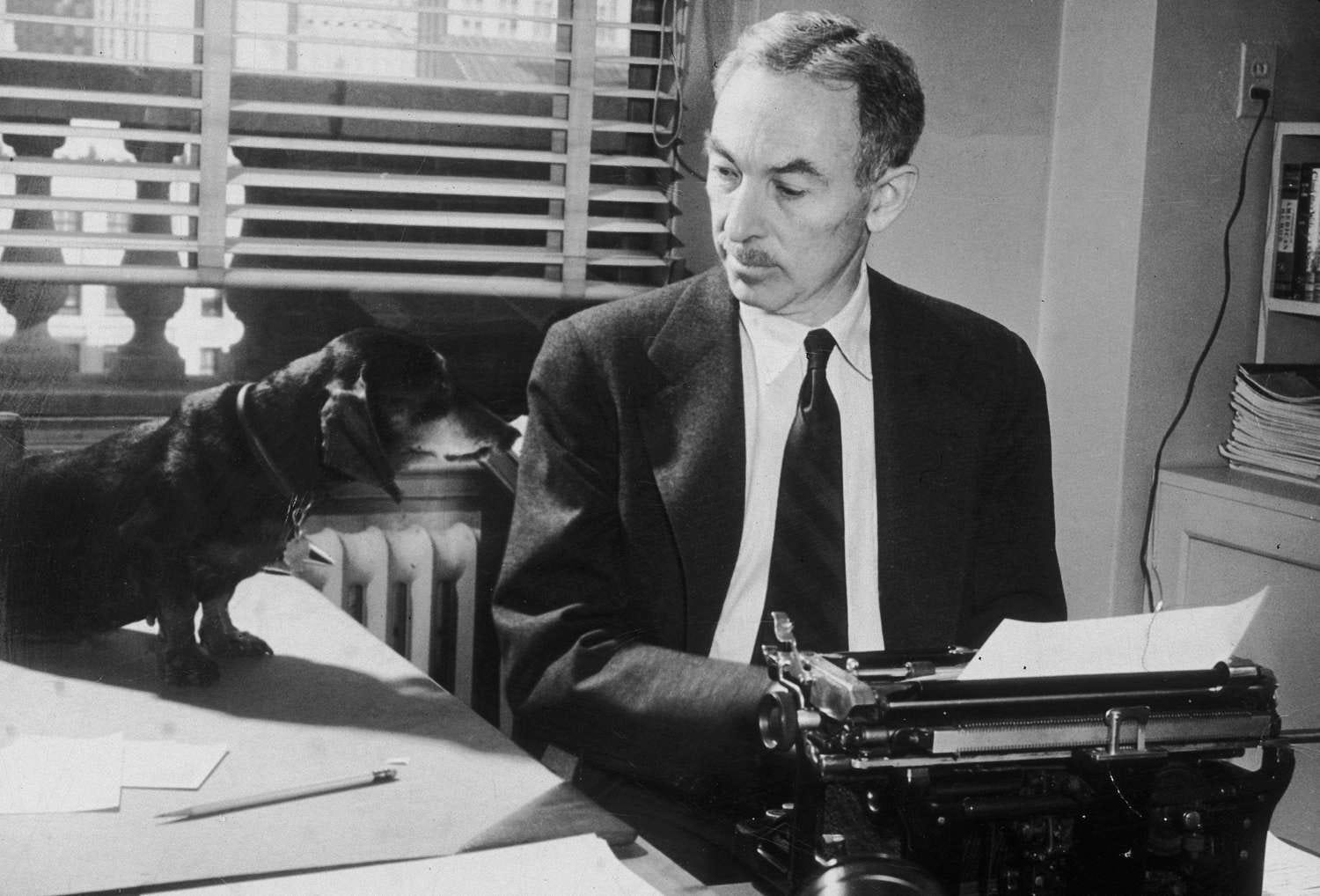
As we explored in Sunday’s essay, E.B. White and Stephen Sondheim were two of the most extraordinary talents to reside in the neighborhood of Turtle Bay Gardens. They were both able to see the world for all its meaning and meaninglessness and tactfully put that experience into words. Let’s look at some of the many instances of overlap in the content of their work and in the shape of their lives.
If you’re currently a free subscriber, consider upgrading to a premium subscription for full access to The Sondheim Hub: an exclusive essay, crossword, extended interview & more each week, plus our complete, paywall-free library of 200+ essays, features & interviews.
The organizing principles that guided both White and Sondheim in their professional pursuits are framed as lessons throughout their work. In the case of White, one of his most direct and impactful teachings appears in his additions to The Elements of Style:
Your whole duty as a writer is to please and satisfy yourself, and the true writer always plays to an audience of one. Start sniffing the air, or glancing at the Trend Machine, and you are as good as dead, although you may make a nice living.
In Sunday in the Park with George—the Sondheim show with the most to say on craft itself—George voices his own disillusioned insights in “Putting it Together” that align with White’s:
Art isn’t easy.
Overnight you’re a trend,
You’re the right combination,
Then the trend’s at an end
[…]
A vision’s just a vision
If it’s only in your head.
If no one gets to see it
It’s as good as dead.
This shared belief that sustained quality writing can only derive from internal fulfillment laid the foundation for both men’s specific success over the years.
Early into their careers, White and Sondheim were cutting through the conventions of their day with bite and humor. They explored the complexities of romantic relationships, such as in White’s 1929 book of parodic essays written with friend and colleague James Thurber Is Sex Necessary? Or Why You Feel the Way You Do and Sondheim’s 1970 Company. In Is Sex Necessary? White noted:
Marriage, as an instrument, is a well-nigh perfect thing. The trouble is that it cannot be successfully applied to the present-day emotional relationships of men and women. It could much more easily be applied to something else, possibly professional tennis.
White also wrote skeptically of marriage from the perspective of a newly married canary in a 1928 essay for The New Yorker called “Bye Low Baby”:
‘Sometimes I get thinking about the old days, when there was nothing to keep me company but the cuckoo clock’…‘I have observed,’ Baby went on, ‘another unfortunate condition in marriage. A woman is always trying to find out things...Do I sound cynical? I don’t mean to be…Of course, marriage has its compensations. I won’t pretend I don’t like the little sleepy noise she makes late in the afternoon when she’s on the nest.’
These sentiments on marriage align with much of Company, including “Sorry-Grateful” and its unpacking of various husbands’ mixed feelings on the institution they participate in:
You’re always sorry,
You’re always grateful,
You hold her, thinking, “I’m not alone.”
You’re still alone.
[…]
Good things get better,
Bad get worse.
Wait—I think I meant that in reverse.
These early works capture both writers’ evolving voices—equally incisive and playful.
The resemblance across White’s and Sondheim’s writing extends far beyond cultural criticism and wit. It metabolizes the significance of time and place—of how a life becomes emotionally rich only when time passes and places fade into memory. In White’s 1941 essay “My Day” featured in his column “One Man’s Meat” for Harper’s Magazine, he wrote:
A man sometimes gets homesick for the loneliness that he has at one time or another experienced in his life and that is a part of all life in some degree, and sometimes a secluded and half-mournful yet beautiful place will suddenly revive the sensation of pain and melancholy and fulfillment that are associated with that loneliness, and will make him want to seize it and recapture it; but I know with me it is a passing want and not to be compared with my taste for domesticity, which is most of the time so strong as to be overpowering.
This distinctly tender yet passive nostalgia cuts to the heart of Follies, set in a theater on the brink of demolition, the “half-mournful yet beautiful place”. Many moments throughout the show depict the specific yearning for lost pain White wrote about. Take “Too Many Mornings,” for instance: “All that time wasted, / Merely passing through, / Time I could have spent / So content / Wasting time with you.” As Follies ends, its characters resume lives they feel unfulfilled by, seemingly in part because of their faithful commitment to an undeniable “taste for domesticity.”
The connections between Sondheim’s and White’s personal lives and work are plentiful and clear—as are the connections that knit the personal and professional together. In the winter of 1929, White found himself at his future wife Katharine S. Angell’s summer house in Sneden’s Landing about a week after Katharine’s divorce from her first husband. White and James Thurber were visiting Katharine during an uncertain time in all of their lives. The great trio of The New Yorker were in their own relationship ruins but felt secure in their friendship with each other. So, on that sunny February day in the Palisades, they each tucked a dated newspaper clipping in their wallets and made a pact to have a reunion at that very spot in 25 years’ time.
It’s a moment that seems impossibly close to one Sondheim wrote about in Merrily We Roll Along. The song “Our Time” expresses the hope a trio of young friends has for their shared future, “Years from now, / We’ll remember and we’ll come back, / Buy the rooftop and hang a plaque: / ‘This is where we began / Being what we can.’” Sondheim more than once acknowledged a similarity between the trio in Merrily We Roll Along and his own trio of himself, Hal Prince, and Mary Rodgers. Just as with White’s friends, Sondheim would experience disappointment with his own—and some promises made early in friendship would not weather the turbulence of time.
The influence of the personal on the professional endures. White undoubtedly played a part in the dissolution of Katharine’s first marriage. The two were having an affair and eventually took a secret trip to Corsica with each other. They stayed together in a small hotel with a lush garden, as White later reminisced in a poem:
Once I felt a garden hold me,
Orange trees and long vines clinging—
I could not escape its fragrance,
Break loose from the strong vines—
Orange trees and swallows winging,
Noon and sunny paths and lizards
And a slow voice singing,
Earth was full of flowers and giving;
I was full of life and living.
Sondheim found his first love around the time he was working on Passion. Although he adamantly denied drawing on his own life to color characters, emotional truth flourished across the score. In the “Garden Sequence”, two lovers in the midst of their affair are writing letters to each other:
Love that grows
Every single day,
Love that thinks
Everything is pure,
Everything is beautiful,
Everything is possible.
[…]
The garden filled with you—
It always comes back to a garden.
E.B. White and Stephen Sondheim, Turtle Bay Gardens’ finest, shared not only a neighborhood but the same impulse to create. White once wrote to a reader of Charlotte’s Web, “All that I ever hope to say in books, all that I ever hope to say, is that I love the world. I guess you can find that in there, if you dig around.” As Sondheim once explained, in an interview with philosopher Cornel West, when asked what he would like to teach through his art: “It isn’t just one thing, but it has to do with the joy of living—the joy of every given moment.”
Perhaps this is why White and Sondheim could write about the complexity of life so well. They could see it for all its beauty.
The Sondheim Hub Crossword
Today, our crossword is all about The Baker’s Wife. Click here to play!
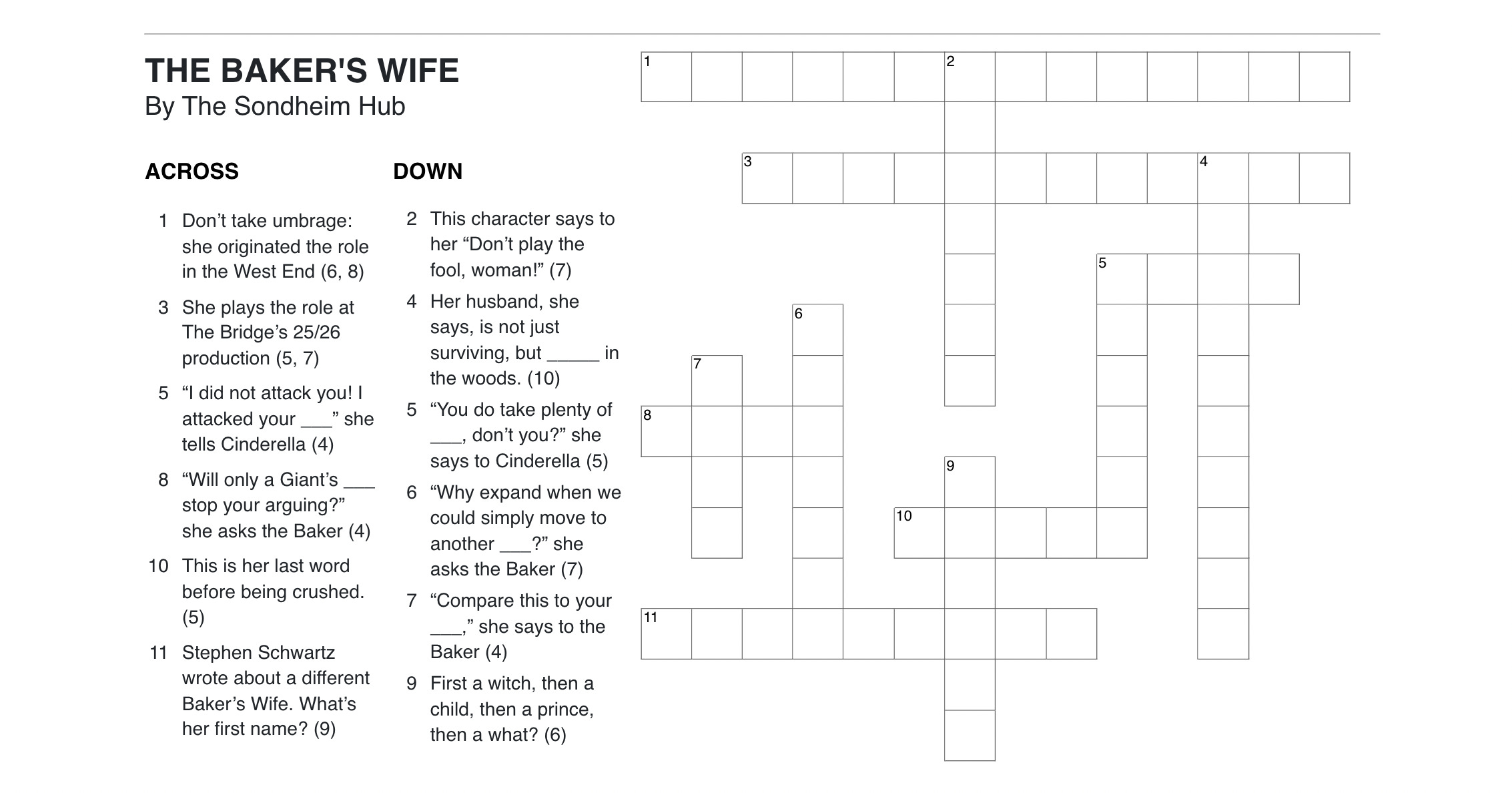
All our crosswords are interactive and playable online, whether on mobile or desktop.
A Conversation Continued: Bella Brown

I’d actually never done a production of Into the Woods before this one. I didn’t do musical theatre when I was in my teens. It wasn’t something that I really understood that you could train in. I used to train in dance, and I’d trained to sing, but I’d never done anything where you put it all together.
But the Into the Woods film came out in 2014, and I’d watch it with my family. At the time, I had no concept of quite how big Sondheim was in the musical theatre world, but I loved the music so much. Then, when I was 18, I went to ArtsEd and I saw that this Sondheim experience, this Into the Woods experience, was not just me. This is a global thing. This is a truly loved and appreciated show. That opened a third eye, really, to Sondheim.
With Rapunzel, you have this expectation of what you think your regular fairy tale character is. And I think what Into the Woods does so beautifully is it takes these fairy tale characters and makes them real. It makes these women understandable and relatable. And the reason we can relate is because it’s very much like real life. I think both Evita and Into the Woods do their own thing with women’s stories, and not the thing we might expect.
—
I realized that, actually, I could use the balcony of the Palladium to my advantage for the people in the theatre during “Don’t Cry For Me Argentina,” and still honor the people outside who’ve come to see this.
As soon as you do it, the nerves kind of go away. I felt so much love from the people outside. I didn’t feel the sense of anybody wanting me to fail or do wrong. I realized, well, you’ve all come here, so you must love this. You must love this cultural moment, this show, and you want to say that you’ve experienced it yourself.
—
I really thought I had a version of myself and what I wanted to do when I was leaving. I was so ready to go into the next West End show, if I could, or tour, or whatever would take me. And I learned, actually, there are a lot of things that I love and a lot of things that I don’t love as an actor, and that’s okay.
When you’re training, you think, well, I just need to do everything. What I didn’t see coming when I left university was that, actually, I can do the things that I love doing, and I can do the things that fill me with enjoyment.
This Week in Sondheim
January 25, 2008: The Broadway revival of Sunday in the Park with George begins preview performances at Studio 54. This production, starring Daniel Evans and Jenna Russell reprising their acclaimed West End performances, would run for 149 performances.
January 26, 2015: A one-night-only 40th anniversary concert of A Little Night Music takes place at the Palace Theatre.
January 27, 1992: The musical revue Putting It Together premieres at the Old Fire Station Theatre in Oxford, England, running for 24 performances. This early staging of the Sondheim compilation would later evolve into various productions, including its 1999 Broadway run.
January 30, 1928: Harold Prince is born. The visionary director and producer would become one of Sondheim’s most important collaborators, creatively partnering on West Side Story, A Funny Thing Happened on the Way to the Forum, Company, Follies, A Little Night Music, Pacific Overtures, Sweeney Todd, Merrily We Roll Along, and Bounce—a partnership that defined modern musical theatre.
This week also marks the birthday of Samuel Byck (January 30th, 1930), whose attempted hijacking of a commercial airliner secured his place in Assassins. In the original Off-Broadway production, Byck’s signature Santa suit—worn during his attempt—became one of costume designer William Ivey Long’s most striking visual elements.
January 31, 1971: Happy birthday, Danielle Ferland! She would originate the roles of Louise in Sunday in the Park with George and Little Red Riding Hood in Into the Woods, later returning to Sondheim’s work as the Baker’s Wife and Fredrika in regional productions.