
Boris Aronson's Pacific Stage
Set design as historiography in Pacific Overtures | Plus, more from our conversation with Christine Toy Johnson, and a V-word-themed crossword
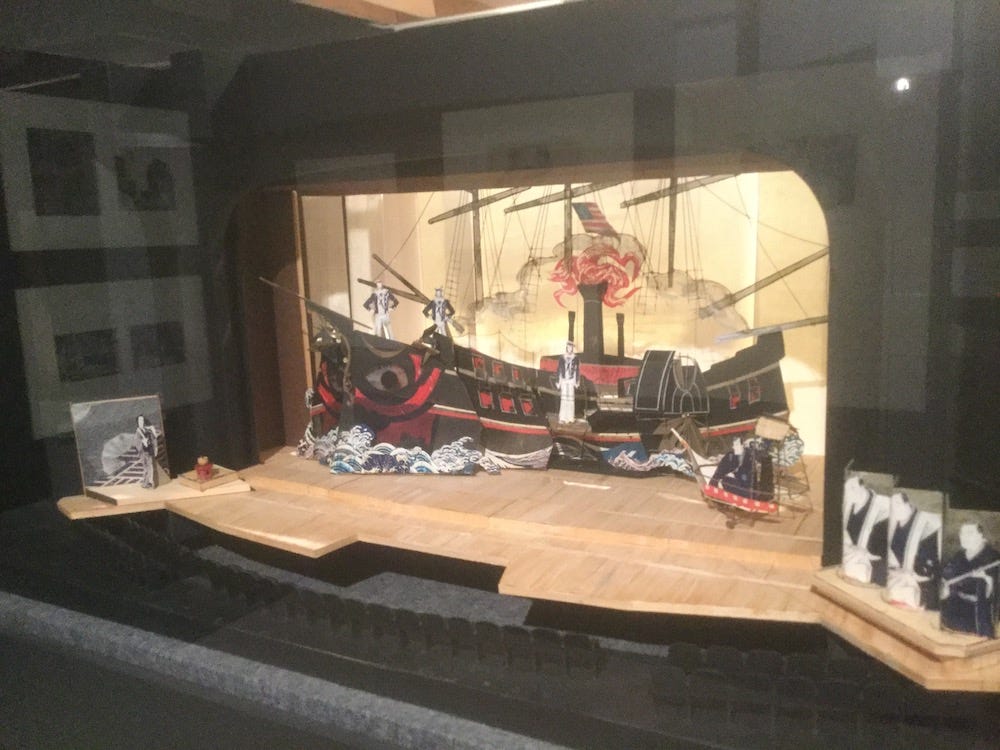
When Commodore Perry’s battleship arrived in the original Broadway production of Pacific Overtures, it unfolded. A contemporary review in TIME described it as the evening’s “showstopper”: first came the prow with “two baleful headlights,” then “in accordion fashion, the rest of the ship spills into being like a black dragon.”
That “accordion” detail feels apt. Historiography, the practice of writing history, is about expansion, contraction, editing, framing. Aronson’s battleship, a force that takes up more space than we might have assumed it should occupy, maps theatrical mechanism onto history with beautiful precision.
If you’re currently a free subscriber, consider upgrading to a premium subscription for full access to The Sondheim Hub: an exclusive essay, crossword, extended interview & more each week, plus our complete, paywall-free library of 200+ essays, features & interviews.
Boris Aronson won the 1976 Tony Award for Scenic Design for Pacific Overtures. But what the design achieves—and what it still teaches, fifty years on—goes deeper than “beautiful” or “inventive” or even “Kabuki-inspired.” The set functions like a historian: it selects, structures, and argues. It stages nineteenth-century Japan and the process by which Japan is pictured—first to itself, then to the West, then to a global marketplace.
The “floating world” as method
The TIME review reaches for ukiyo-e, the “floating world” of Japanese prints, to describe the production’s visual impact: screens, sets, costumes, all working to transport the viewer into that realm. It’s a useful contemporary diagnosis and a clue to Aronson’s governing method.
Ukiyo-e is art built on framing and replication. A print is an image designed to travel, to circulate, to be re-encountered. That’s the grammar of Pacific Overtures: a show about treaties and translations, about a country becoming permeable, about one culture entering another as an image first, a commodity second, and only later as something like a lived reality.
Aronson, according to the New York Public Library’s overview of his papers and designs, was especially drawn to innovations in process. He also had a “lifelong fascination with traditional art forms like Japanese printing.” Pacific Overtures, the NYPL notes, is where those two loves meet. The visual world of the show fuses reproducible image-making (copying, printing) with theatre’s own live, vanishing event.
The set already thinks about the show’s subject. Mediation lives in the materials as much as in the book.
Research as dramaturgy: kites, fans, and warships
Revisiting the original production through archival traces reveals how insistently Aronson approached it like a scholar-collector.