
Benjamin Stone: American Hamlet?
The time is out of joint...
Hamlet. Act 1, Scene 5. The ghost of a king vanishes into the night, leaving behind a shattered prince and a terrible command: to avenge his “foul and most unnatural murder.” The crime is fratricide. Claudius has poisoned his own brother and seized both the crown and the queen. As Hamlet secures his companions’ silence about this supernatural encounter, the full weight of his situation crashes down on him. “The time is out of joint,” he declares. “O cursèd spite, / That ever I was born to set it right!”
The time is out of joint. It is a phrase suggestive of violent dislocation: a limb wrenched from its socket, a body left dysfunctional and in pain. Applied to time itself, Hamlet’s words speak to a severing of the natural order of succession, of morality, of kinship.
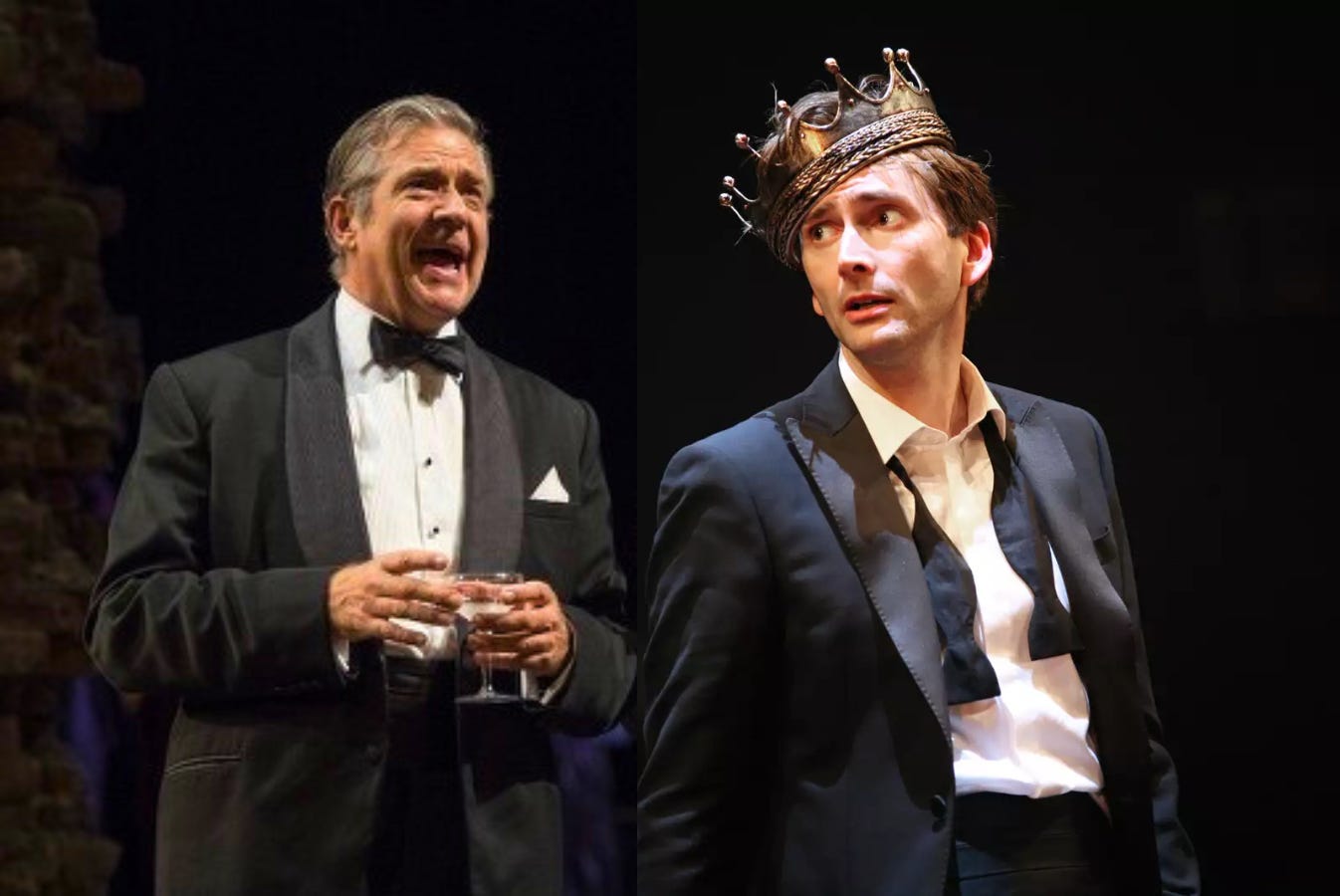
In Follies, Benjamin Stone is haunted not by his father’s ghost but by the spectral presence of his younger self. He returns to the ruins of the Weismann Theatre and finds himself estranged from both his past and his present. Ben’s dislocation is born of a culture that promises you can have it all: love and success, authenticity and achievement, the road taken and the road not taken. If Hamlet is trapped between his father’s ghost and his uncle’s Denmark, Ben is caught between the mythology of limitless possibility and the brutal arithmetic of actual choice.
✍️ Please support our work by upgrading to a premium subscription:
Thank you for reading! A premium subscription offers full access to The Sondheim Hub: an exclusive essay, crossword, extended interview & more each week, plus our complete, paywall-free archive of 200+ essays, features & interviews. 📚
When Hamlet cries that “the time is out of joint,” he names not just Denmark’s disorder but a deeper fracture in human experience: the sense that past, present, and future no longer align. That image of dislocation captures the essence of Ben’s crisis in Follies. Like Hamlet, Ben finds himself caught in a temporal snare, forced to live in multiple times at once, unable to locate a stable present.
“The Road You Didn’t Take” makes this fracture visible. Ben begins the song as though speaking from a position of hard-won wisdom, telling Sally that choice is simple: “You’re either a poet / Or you’re a lover / Or you’re the famous Benjamin Stone.” He frames his life as the product of clarity and decisiveness. But the illusion falters almost immediately. Mid-song, the past intrudes: Young Ben appears, still full of ambition, still grasping at success. We see what Ben himself cannot keep buried: that every choice creates a wound in time, each “either/or” leaving behind a ghost of a path not taken.
Hamlet, too, lives inside the wound of indecision. Fired by the success of The Mousetrap, the play he stages to “catch the conscience of the king,” he vows, “Now could I drink hot blood, / And do such bitter business as the day / Would quake to look on.” But what follows is not decisive action, only the endless circling of either/or: to endure or to end, to kill or to delay, to remember or to forget. Like Hamlet, Ben dresses his paralysis in the language of reason, pretending to clarity while remaining trapped in a maze of branching possibilities. Both men are haunted not just by the past but by the very act of choosing, as if decision itself were a form of violence against the self.