
Be Our Guest? Sondheim's French Music
Offenbach, Beauty and the Beast, and Please Hello...
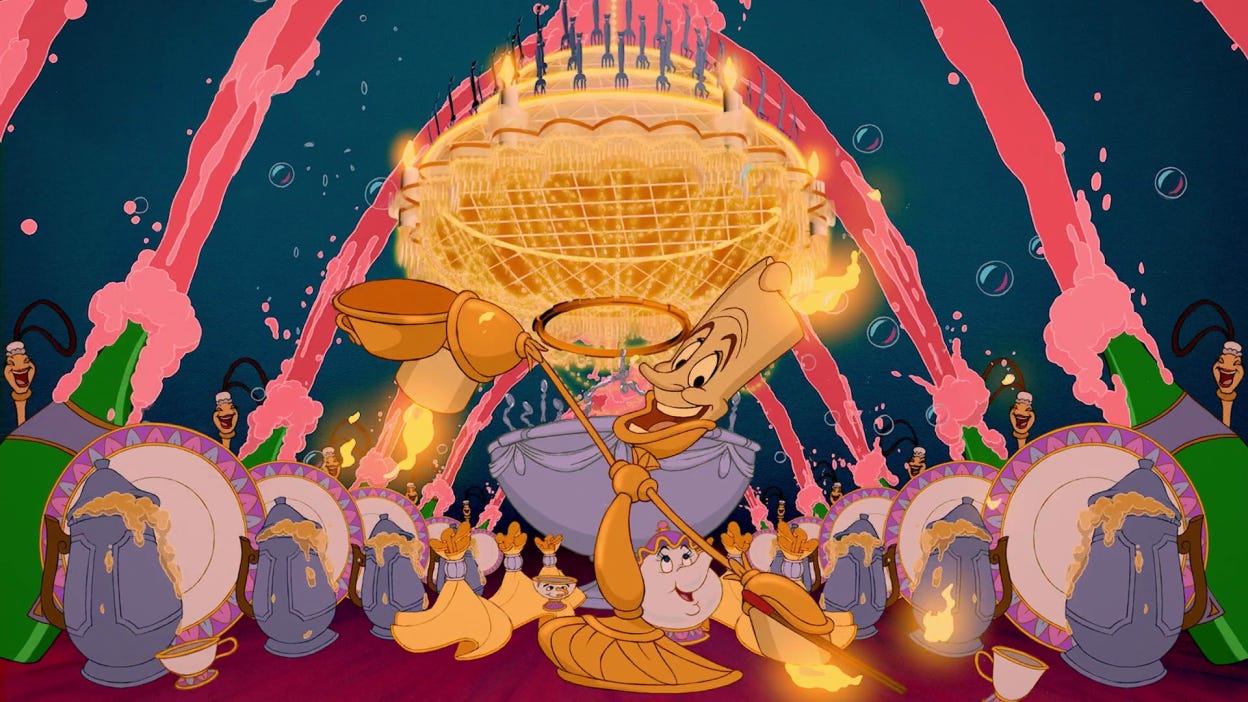
Sondheim gives each Admiral in “Please Hello” a musical and rhetorical idiom as precisely chosen as his demands. Over the past few months, we’ve heard Sousa march plus pidgin-as-condescension, Gilbert and Sullivan-esque patter, a desperate clog dance, and lugubrious, rubato authority.
The French Admiral gets operetta. Specifically, he gets the musical idiom of Jacques Offenbach — the composer of Orphée aux Enfers, La Belle Hélène, La Vie Parisienne — whose frothy, irresistible, relentlessly cheerful music was, in the 1850s and 1860s, the soundtrack of the Second Empire, of Napoleon III’s Paris, of a regime that used spectacle and gaiety as instruments of political management.
Offenbach’s operettas were entertainment, to be sure. But they were also, as critics from Nietzsche to Karl Kraus observed, a narcotic — a way of making the uncomfortable comfortable, of dissolving anxiety. Sondheim’s pastiche of this style in “Please Hello,” then, is a precise one. But to understand just how precise, it helps to spend a moment with what Offenbach actually did, and why Napoleon III needed him.
Thank you for reading! If you find our work valuable, consider upgrading to a paid subscription for the full Sondheim Hub experience. ✍️
Napoleon III and His Composer
Jacques Offenbach was born in Cologne in 1819, the son of a Jewish cantor, and arrived in Paris as a teenager with a cello and enormous ambition. He spent decades on the margins of the official musical establishment before finding his form in the early 1850s: short, satirical, wildly energetic operettas performed in tiny theatres on the Boulevard du Temple. When Napoleon III’s Second Empire was declared in 1852, Offenbach was ready for it, and it was ready for him.
The Second Empire was, among other things, a regime of surface. Napoleon III understood, better than almost any ruler before the age of mass media, that political legitimacy could be manufactured through spectacle. Baron Haussmann was tearing apart medieval Paris and replacing it with wide boulevards and grand vistas, not only for sanitary and military reasons but because a city of magnificent surfaces was a city that looked like it was being well governed. The 1855 and 1867 World’s Fairs brought millions to Paris and told them: this is the center of the world, and the center of the world is having a wonderful time.
Offenbach provided the music for that wonderful time. His operettas — La Belle Hélène (1864), La Vie Parisienne (1866), La Périchole (1868) — were officially satirical, full of jokes at the expense of the gods, the aristocracy, and pompous authority. But the jokes were so good, and the music was so irresistible, that the satire dissolved in the pleasure of the thing.
The music itself was the mechanism. Let’s break it down: