
Anyone Can Whistle Down the Wind
Sondheim x Lloyd Webber | two title songs, two kinds of simplicity
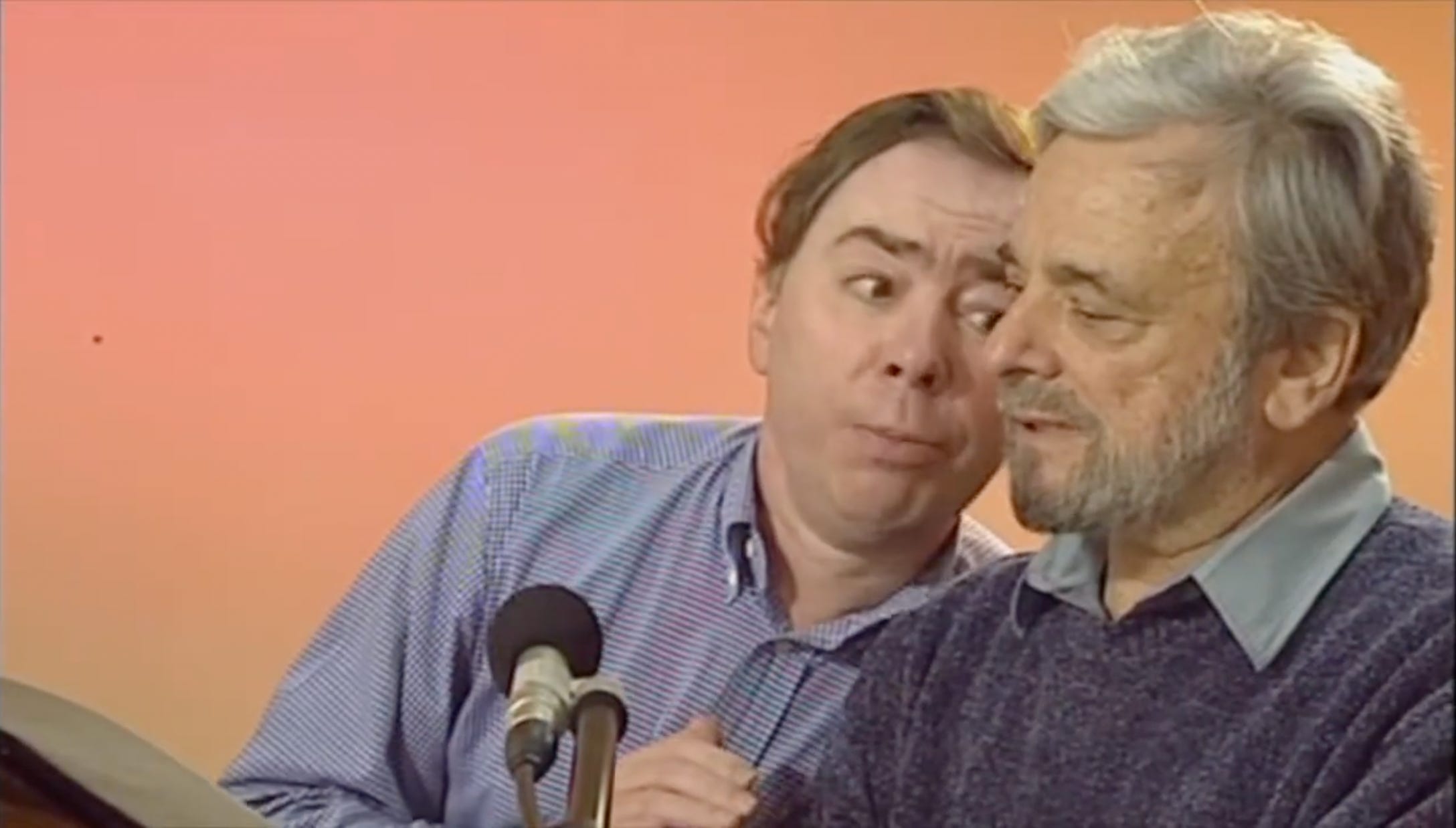
Stephen Sondheim and Andrew Lloyd Webber famously share a birthday. But the two musical theatre titans, so relentlessly (and often tediously) compared, share something else too. They both penned songs — title songs, no less — whose central image is whistling. Set “Anyone Can Whistle” and “Whistle Down the Wind” side by side and we are invited to consider two different ideas of what simplicity is, what it costs, and what it might promise.
Thank you for reading! Upgrade to a premium subscription for full access to The Sondheim Hub: an exclusive essay, extended interview, crossword & more each week — plus, our complete, paywall-free library of 250+ essays, features & interviews.
Anyone Can Whistle (1964), Sondheim’s second produced Broadway score as both composer and lyricist, closed on Broadway after 12 previews and nine performances. By any conventional measure it was a disaster: savaged by the New York Times, deemed unable to reconcile its warring impulses (absurdist social satire on one side, genuine romantic musical on the other). But the show — and, crucially, the score — survived, and more than survived.
The title song in particular has become a cabaret standard, a concert perennial, a touchstone. Sung by the emotionally armored nurse Fay Apple, it is the least showy number in a musical full of theatrical pyrotechnics. It has outlived every scathing review.
Whistle Down the Wind (1996), meanwhile, emerged in the wake of overwhelming success. Lloyd Webber was by this time musical theatre’s supreme commercial force. But this new show, with lyrics by Jim Steinman (the man behind Meat Loaf’s Bat Out of Hell and Bonnie Tyler’s “Total Eclipse of the Heart”), received mostly negative notices at its D.C. premiere, and had its scheduled Broadway opening canceled.
Reworked and redirected by Gale Edwards, Whistle Down the Wind opened in the West End at the Aldwych Theatre on 1 July 1998, ran for 1,044 performances, and became something of a cult classic. The title song was recorded for the concept album with Boyzone and others; its companion piece, “No Matter What,” became the UK’s biggest-selling single of 1998.
Two shows, then, that struggled to find their footing, but whose title songs slipped free of their circumstances and entered the wider musical theatre bloodstream.
What Whistling Means
Before the music, the metaphor.
In “Anyone Can Whistle,” whistling means ease — the easiest thing in the world, the thing any person can do without thought or effort. Fay is a woman who has organized herself entirely around competence. Dancing a tango, reading Greek, even dragon-slaying — easy, she says. And yet she cannot whistle. Why? Because of any physical incapacity? No. Whistling requires something she has never allowed herself: the freedom to be unguarded, to stop performing, to relinquish control and simply breathe. In short, to let go. Whistling, in Sondheim’s imagination, is a kind of emotional surrender — and surrender is precisely what Fay cannot do.
In “Whistle Down the Wind,” the metaphor is nearly the reverse. Here, whistling is not ease but signal — a call sent out into darkness, a cry for help, a promise of presence. The show is set in 1950s Louisiana, where the young girl Swallow discovers a fugitive man in her barn and, with her siblings, comes to believe he may be Jesus. The title song is essentially: I will not abandon you. To whistle down the wind is to throw your voice into danger, into the unknown, into the night — and to trust that someone is listening.
If Sondheim’s whistle is what Fay cannot produce, Lloyd Webber and Steinman’s whistle is what Swallow sends out and trusts will be received. One song is about the ache of being unable to let go; the other is about the comfort of being answered when you call.
Musical Simplicity
Both songs are strikingly simple.
Sondheim’s harmonic world is frequently — and thrillingly — a dense, chromatic, endlessly surprising place. We can’t always be certain where and when the next chord will land; suspensions are held past the point of comfort; modulations arrive sideways. But “Anyone Can Whistle” is harmonically smooth — tranquil, even. The melody moves in easy, symmetrical phrases. The accompaniment is spare. It is, on its face, a diatonic song — i.e., it uses only the notes of the key it’s in.
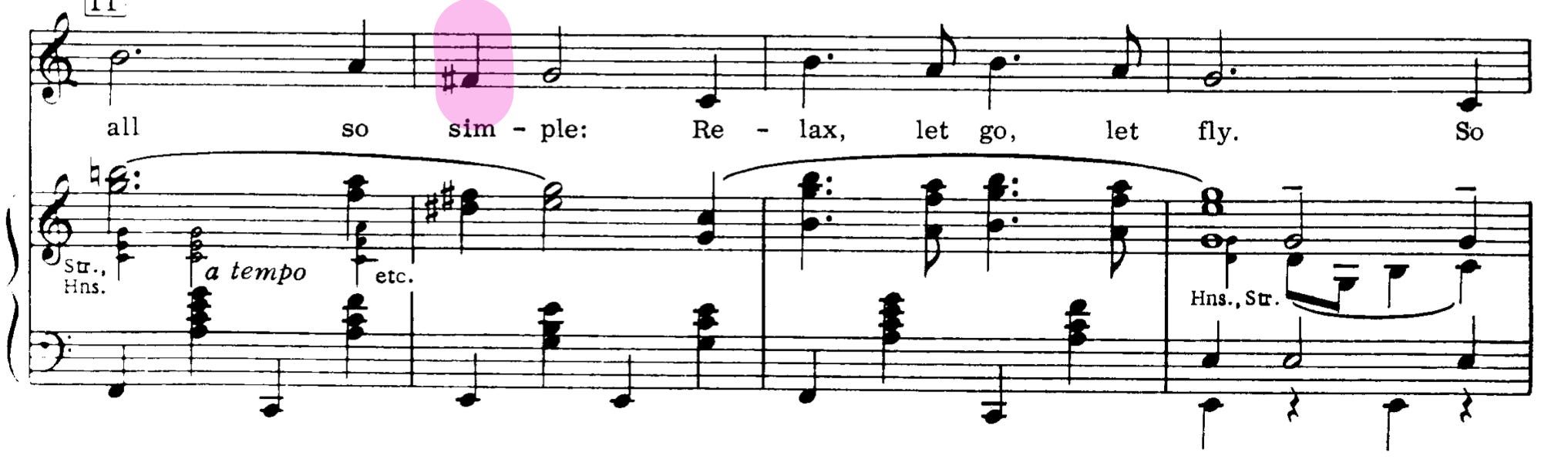
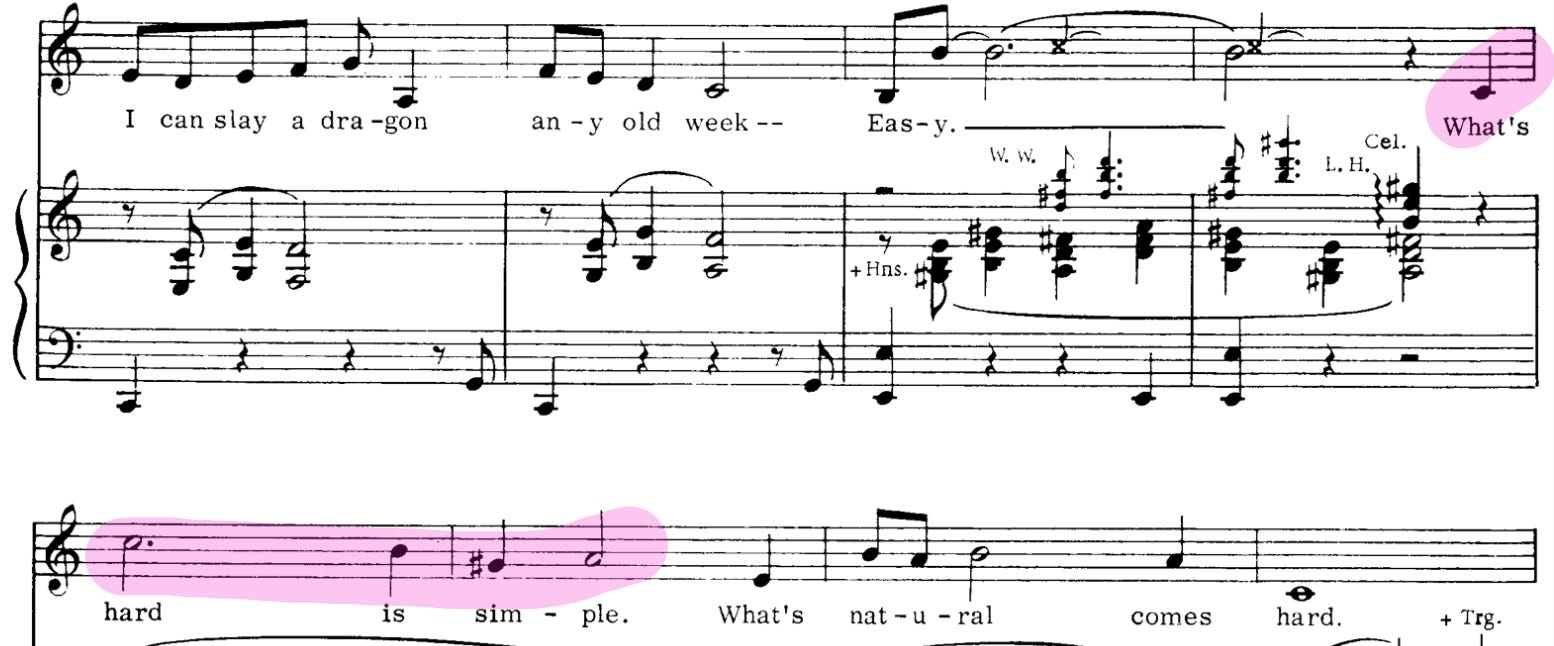
Almost. Because there is a moment when Sondheim musically contradicts his lyric, and it is exquisite. On the word “simple” — “it’s all so sim-ple” — the note ventures outside the key (which itself is that “simplest” of keys: C major). An accidental (F♯), modest but unmistakable, falls precisely on that first syllable of “simple.” The song presents itself as easy — but Sondheim proves, in that single inflection, that ease is never quite what it claims to be. The coloring is fleeting and subtle, merely a way of pressing into the G♮ that follows. But we feel it, the way we feel the catch in someone’s voice when they insist that everything is fine.
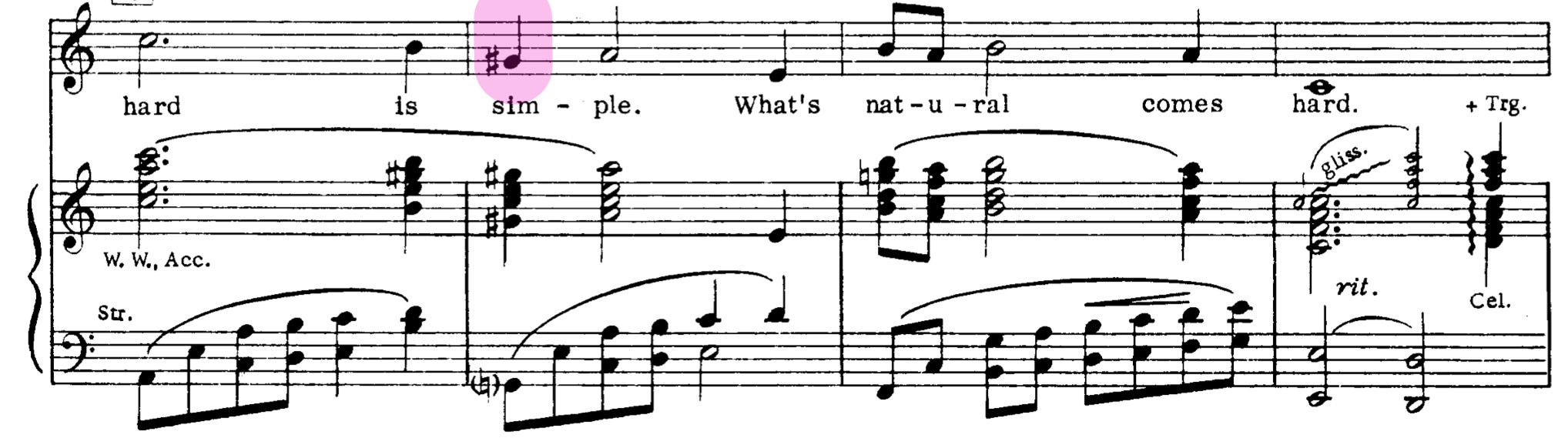
Later in the song, at the equivalent moment, Sondheim reaches slightly higher melodically. The major 7th of “it’s all (so simple)” becomes a full octave leap for “what’s hard (is simple)” — but that chromatic inflection on “sim-ple” remains (now as a G♯ pressing into the A that follows). Aside from a quick F♯ on “why can’t I,” these are the only two non-key notes in the whole song.
Lloyd Webber’s title song is purely diatonic — there is not a non-key note in it. The melody is open, memorable, built for large voices in large spaces. Where Sondheim’s song is an intimate, almost confessional piece, Fay alone with her inability, Lloyd Webber’s is musically declarative, anthemic, a kind of lullaby made large.
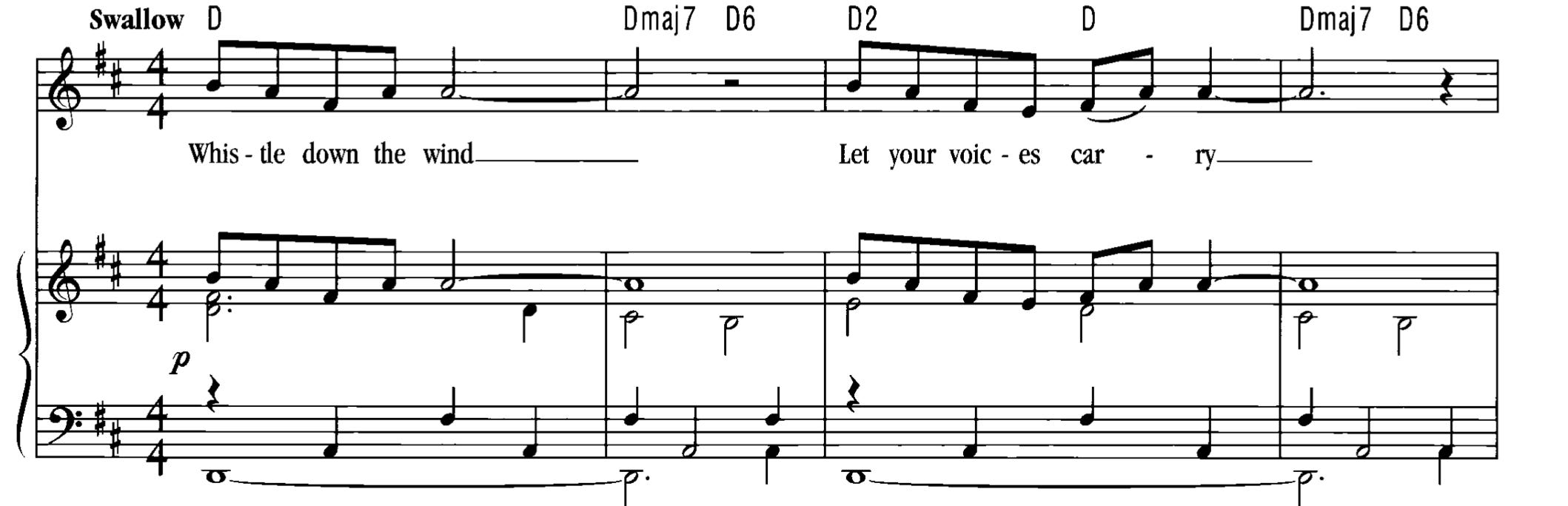
Lloyd Webber’s melody is entirely contained with in the span of an octave — meaning that the octave leap from “make it” to “clear” (in the line “make it clear and strong”) is articulating the song’s full melodic span, the edges of the known musical universe. And if you compare Sondheim’s “what’s hard is simple” to Lloyd Webber’s “make it clear and strong,” their contrasting approaches to simplicity shine through in miniature. An octave leap upward begins both phrases — but where Sondheim chromatically inflects, Lloyd Webber remains scrupulously, solidly undecorated. Sondheim underscores the irony of “what’s hard is simple”; Lloyd Webber is the musical embodiment of “clear and strong.”
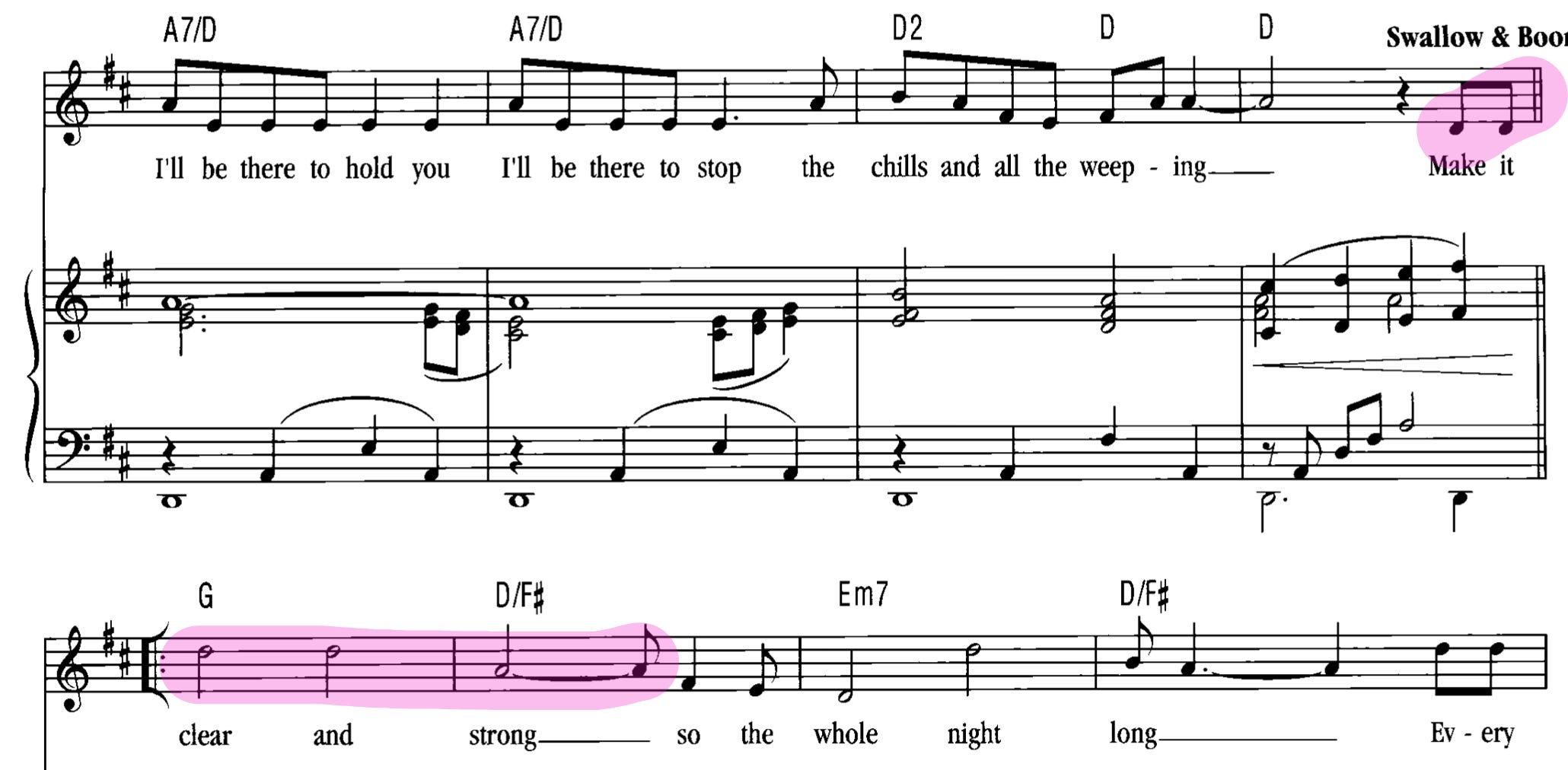
In “Whistle Down the Wind,” such harmonic stability and untroubled diatonicism perhaps reinforce the song’s point: this is how faith sounds, or how it wants to sound — clear, singable, unwavering, without shadows. To introduce harmonic ambiguity would be to introduce doubt, and Lloyd Webber will not do that.
The musical contrast here, then, is not necessarily between sophistication and simplicity, but between two different uses of simplicity. Sondheim’s simplicity is undermined from within, its ease elusive. Lloyd Webber’s simplicity is sustained as a kind of shelter: stability offered precisely because everything outside the song is unstable.
Lyrical Simplicity
Sondheim’s lyric is masterfully concise. The vocabulary is meticulously plain — “easy,” “relax,” “let go,” “free” — but the emotional situation is anything but. That paradox lands in two lines we’ve already considered musically:
What’s hard is simple,
What’s natural comes hard.
Fay handles the things that ought to require effort without breaking stride, because they are tests of competence, and competence is her armor. The things that ought to require nothing defeat her completely. And at the end of the song, she makes a request:
Maybe you could show me
How to let go
Lower my guard
Learn to be free
Maybe if you whistle
Whistle for me
She cannot do it herself, so she asks someone else to model the thing she cannot access. The whole song turns inward, and inward again, even in that final plea. And Sondheim achieves all this with words not exceeding two syllables.
Steinman goes in precisely the opposite direction. He escalates. “Whistle down the wind” becomes “howl at the stars” becomes “send a flare up in the sky” becomes “burn a torch” becomes “build a bonfire.” Each image seems louder and brighter than the last; we move from private call to public beacon. There is nothing oblique about it: this is a lyric of transmission, not interiority. Its refusal to remain quiet is itself a kind of protection — and, of course, exactly the right mode for children in crisis who need to believe and trust that their voices will be heard.
Set these two songs side by side and the coincidence of their shared image starts to feel less incidental, and more revealing. Both composers reached for whistling as a symbol of something elemental — something beneath performance, beneath even language.
For Sondheim, it’s what remains when all of Fay’s armor has been stripped away: the one simple, human, undefended gesture she cannot make. For Lloyd Webber and Steinman, it is the first and purest act of faith — a sound thrown into darkness on the trust that darkness is not the end of the story.
One song asks: can you whistle for me? The other answers: I have always been right there. That the two songs don’t quite speak to each other is unsurprising. But it’s rather wonderful that, for a moment, they almost seem to.
✍️ Please support our work by upgrading to a premium subscription:
The Sondheim Hub exists solely thanks to the generous support of our readers. Please consider supporting our work for a few dollars each month. A premium subscription gives you full access to The Sondheim Hub: an exclusive essay, crossword, extended interview & more each week, plus our complete, paywall-free library of 250+ essays, features & interviews. 📚
An unexpected topic and comparison. Maybe not a big "Aha" but a little "Oh!...well, now..."