
An Ordinary Sunday
Exploring the painting at the heart of Sunday in the Park with George
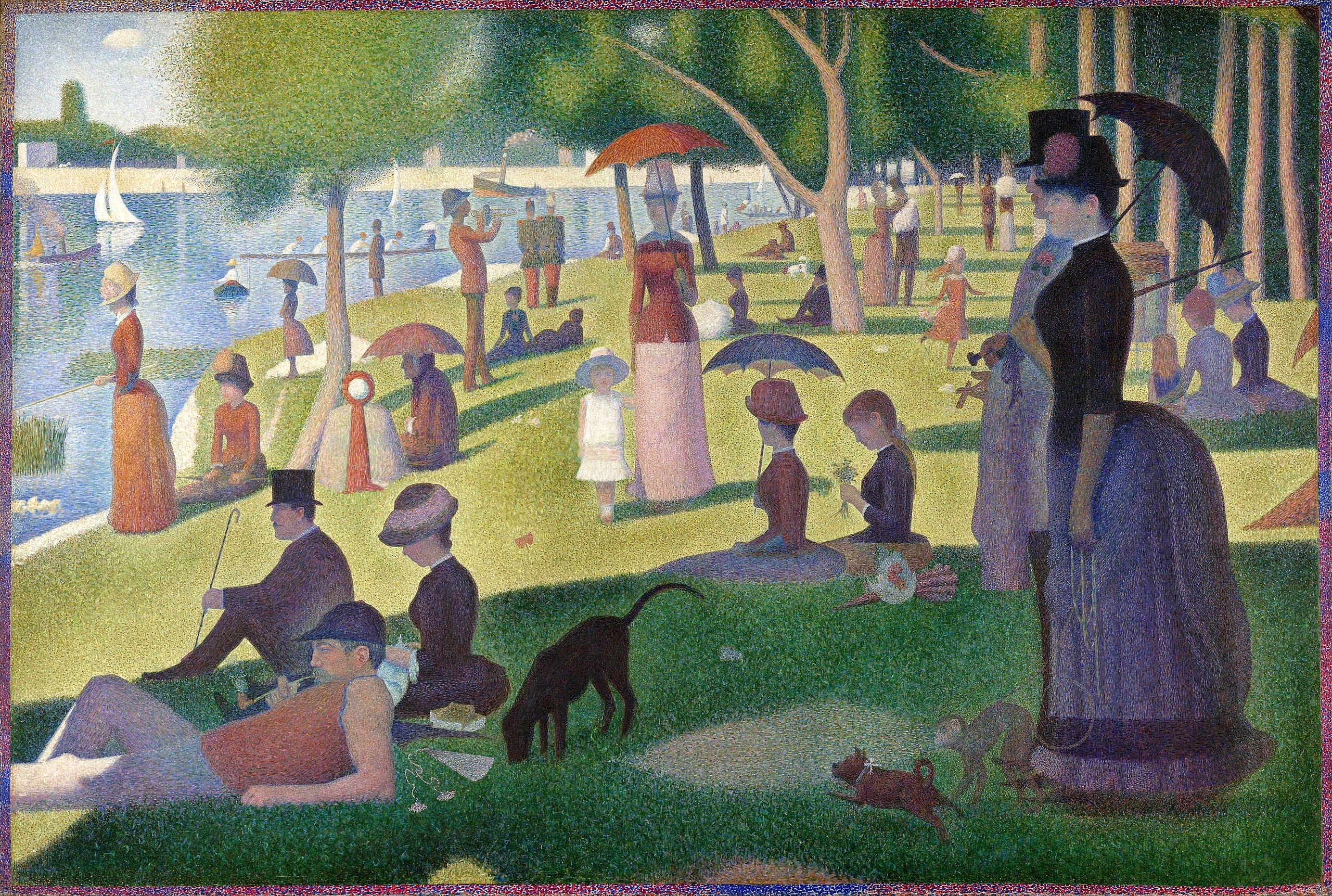
When it was first exhibited at the eighth Impressionist exhibition in May 1886, Georges Seurat’s A Sunday Afternoon on the Island of La Grande Jatte provoked confusion, derision, and—from a few perceptive critics—admiration for its revolutionary technique. Today, it hangs in the Art Institute of Chicago. It is one of the most recognizable paintings in the world, a monumental canvas made of flecks of light. And dark. And parasols.
✍️ Please support our work by upgrading to a premium subscription:
Thank you for reading! A premium subscription offers full access to The Sondheim Hub: an exclusive essay, crossword, extended interview & more each week, plus our complete, paywall-free archive of 200+ essays, features & interviews. 📚
What makes this painting worthy of such sustained attention? How did a young artist create something so distinctive that it would redefine modern art? And how might taking a closer look at La Grande Jatte—its creation, its context, its legacy—deepen our appreciation of both Seurat’s achievement and the musical it inspired?
The Creation of La Grande Jatte
In 1884, Georges Seurat, just twenty-four years old, began work on the painting that would consume the next two years of his life. By the time he exhibited La Grande Jatte in 1886, he had produced more than thirty oil studies, crammed countless sketchbooks with drawings, and covered canvas after canvas with experiments in color, light, and form. What we see today is the product of a careful, deliberate, arguably obsessive quest to get through to something new.
Seurat’s ambitions were grounded as much in science as in aesthetics. Influenced by contemporary theories of color perception, especially the writings of Michel Eugène Chevreul and Ogden Rood, he developed what he called chromoluminarism—more commonly referred to today as divisionism or, less precisely, pointillism. (See our essay “Studying Seurat” for more on this.) Rather than blending pigments on a palette, Seurat placed tiny dabs and dots of pure color side by side on the canvas, trusting that the viewer’s eye would do the mixing. The result, when seen from the right distance, is an image that fizzes with an almost electric intensity, the air itself seeming to vibrate between the figures on the riverbank, who twinkle and shimmer and buzz.
In the words of art critic Robert Herbert, Seurat “transferred Impressionist color into a rigorous, almost mathematical order,” replacing the spontaneity of the Impressionists with a structured, monumental calm. And Seurat’s working process reflected this sense of structure. He spent months sketching directly on the Île de la Grande Jatte, that “island in the river” northwest of Paris, carefully observing the quality of light at different times of day, studying the gestures of the people who came there to stroll, fish, or idle. Seurat’s preparatory studies are marvels of quick observation; only later did he assemble those fragments into a unified whole.