
A Conversation with Stacy Wolf
Princeton Professor, Author, and Pioneer of Musical Theater Studies
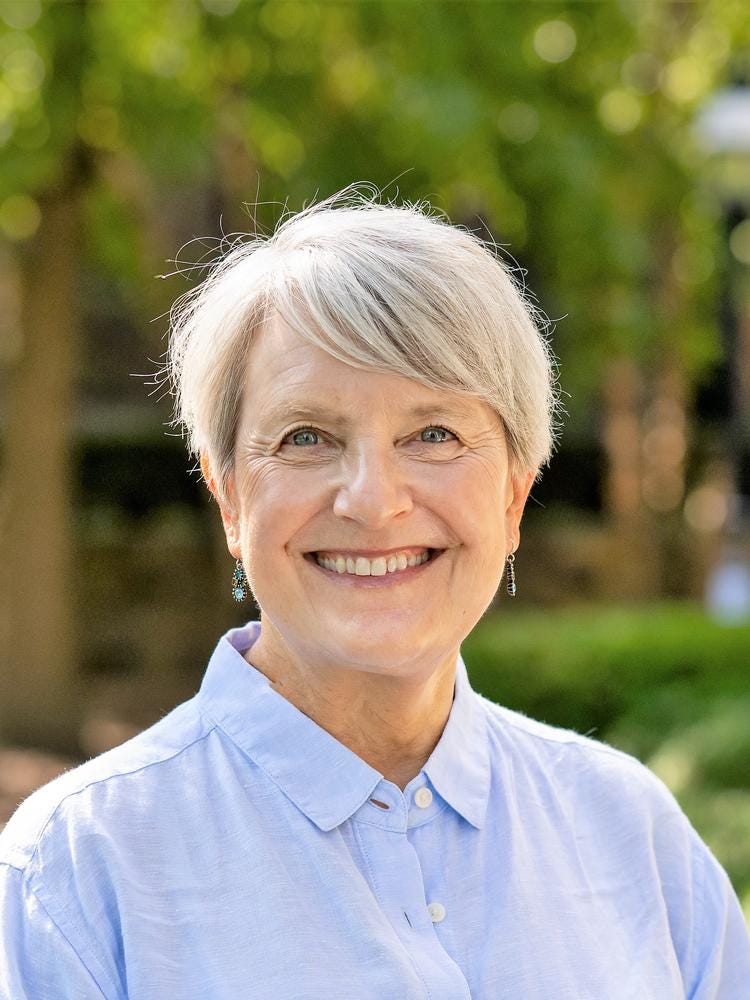
It’s a pleasure to welcome Stacy Wolf, Professor of Theater and American Studies at Princeton University, to The Sondheim Hub. Stacy has spent decades helping to establish musical theater as a serious field of academic inquiry. In our conversation, we discuss Sondheim’s musicals as endlessly renewable texts: works haunted by past productions, transformed by new contexts, and continually reinterpreted by each generation that encounters them. Along the way, Stacy reflects on teaching Company, Passion, Pacific Overtures, and more, offering a fascinating glimpse into how students, performers, and audiences continue to reshape the questions we ask of Sondheim’s work today. Our conversation begins below:
Thank you for reading! If you find our work valuable, consider upgrading to a paid subscription for the full Sondheim Hub experience. ✍️
It’s really good to speak to you. Could I ask you to start by introducing readers to what you do, and how your scholarship intersects with Sondheim’s work?
Thanks so much for wanting to talk to me! I’m a Professor of Theater and American Studies at Princeton. I’ve written a few books about musicals and most recently published a small handbook, Feminist Approaches in Musical Theatre, which I co-wrote with my former student and now collaborator, Paige Allen.
I’m probably in the second generation of musical theater scholars — that is, people take musicals seriously as a form of art and culture and use tools of musicology, theatre and performance studies, and dance studies, as well as history and sociology, to analyze them. We might say that Joseph P. Swain’s The Broadway Musical: A Critical and Musical Survey (1992) and Geoffrey Block’s Enchanted Evenings: The Broadway Musical from Show Boat to Sondheim (1997) were among the first books in the field of what we now call “musical theatre studies.” I came to musical theatre by way of feminist and queer performance studies and popular culture studies. My first book, A Problem Like Maria: Gender and Sexuality in the American Musical, was published in 2002, shortly followed by work that then hugely influenced mine: Andrea Most’s Making Americans: Jews and the Broadway Musical (2004), Scott McMillin’s The Musical as Drama (2006), and two books by my dear friend and colleague Raymond Knapp, which were published in 2005 and 2006. And since then, the field — of which Sondheim studies is a subfield — has exploded!
I first wrote about a Sondheim musical in an article about the women in Company for Robert Gordon’s The Oxford Handbook of Sondheim Studies. From there, I learned about Sondheim’s musicals by teaching a seminar on his work.
Musicals are middlebrow. Sondheim is the highbrow of the middlebrow, and his work is considered serious. In fact, when I first started teaching a Sondheim seminar at Princeton, it was under the course for “master authors” (or something like that), an English department course number that was for single-author courses. It was Faulkner, Toni Morrison — and Sondheim! Now my Sondheim seminar is housed in American Studies with an emphasis on the musicals in conversation with U.S. history and culture.
Since then, I’ve written about West Side Story in my book, Changed for Good; about gender and college productions of Sondheim’s shows in Tony Sheppard’s edited collection; about high school productions of Into the Woods in my book, Beyond Broadway: The Pleasure and Promise of Musical Theatre Across America; and about the gender-swapped Company in an article that Gail Leondar-Wright and I co-wrote, in a forthcoming collection edited by Elizabeth Wells.
I’m lucky because I get to teach what I love, and I get to be with brilliant, enthusiastic students and learn from them every day. Over the years I’ve been teaching, taking musical theater seriously as an academic subject has become increasingly acceptable. I have many colleagues now who teach musical theater history from a critical perspective across the country and around the world.
I’m also lucky because John Doyle was my colleague at Princeton for 10 years. He visited my classes and transformed students’ lives. John generously introduced me to many artists who visited Princeton (we’re fortunate to be a short-ish train ride from NYC). Also, my colleagues, lighting designer Jane Cox, and more recently, Tess James, designed some of John’s shows. This is only to say that a love for Sondheim’s musicals is in the water in Princeton! (Save the date! We are holding a symposium on “Sondheim’s Afterlives” at Princeton on the afternoon of Friday, November 6, 2026, which will feature an impressive collection of artists and scholars talking about Sondheim’s musicals.)
You’ve described meaning in musical theater as something made between text, context, performance, and spectator. As you came to know Sondheim’s work, did his musicals seem like especially fertile ground for that kind of analysis?
No and yes. On the one hand, ALL musicals (and really, all theatre and performance) can be analyzed by way of text, context, performance, and spectator — those elements are essential to interpretation. That said, there is always more to be gleaned from examining Sondheim and his collaborators’ texts (meaning lyrics, music, and book); from considering various historical, geographical, and theatrical contexts of their shows; from experiencing different performances and productions; and from imagining the perspectives of different spectators with their own interpretive practices.
I love teaching Sondheim’s musicals because they are truly the gifts that keep on giving. Every semester, I see or hear things I never noticed before. In terms of performance, more and more directors and designers and actors are thinking about these shows afresh and letting go of the canonical version. I think that John Doyle was the person who really broke that open with his reimagined actor-musican Sweeney Todd, and he left that door open for someone like Lear deBessonet, whose revival of Into the Woods was phenomenal. I heard so many lines in ways I never had before — even though I’d seen Into the Woods a hundred thousand times (maybe a slight exaggeration!). Same with Jordan Fein’s production at The Bridge. And earlier, Fiasco’s incredibly inventive production. There are so many nuances and subtleties in these shows that brave and creative directors, music directors, choreographers, designers, and performers can bring out.
In terms of context, Sondheim has been done all around the world now — professional, non-professional, Broadway revivals, off-Broadway, high schools, community theaters, even primary grades with Into the Woods JR. There are many more contexts to think about. How does this show resonate in this different context? What does it mean to these people (this audience) in this place at this time? And in terms of spectatorship, because of the circulation of his musicals over time, many spectators come to a performance with much more knowledge and experience. They’ve often seen many productions in their lifetimes, which makes for a richer viewing experience.
So, yes — there are qualities of these shows that make them, in these different categories of analysis, especially interesting. Sondheim’s shows give us a lot to chew on.
One theoretical idea I introduce early in the semester is Marvin Carlson’s notion of “the haunted stage” — the idea that every theater space, every character, every play is haunted by past productions. When Patti LuPone performs Joanne, she’s bringing with her all the other roles that she’s played in Sondheim shows, and her performance as Evita, and even Fantine in Les Mis. All of those ghosts come with her when you see her in Company. She’s a diva, she’s Patti, and she’s all of those characters. Also, when she (or anyone) plays Joanne, that role will always be haunted by Elaine Stritch.
This idea that theater is layered, that we never see a performance in a vacuum, and that as more and more Sondheim musicals are revived, there’s a larger collection of ghosts — many, many ghosts in the room — is important. And not only in Follies, which is itself, of course, a ghost-filled show.
Another concept we rely on in my classes was first articulated by the theater historian Freddie Rokem: triple historicity. Triple historicity is the idea that theater exists in (at least) three time periods at once: the time the play is set, the time it was first produced, and the now. To think about Company in 1970 is completely different than thinking about it in 2006 with Doyle’s production, and completely different than thinking about it today, whether that production is gender-swapped or not. And sometimes the very day you’re discussing a show inflects the conversation — which is why theater is awesome, because it’s live.
How do you balance those different layers — the original works and their original contexts on the one hand, and our contemporary frameworks and expectations on the other? Do you see a tension between what these musicals achieved in their own moment and the ways they can be read critically today?
Absolutely. And that’s why, as an instructor, I hope — without ever telling my students what to think — to keep that tension always alive. So, to say: John Weidman and Sondheim were these white Jewish guys who wrote Pacific Overtures because Weidman was extremely knowledgeable about Japan, interested in history, and he had this imaginative, smart, and brave idea for a musical. They wrote a show that, at the time, offered an extraordinary performance opportunity to Asian American performers on Broadway, that brought Kabuki to the Broadway stage, and brought a critical story of the West’s imperialist project to the Broadway stage. From that perspective, it was not only theatrically groundbreaking, but politically groundbreaking.
From a contemporary perspective, students see it as racist, ethnocentric, and demeaning. Because they’re students in this decade of the 21st century, they bring a more progressive critical sensibility. What I hope is that we can talk about and hold both perspectives at once.
Usually John Weidman will visit my class, either by Zoom or in person, and as soon as John starts talking, the students are disarmed. Not only because he’s completely lovely and smart and generous, but because he says to the students: “This is where this show came from.” And he will also readily admit: today, would I write this exact show? Probably not. Probably not today. But at the time, this is what we did. And we did it with our very best intentions. John welcomes the students’ criticisms and underlines the importance of the historical moment, of context.
Every single one of Sondheim’s and his collaborators’ musicals was groundbreaking in its moment — often so much that many audiences didn’t know how to interpret them. They were doing completely new things in terms of characterization, music, story, topic, structure. They were not doing what other shows were doing. But from a critical distance, they read differently. I try to keep that tension alive all the time. Let’s not in any way compromise our own politics and our own critical and political views of these shows. And also, let’s have generosity towards the moment, and towards what happened at the time.
You’ve written about mega-musicals and their treatment of women — often as objects — and compared Sondheim’s work favorably to some of those examples. Sondheim is often unhelpfully pitted against the more commercial composers and shows, but it seems like you’ve identified something genuinely grounded in the texts themselves. Are there some examples you could point to that illustrate that comparison?
First of all, because I write about a middlebrow art form, I’m not that keen on reproducing hierarchies of taste in my classes (even as it’s hard to resist). And I’ve found it falls flat with my students — although now some of them know that they “should” love Sondheim and hate, say, Andrew Lloyd Webber. But most of my students come to all musicals with love and affection. That said, I do think that with the mega-musicals — Les Mis, Phantom, Miss Saigon — the women are only functional, in service of the men’s stories. (Evita, which I love, and Sunset Boulevard are different, so I might be reluctant to make a generalization about ALL mega-musicals.)
In my class, we often talk about “page versus stage.” On the page, the women in these musicals are useless. They’re victims, they’re objects, they have no purpose other than to reveal the complexity and dilemmas and character arcs of the men. But they also get to sing some of the best songs — so how should we think about that?
Something that’s important to me as a writer and a teacher is feeling comfortable with ambivalence and contradiction, and saying: you can absolutely hate this show and love this show at the same time. Having a critical perspective doesn’t prevent you from loving it. That’s how I feel about most mega-musicals (and Hamilton). All the women in Les Mis exist solely to pine after men, to be useful to men, and to be discarded by them. The men do all the things. But the women do get to sing some great songs.
That’s not how it works in Sondheim at all. These women are complicated, and a lot of them are thoroughly… I don’t really like to use the word unlikable, but I think in an art form that seeks to please, to have characters who aren’t villains, but who are complicated and difficult and layered, it’s worth noting. The women’s journeys in these shows are their own journeys. Even a character like Sally in Follies who we might think of as more or less a sad sack — she’s in love, she’s been rejected, she doesn’t get what she wants, the love remains unrequited — her journey in that musical is incredibly interesting. Even just in “Losing My Mind”, in that one song, her journey is compelling.
The women in Sondheim’s musicals are not there for the purpose of male characters to find their way. For the most part they’re very smart — or if they’re not smart, they’re self-conscious.
I was really struck by your idea that a musical can have an emotional or even erotic center of gravity that may not be exactly where the surface of the show seems to place it. Regarding Gypsy, you’ve written about Rose and Louise in that way. How do you think about that now?
Isn’t Gypsy such an amazing show? It’s so good! I just love it. When I wrote that chapter, which was a fairly long time ago, I was struck by the fact that in a musical written in 1959 — a Golden Age musical, if you want to use that term — not only is there no celebration of heterosexual romance at the end, but the whole last section of the show is about the relationship between a mother and a daughter. The powerful reconciliation is between two women. The last moment is two women embracing and going off stage together.
At the time (when I was writing A Problem Like Maria and then Changed for Good), I was thinking about how that ending upends the convention of heterosexual romance as the dominating force, and the dominating narrative, and the dominating political work of most musical theater. I was thinking about Gypsy alongside the end of Guys and Dolls — “Marry the Man Today” — which also, despite the wedding that follows, ends with women bonding. And also alongside “A Boy Like That / I Have a Love” near the end of West Side Story. The musical is a Romeo and Juliet story plus gangs, and then near the very end, there’s this powerful duet between two women that changes the entire gender dynamic of the show.
Thinking about Gypsy now, especially after seeing Audra McDonald’s performance several times, I think I would not say, in the end, that it’s about Rose and Louise equally. I think that it’s a show about Rose, and the other characters are spokes on the wheel around her — including the audience. We are part of the drama. “Rose’s Turn” is a number about the character, the actor, and the audience. We participate in what happens in that song.
What’s fascinating about Gypsy — especially because it was written in 1959 — is that it is about a woman who refuses to be the housewife she’s expected to be. She will not do it. She will not be that kind of wife or that kind of mother. At the end of the show, Rose and Louise have something in common: they are in love with show business, in love with performance. Louise has found herself and expressed her rage. Rose has expressed her rage, partly witnessed by Louise, and fully witnessed by the audience. And that’s how they can go off together — not that it’s going to be happily ever after, not at all. But they can leave for a party together.
If I were writing that chapter again, I don’t think I would make the same argument about the ending. That’s what’s good and bad about scholarship: it’s out there, and there it is. In this case, for me, performance revises criticism.
This seems like a perfect moment to ask about how your thinking about Sondheim might have changed or deepened over the years. You’ve just given a great example from your own scholarship, but I’m interested in how conversations with colleagues and students continue to shape your understanding of Sondheim in 2026.
In terms of colleagues, there’s so much great work out there about Sondheim, so I feel like I’m learning more all the time! I’m fascinated by all the books that are about process, even those that aren’t new, and by criticism that offers new perspectives. There are excellent podcasts, including, for example, Kyle Marshall’s. And your work is really important. Thank you for the work you do!
As far as my students are concerned, the thing about young people is that you do not know what’s going to happen when you come into the room with them. I don’t teach a lecture class; it’s a seminar. We do a lot of on-your-feet activities, all kinds of performance analysis. We do scenes. We play around a lot. But I don’t know what they’re going to think, or how they’re going to react, or what they’re going to say. This is why I learn so much from my students every year.
There was a semester when everyone’s view of Passion completely changed. I had taught Passion for a number of years, and I would raise questions like: what is this musical saying about love? About appearance? About gender? About power? For years, my students did not like the musical, and they were repelled by Fosca. And then one year, they all came in saying that Fosca is a character with a disability, that she has a chronic illness, that her view of love is spot-on, and that she is absolutely a heroine worth identifying with and relating to. And they all loved the show and found it perceptive and powerful. I thought: okay, I guess we’re in a new world here with this musical. So I really never know how it’s going to go, which I enjoy and appreciate.
More and more, my students see Company as being — and this started because I teach the work of Ashley Pribyl, who’s written a lot about Company — about friendship and other kinds of relationships. Marriage doesn’t feel the same to them; many don’t feel the same pressures around marriage. So for them, it’s not exactly a play about marriage. It’s about connection, intimacy, friendship, community. And that’s endlessly interesting to me: that they come at this work from different angles than I do, and they respond to every show in surprising ways.
The Sondheim Hub is a reader-supported publication
If you find our work valuable, consider becoming a paying subscriber.
You’ll get access to our full archive of 250+ essays, interviews & features, an exclusive essay each week, more from each interview, and a weekly Sondheim crossword. Paid subscriptions make our work possible. 📚
“Performance revises criticism” - absolutely brilliant, like most of this conversation!