A Conversation with Robert Kaplow
We speak to "Blue Moon" screenwriter Robert Kaplow
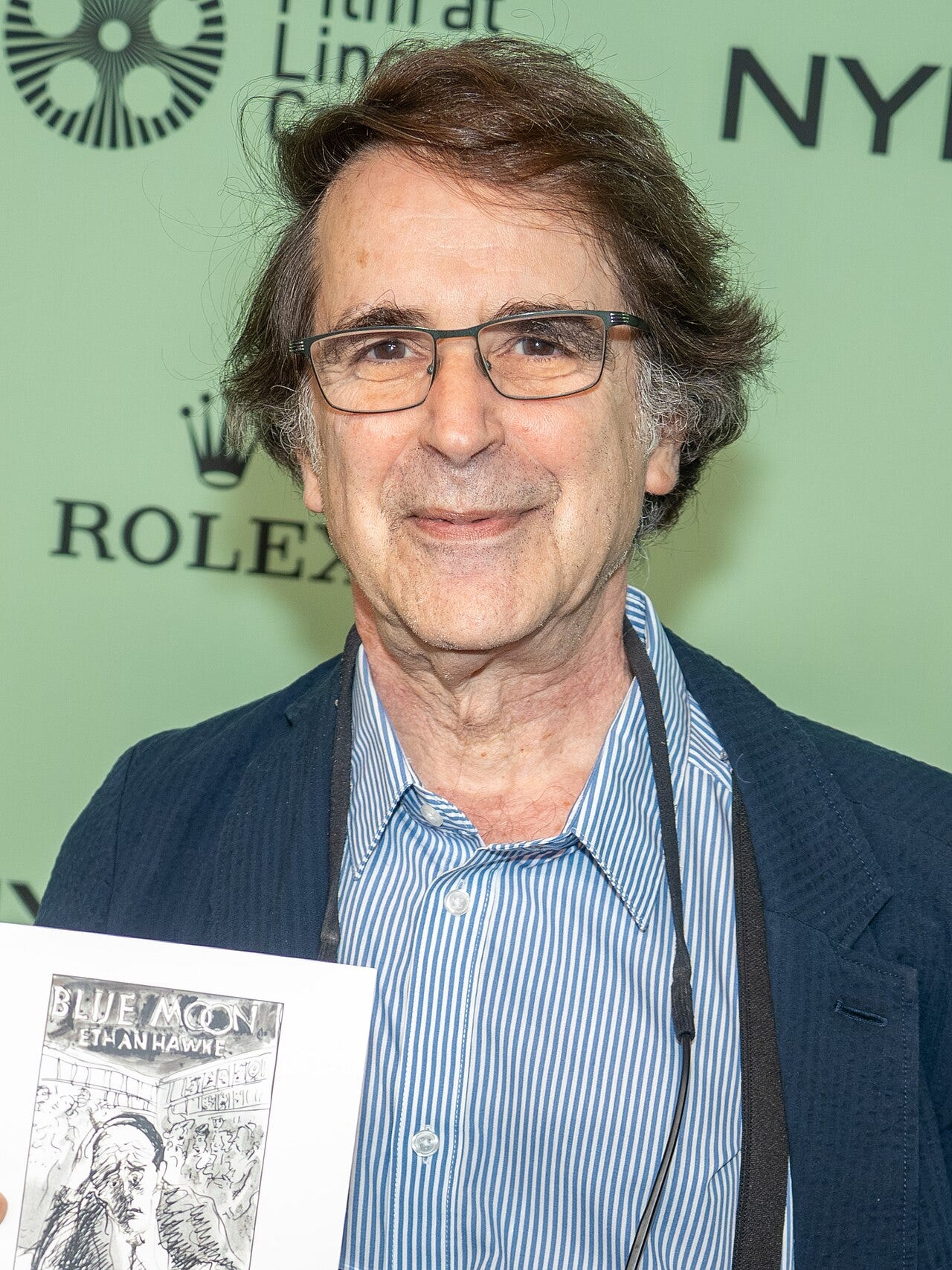
It is a privilege to welcome Blue Moon screenwriter Robert Kaplow to The Sondheim Hub this week. We discussed his decades-long fascination with Lorenz Hart, writing at the boundary between fact and imagination, and the pleasure of writing a film that lives by its words. Our conversation begins below:
Thank you for reading! Upgrade to a premium subscription for full access to The Sondheim Hub: an exclusive essay, crossword & extended interview each week, plus our complete, paywall-free library of 200+ essays, features & interviews.
As a writer, so many people and potential subjects must spark your interest. When did you know you had to write about Lorenz Hart?
My interest in songwriting and songwriters is from my early 20s, when I actually thought I might become a songwriter. I had some interest and some talent in that regard. During those subsequent decades, as a labor of love, I read anything on Rodgers and Sondheim and Frank Loesser—any of the figures that I really admired from that period. And I suppose it was coalescing in some way.
I knew for a long time that Lorenz Hart had gone to the opening of Oklahoma! That seems to be a factual thing, in that he put on a very brave face and applauded louder than anyone in the room. And I knew that was worth writing about. I mean, that just seemed to me so complicated emotionally—and a brave thing to do, I think, for him, too. Brave and a little self-destructive at the same time.
And then, 10 or 15 years ago, I encountered some letters through an estate sale in New York from a young woman who had been writing to Hart. She kept carbons of her letters to him, and I bought them. They were more thought-provoking than explicitly revealing, but I knew this would give the story another dynamic.
I think if the film was just Hart showing up at Oklahoma! and realizing he’s watching his own career eclipse in front of his eyes… I mean, that’s a good story, but I don’t know if that was a whole story that I could have brought in for a landing in 90 minutes. Whereas if I had this other subplot, which is his own romantic confusion, I thought that could give the story body. The story could be about the collapse of his professional life and his personal life at the same time. And the way they would intertwine, I thought, would put blood in the veins of this story.
Do you have rules for invention around real people when you’re writing? Are you always reaching for an emotional truth, even when there are things we can’t know?
That’s an interesting and difficult question to answer. I think as a historical novelist or writer, you try to get the history as accurate as you can and as seamless as you can, so that when the story moves into the realm of the imagined and the “what if,” the line isn’t that clear. I think if you can convince the reader, “Well, maybe this could have happened. Maybe this did happen,” that’s when it works really well.
Some years ago, I wrote a novel, Me and Orson Welles, which is about Orson Welles putting on his 1937 production of Julius Caesar. I invented this whole other story within the parentheses of that larger story, and I think that was the fun of it.
And so, in the case of Blue Moon, I wanted to have Hammerstein obviously showing up at his own opening night, and I could have brought him into Sardi’s with his wife. But I just thought it would be much more entertaining if he had the young Stephen Sondheim with him.
The truth is that Sondheim said that the first real opening night he went to for Rodgers and Hammerstein was Carousel. Sondheim tells the story about sitting next to Dorothy and crying uncontrollably into her fur coat. And so it’s just about bending the truth a little bit, and Sondheim is now showing up for the opening of Oklahoma! instead.
It’s interesting: in one of the early drafts, after they had their scene—Sondheim and Hammerstein and Hart, with Hammerstein leading Sondheim away to take him back home to Doylestown, after he’s made this slightly bitter appraisal of Hart’s work—I had Hammerstein saying something like, “Listen, nobody cares what a 12-year-old Stephen Sondheim has to say about his work.”
And my friend, the artist Ed Sorel, read a draft of the script, and he said to me, “Don’t reveal that it’s Sondheim so explicitly. Let the audience figure it out or not figure it out.” That was such a good suggestion. So I cut that out, and he’s never identified. If you stay for the credits, it says Stephen Sondheim, but within the body of the work he’s never identified. And I like that.
It’s the same way when Elizabeth shows up at the party. She calls her date George Hill. But until the credits, some people are not going to put together that that’s George Roy Hill, who’s going to go on to direct Butch Cassidy and the Sundance Kid and The Sting. And so when Hart says to him, “Avoid love stories, make stories about friendship,” of course, that’s exactly what George Roy Hill is going to do in his career. So it’s one of those things you get or you don’t get, you know?
I loved that we meet E.B. White in Sardi’s, too. What interested you about putting Hart opposite White? Was it important to you that he wasn’t a man of the theatre, per se?
I think I needed a serious writer and a serious stylist. Hart says, “I’ve been reading these essays,” and those essays were appearing monthly in Harper’s Magazine. E.B. White was writing these essays all during those war years, which were eventually collected in a book called One Man’s Meat. And I think I needed them both to admire each other as wordsmiths. They could talk about, you know, “What’s the perfect word here?” “Ineffable.” “Yes. And ethereal.”
We see in Hart someone whose whole life is language. He didn’t have the looks. I think his whole adult life was, “The only way I’m gonna be seen is if I’m the smartest and funniest guy in the room.” And he recognizes E.B. White as somebody smarter than he is, and probably even better with language than he is.
Once you’ve seen the film, it’s almost impossible to separate the voice you found for Hart from Ethan Hawke’s brilliant performance. When did you know he’d be playing Hart—and once he was involved, did that voice change at all?
Well, when I see the film, it is the voice I imagined—but I don’t know if another actor could have pulled that off. Richard Linklater and Ethan Hawke are friends, and that’s how Hawke got pulled into it.
I remember Hawke wanted to meet with me and talk about the script. This is before he had agreed to do it or anything. And so I met with Ethan in New York, in a coffee shop. He didn’t really know Lorenz Hart until this script, and he had a lot of questions. So we’re having lunch, and we’re talking for an hour, and he still hasn’t said, “I’d like to play this.” I was thinking, I should probably ask him that question before this lunch is over and the moment is gone.
Finally, as we’re winding down and he’s telling me how much he likes it, how poetic it is and all this kind of stuff, I finally said, “Do you think you could play this role? I think you could act this role.”
He looked across at me, and he goes, “I could act the fuck out of this role.” That convinced me.
And then, from that point on, I think the assumption was he was going to do it. We would meet at Hawke’s townhouse in New York—Hawke, Linklater, and I—and just read the thing through. It took us two days to read through the script, because I’m sitting there with a pen in my hand and tweaking the lines, and they’re saying to me, “Haven’t we heard this already? I don’t think the audience needs to hear that twice,” or, “He’s calling her Elizabeth too often. Let’s lose half of those.” We were all in the dramatic crucible, trying to make this thing work.
But the nice part was, the ultimate edit was always mine. Nobody changed anything. They would ask me what I thought, and would this be better? But throughout the whole process—and the process was 10 years long—nobody ever strong-armed me into making some decision I didn’t want to. Nobody ever said to me, “This whole film is in one room. Why don’t we have some scenes outside the room? When she tells the story of her boyfriend at Yale, why don’t we cut to that and show that?” I really thought somebody was going to say that.
But I think Richard Linklater knew that this was going to be a very intimate chamber piece. You look at a film like Ingmar Bergman’s Scenes from a Marriage, and you don’t say, “Gee, this should be a stage play, because there are only four people in it.” No. It’s meant to be a very intimate movie, where the camera is inches away from these people.
Right. And I think part of the magic of this film is that, even though it’s contained in one space, it feels porous: people drift in and out, the world beyond is always pressing in. Did that sense of a liminal space shape how you introduced and used, say, E.B. White or Elizabeth?
Yeah, I think that’s probably the only way to have done it. Because he comes in, there are these intimate scenes, they talk about the war, and then he’s gone. And Elizabeth comes in for a minute in the beginning, and then she’s gone until the last 20 minutes of the movie, when she has that long scene in the coat room with Ethan.
I remember when we got to Ireland and we were on the Sardi’s set there, Ethan at first wanted to wander around as he was doing a lot of these speeches. But he couldn’t really do that because of the height thing. The set was built with these trenches that he could walk in, so he would be a foot shorter than everyone else—but he couldn’t just walk at random, and he had to come to terms with that.
And we finally realized, if this guy really was that small, he wouldn’t be walking around that much. He would be finding a place at the bar, and other people would be coming to him. He would be holding court. And I thought that was kind of a breakthrough in the way that they realized this had to be filmed.
Finally, I’d like to ask: after spending so much time with Lorenz Hart, have you learned anything as a writer from him? And what do you hope a young writer might take away from the film and the man at its heart?
Well, I certainly admired him before I wrote the script. But I really admired him as I wrote it and worked on it more, as I looked closer at his lyrics. Even at the end, when he’s writing those songs for A Connecticut Yankee—and this is weeks before he’s dead—those songs like “To Keep My Love Alive” are brilliant lyrics.
Even at the end, when he’s suffering from alcoholism and depression and all these things, as a creative writer, Hart remains brilliant. It’s in his DNA. And I think I came to really admire that a lot. I don’t know if I see Hart as tragic so much as heroic, in a way: that in the face of a changing world and a changing audience, he remains true to his creative drives.
And to me, one of the nice things is that I think a lot of people didn’t know who Hart was before this movie came out. They knew Rodgers and Hammerstein, and maybe they vaguely knew that these other songs had been written. But I think he has been a forgotten figure. If people rediscover him and his work through the film, that would be deeply satisfying.
✍️ For premium subscribers, the conversation continues on Friday. Consider supporting our work for full access to The Sondheim Hub:
The Sondheim Hub exists solely thanks to the generous support of our readers. Please consider supporting our work for a few dollars per month. A premium subscription gives you full access to The Sondheim Hub: an exclusive essay, crossword, extended interview & more each week, plus our complete, paywall-free library of 200+ essays, features & interviews. 📚


Such a beautiful film! The pacing, the confinement, the dialogue. Also, love the E.B. White bits! What a guy
A wonderful interview. I must see the film. I’m currently enjoying the book SOMETHING WONDERFUL, by Todd S. Purdum. Learning so much about Rodgers and Hammerstein….and more about Sondheim. Love it!