
A Conversation with Richard Kind
It is an honor to welcome beloved character actor Richard Kind to The Sondheim Hub. Mr. Kind’s admiration for Stephen Sondheim runs deep—so deep that he considers him “the best artist since Shakespeare.” In this candid conversation, he reflects on his time starring in Bounce, reveals his passionate vision for how that show could be reimagined, and offers insights into Sondheim’s creative process and enduring legacy. Our conversation begins below:
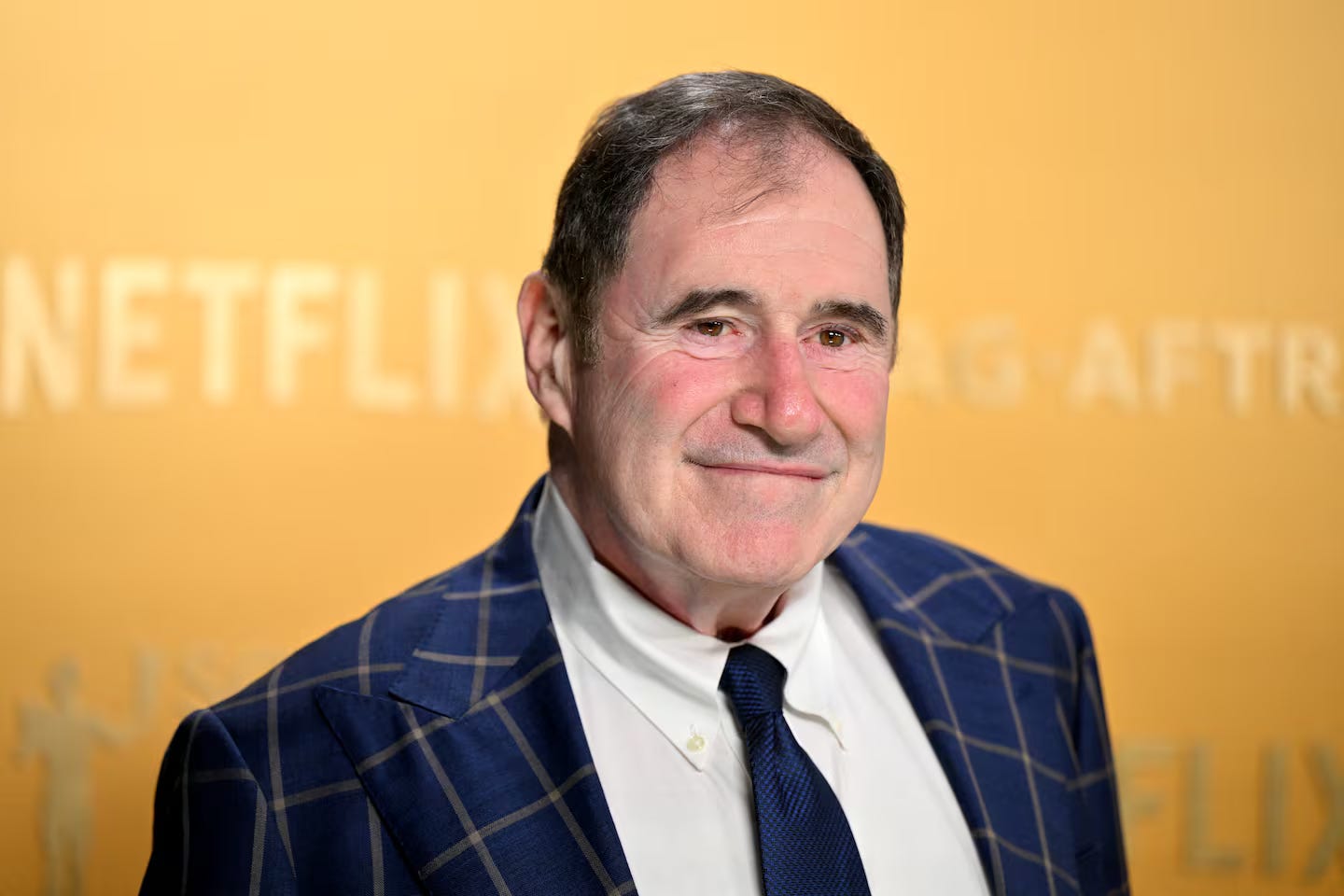
Richard, it’s such a pleasure to meet you. I’d love to start with Bounce, which you’ve described as a masterpiece. Among all your work on stage and screen, what marks that experience out as special?
I love rehearsal periods. Rehearsal is my favorite time. And the experience of working with Hal Prince, Stephen Sondheim, and John Weidman makes that time very special indeed. After the show, you go out for a drink, you talk about the show, and you ask them questions. I think the show can be done correctly. I don’t know whether it has yet had its great incarnation. I liked Road Show very much, but I think there were some things that were missing, that I thought had been so good in Bounce. I think a good patchwork of Wise Guys, Bounce, and Road Show can and should be made.
Is that a project you’d like to take on yourself? I’m thinking of Nathan Lane’s work on The Frogs…
I would love to. I’d love to work with John Weidman to do it. I don’t think I’m a good enough director to stage it alone, but I certainly would have my ideas of how to do it.
Had you met Sondheim before you starred in Bounce?
I tend to tell stories a lot. This is the story of how I met Stephen Sondheim.
I had been in a room with him many a time, and I had probably had the opportunity to go up and talk to him. But there are a handful of people in my life who I admire so much that I’m afraid I would not be able to find the words to talk. I’m afraid I would just start dribbling out the side of my mouth.
So I auditioned for Sondheim having never met him before, but having been in the same room plenty of times. I got the role of Addison in Bounce, and I was invited to Hal Prince’s Christmas party. Steve was at the Christmas party. I had grown a beard between my audition and this party. I went up to Steve and I said, “Excuse me, Steve. Do you know who I am?” And he said, “Yes, you’re Richard Kind. And the beard goes.” That was the first thing he ever said to me.
And then we really started talking. I was very effusive about my admiration for his work, and how I think he’s superhuman, and he said something to me that was very telling. He said, “I am not my songs. I’m just a nice Jewish boy from the Upper West Side.” But I do think that his songs will withstand time. They will live for centuries after we’re all gone.
I will also tell you that, in my opinion, I do think that Stephen Sondheim is the best artist since Shakespeare. And I mean that literally. I’m taking into account Dostoyevsky. I’m taking into account Chekhov. I’m taking into account Arthur Miller. What Sondheim can evoke through a chord, or with a lyric, is without equal. And it’s not just the emotion: he can propel a story and expose any character. I’m astounded by it. I don’t know of anybody else today that can do that, within the constraints imposed on you by meter and rhyme. And that’s just like it was with Shakespeare.
I was lucky enough to see the original production of Sweeney Todd with Angela Lansbury and Len Cariou in previews, and I went again early on in the run. That’s when I first knew I was in the same space as genius.
After Bounce, but before it became Road Show, you were involved in a private workshop of the show with Bernadette Peters.
Yes, I actually was!
How much do you remember of the show at that stage?
I’ve got to admit, I don’t really remember much of anything. It was a workshop that we did primarily so that Oskar Eustis could see about doing the show at the Public. That’s what we were doing. But I don’t think there had been much change by that time. They changed it drastically for Road Show, of course. “The Best Thing That Ever Has Happened,” the song Wilson sang to his wife, was changed to be between Addison and Hollis. And I think that was right. But I personally think it should be both.
I’d love to know what your memories are of Sondheim the collaborator, in that rehearsal room for Bounce.
He was meticulous, of course. Every so, and, or but was meticulously chosen—so you didn’t mess around with it. And he was always consumed with the real estate boom and collapse, the song at the end of Act II. He just felt he could never get it right. I thought it was right. You accept that there was this huge rise and fall, and that the fall was tragic. He was always tinkering and rewriting that number. He seemed to be consumed with it, and he’d make changes all the time.
There was a wonderful song when the show was Wise Guys called “A Little House for Mama.” When I spoke to Nathan Lane, who had played Addison in Wise Guys, I told him they’d cut it. He goes, “Why would they cut that song? It’s the most beautiful song.” And I thought he was absolutely right.
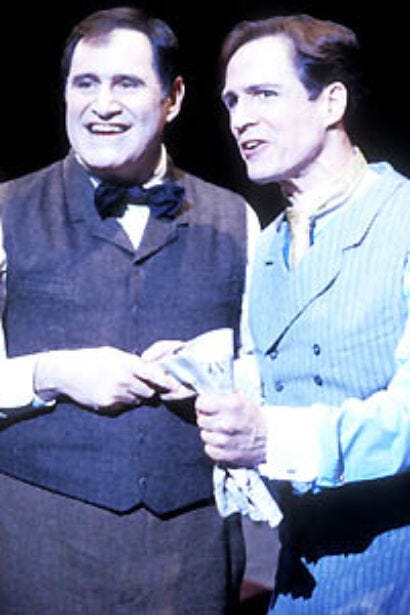
The show ends with the magnificent sequence where I’m screaming, “Get out of my life,” and Wilson is saying, “You’ve always loved me.” I had a conversation with Stephen about this. It’s a little gross, but I thought Addie was in love with Wilson. I thought he was literally attracted to him, and of course he partly also wanted to be him. Even though they were brothers, I think Addie admired Wilson so much that that’s what truly broke his heart. And Stephen thought the same thing. Nothing sexual, of course. And we didn’t want to underline it too much, but we did want to at least hint at it. We tried to hint at it with some of the staging.
Right. That idea of “Brotherly Love,” which became a song for Road Show, left slightly more open to interpretation?
Exactly. Sondheim always said that what he set out to create with this show was a Hope and Crosby musical. Now, I don’t think it was. But I think it could be. I think it needs a sitcom writer to come in and punch it up with jokes. Literal jokes, where they get in trouble in the Yukon, or he gets in trouble when he’s doing the fight promotions. That said, John Weidman’s script tells the story just perfectly.
My idea is this: the first act, when you’re in your youth, you’re trying to answer that question of where do I belong in the world? What am I doing? What kind of a person am I? You go traveling. You go find yourself. So it really is a Road picture, like Sondheim wanted to do. You bounce around like you’re in a pinball machine. The whole first act should be like the song “Addison’s Trip.” I’m on my way… He’s going to Madagascar, he’s going to Morocco, he’s going all over the place. I think that’s what the boys are doing.
In the second act, after you’re 35 years old, you settle down. Some people settle down with a wife and kids. I think these guys settle down into what they’re going to do. Addison knew he was an architect. That’s what he did. So the first act should all just be bentwood chairs, signifying the gold rush, signifying a whorehouse, or signifying a boxing ring. And then the second act should be sumptuous. The scenery should be beautiful. It should be a nice, full, well-appointed Broadway musical. There should be a real different feeling between Act I and Act II.
If you know the father’s song, it’s a little zany. He gets up out of his death bed and starts talking about money. That’s pretty zany. I think that’s what the first act needs a little more of. It needs truly wild stuff. You need these little vignettes, little chapters, of just flat-out craziness. And then in the second act, it becomes more like a play.
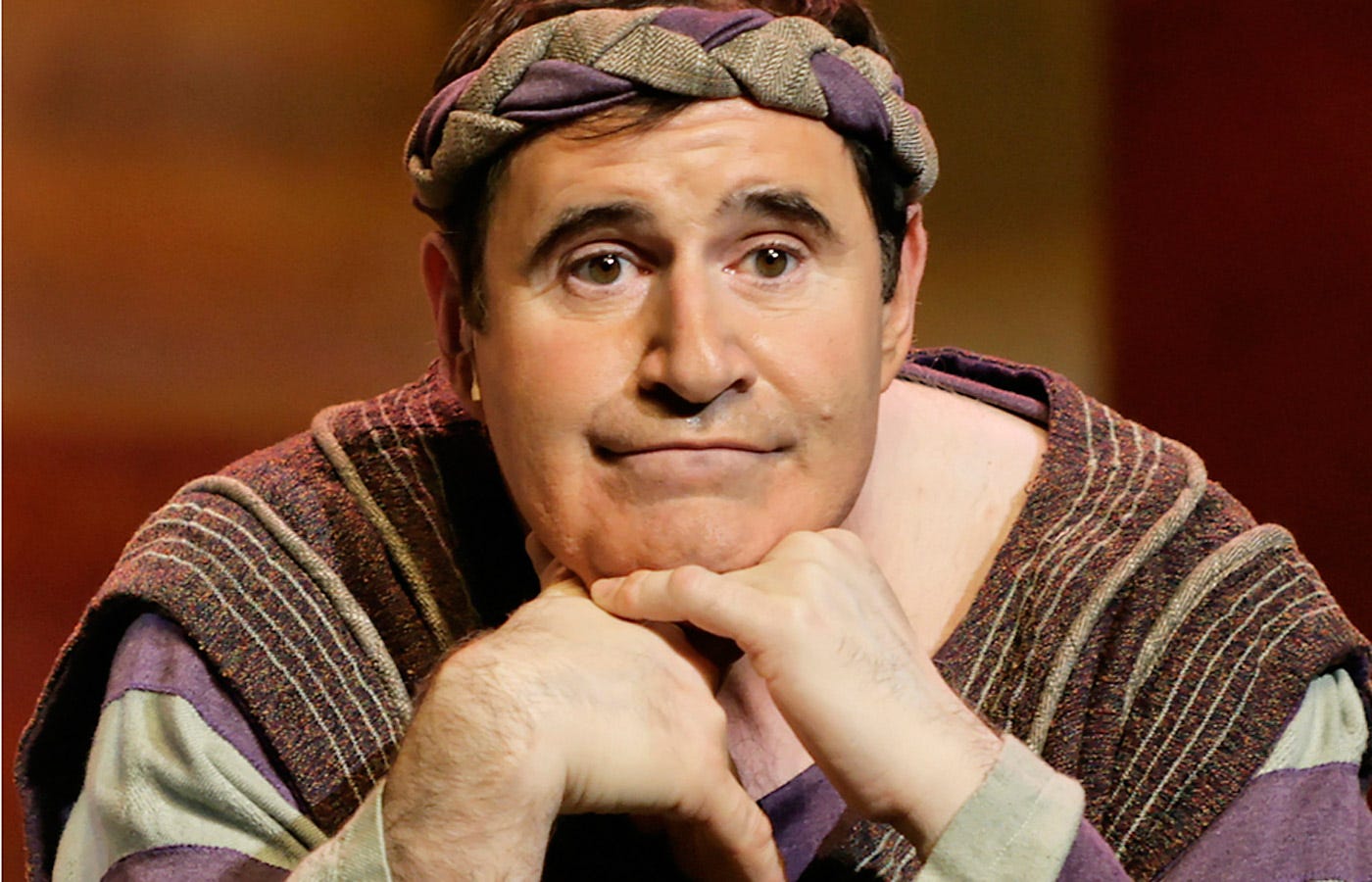
Talking of a libretto being punched up with jokes, A Funny Thing Happened on the Way to the Forum springs to mind. You’ve played Pseudolus more than once. I’d love to know your reflections on that show and that character.
Well, let me talk personally about Pseudolus and Richard Kind. Quite often I am offered roles where I play weak guys, like I did just recently in Poker Face. Pseudolus is 180 degrees away from that kind of character. Pseudolus is brash and loud and aggressive. But I have played those kinds of characters, too. I think Max in The Producers is such a role. Roles like Pseudolus come along and roles like Hysterium come along. I’ve never played Hysterium, but I could!
And that’s the brilliance of Burt Shevelove and Larry Gelbart: they were able to encompass all these different types into that one play. It’s an astounding libretto. Astounding.
And you want to hear a story? Almost everybody involved with A Funny Thing Happened on the Way to the Forum was nominated for a Tony. David Burns was nominated, and won. Zero Mostel was nominated, and won. Shevelove and Gelbart were nominated, and won. George Abbott, who directed, won too. Stephen Sondheim wasn’t even nominated. And, when everybody went up to collect their awards, nobody thanked him. How terrible is that? Nobody thanked him! And it’s an outrage that he wasn’t even nominated, of course. I think it had a big effect on him. He was sore, he told me 50 years later, that that had been the case.
Were you able to talk to Sondheim about those other shows that had meant so much to you over the years?
You know what’s interesting? I don’t think I ever spoke to Sondheim about any of his other musicals. I honestly don’t think I ever did. I’m sure he told stories about his shows. But how you and I are talking now? I never did. And I just realized that. Now, we did spend many a night together, talking about other things. We talked a lot about his film work: Dick Tracy, The Last of Sheila, Topper. But we never talked about his shows.
Let me tell you one more thing that Sondheim said. I did tell John Weidman some of my thoughts about Bounce at a lunch that we had, and he said, “Oh, yeah, those are all good ideas.” So then I’m at a party somewhere with Stephen, and Road Show had just been up at the Public. And I said, “Oh, you know, I have these thoughts…” And without me even talking any more about them, Steve said, “Nope, I think we’ve got them solved with Road Show.”
And I loved Road Show. I thought Road Show was great! Alexander Gemignani was magnificent as Addie. But I loved it the way that I loved Bounce: these are great shows, but there are things in both of them that could be made even better.
Another wonderful interview, thank you! I wonder if, in your conversations, Richard’s brilliant performance in “Co-op,” the hysterically funny and clever spoof of the “Company” recording documentary, ever came up. He deserves mega kudos for that tour de force.