
A Conversation with Mark Eden Horowitz
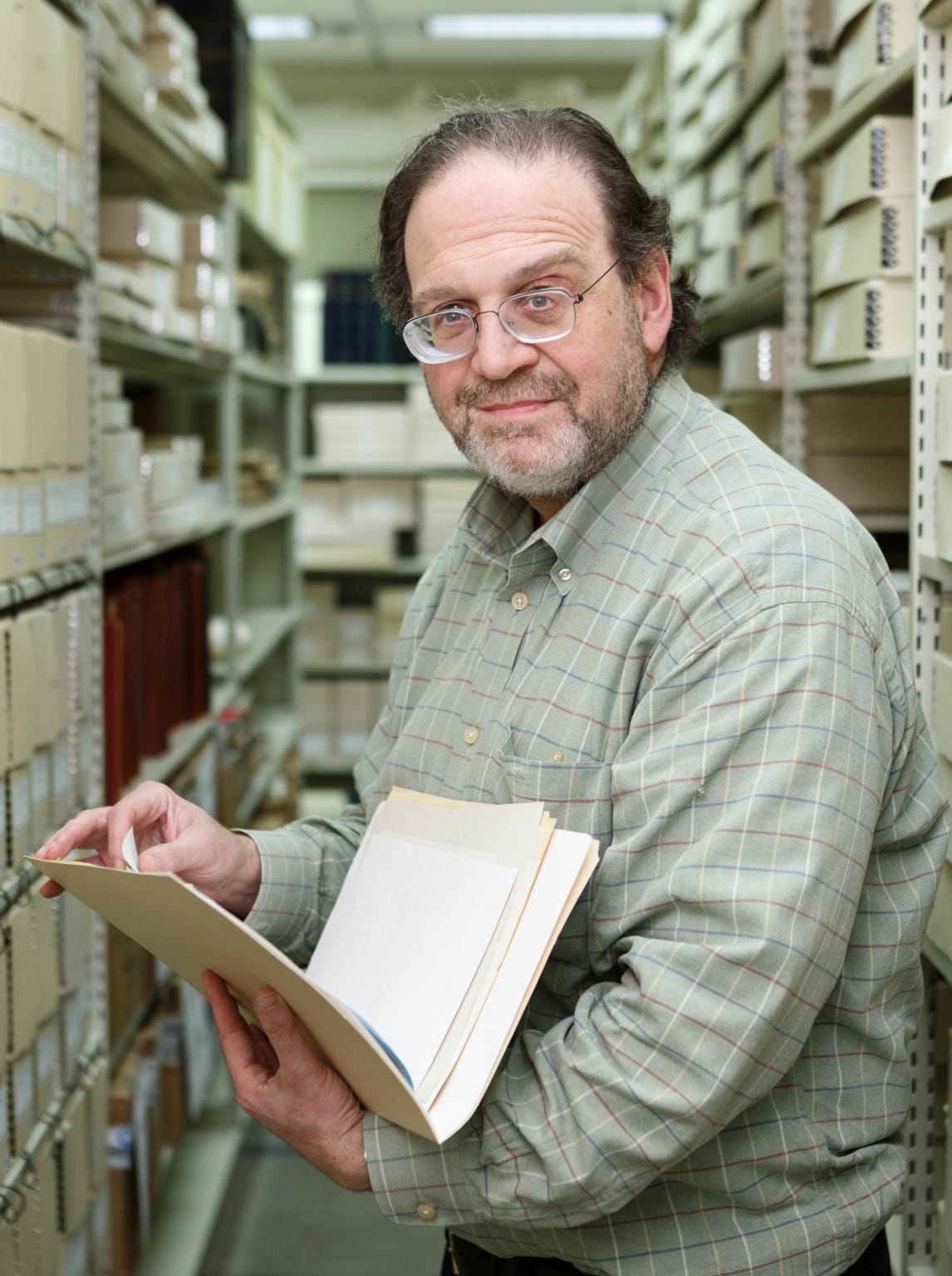
It is an honor to welcome Mark Eden Horowitz to The Sondheim Hub. As a Senior Music Specialist in the Library of Congress’s Music Division, Mark is a principal steward of the newly opened Stephen Sondheim Collection. He is the author of Sondheim on Music: Minor Details and Major Decisions, which emerged from his landmark 1997 conversations with Sondheim. Below, Mark reflects on those extraordinary conversations, what excites him most about the collection, and much more besides. Our conversation begins below:
✍️ Please support our work by upgrading to a premium subscription:
Thank you for reading! A premium subscription offers full access to The Sondheim Hub: an exclusive essay, crossword, extended interview & more each week, plus our complete, paywall-free archive of 200+ essays, features & interviews. 📚
You begin the introduction to Sondheim on Music by writing, “Stephen Sondheim became my teacher long before we met.” When did you first meet, and what were some of the first things he taught you?
The first time we actually met was in January of 1980. I was a senior in college. I had fantasies of I’m not sure what, but his work had already become so important to me. It had already changed my life at that point, because it had made me change majors in college. I wanted to pursue musical theatre as my life’s work.
The most fun encounter we had during that first meeting was me asking him, “Other than your own works, what works of recent vintage are you a fan of?” Do you have any idea what his response was?
Hmm, speaking in 1980? Did he mention The Wiz by any chance?
That was it! He saw the shocked look on my face, and he said, “And I’ll tell you why. There are three primary reasons. One, I thought the staging of the tornado was brilliant.” Then he talked specifically about the song “Ease On Down the Road,” and he said, “Do you know what prosody is?” And I shook my head, no. And he said, “It’s the way a lyric sits on a piece of music, and that lyric was born to sit on that piece of music. And you have no idea how rare that is.” And his third reason was the song “Home,” which he said made him cry every time he heard it. He said, “I could never write a song that sentimental, and we always tend to envy that most which we could not do ourselves.”
That’s my most memorable takeaway from that meeting. He had no memory that we’d met then. But in 1990, I’d been working at Arena Stage, a local regional theater in D.C., for several years, and we were doing a production of Merrily We Roll Along. I was the assistant to the musical director for that production, and Steve was involved in that, and that’s when we really met.
George Furth was there the whole time, and he and I became pretty good friends. Steve was mostly around for the last week, and in fact, he borrowed my rhyming dictionary as he was writing new lyrics. And when he handed it back to me, he said, “And just so you know, I’ve written in some missing words.” Which he had, in fact, done.
As you talk, a picture is already emerging of Sondheim the natural-born teacher. I’ve always been struck by how vividly that quality shines through in your 1997 conversations with him. How did you strike such a good balance between meticulous, detailed preparation and leaving enough space to be led by what he said in the moment?
Well, the evolution of those interviews was so unexpected. There was no idea that they would become a book. The whole point of them was that he’d promised us his collection, and I thought, wow, it would be great to be able to interview him now with his manuscripts, to try and answer questions for future researchers who come to look at the collection.
I spent three days in advance of the interviews with his collection, looking through things, photocopying pages that looked interesting to me. Then I came back home and tried to gather my thoughts and make decisions about the questions I wanted to ask, the things I wanted to focus on. I corresponded with some people, too. I asked Gemignani and Tunick and other friends for their input on questions I should ask.
I’d never done anything like this before, but Sondheim really was such a natural teacher. Once we started, it was just instinctual that if he wanted to talk, I’d let him. Anything he has to say is going to be more interesting than anything I have to say. Mostly, I was responding to what he was saying: anything I wasn’t sure about, or unclear about, or wanted to find out more about. For the second edition of the book, when I went back for another set of interviews, I took that as my opportunity to ask more of the questions that had been weighing on me over time.
Now, of course, the Stephen Sondheim collection is open at the Library. I suspect no one in the world is more intimately familiar with these manuscripts and papers than you. What excites you most about the collection, and about the response to it so far?
Well, I will tell you, the response has been incredibly gratifying. It’s been three months since we began serving the collection, and we’re already breaking records. The most heavily used collection in the entire Library last year was NAACP in the Manuscript Division, and they had 450 call slips over the course of the full year. We’ve had 250 in just three months for Sondheim.
But it’s not just the quantity. We had a couple coming on their honeymoon. We had parents bringing a teenager who was such a fan. We’ve had to bring people Kleenex because they started crying. And I’ve seen people literally shaking when they start looking at the actual manuscripts.
I’m not sure that I want to give advice to anybody. I give talks to young people often, to students, and I tell them: don’t come to a collection looking for something specific. Let it come to you. I’m a big fan of just looking through things until something hits you and strikes you as being of interest. Otherwise you’re working on your own assumptions, as opposed to being open to things that you wouldn’t otherwise discover.
It’s funny, even though the interviews I did with Sondheim were mostly about the music manuscripts, the reality is, he gave me more credit than I deserved in terms of actually understanding his sketches. And I’d love for somebody who’s a master of musical composition to really look at these musical sketches and interpret them for us, because they really are fascinating.
And it seems to me that there are more and more sketches the older he got. That’s been one of the surprises of the collection. You know, for Company, there were three sheet music boxes of material. For Follies, I think there were six. For Sunday in the Park, I think there were nine. For Into the Woods, I think there were twelve. And the amount of both music and lyric sketching that he does is unlike anything I’ve ever seen in another collection of any kind of composer, any kind of lyricist—just the sheer quantity and organization of them. It really is staggering just how much there is, and how many pages there are.
You paint such a vivid picture of the emotional response people are having to this collection. For you, remembering the experience of poring over these manuscripts with Sondheim in such detail, that emotional component must have been pretty heightened.
The emotions are all over the place about it. It’s been incredibly gratifying. There’s also a certain level of sadness, because he’s gone. Again, there have been so many times I’ve wished I could ask him about something. Processing the collection, I had to force myself not to get too lost in the work itself. And it was hard, because you’re going through every page, and things catch your eye, and you want to start studying them. But we wanted to process the collection as quickly as possible, so we could get it out there.
Every day, there would be things that would catch my eye. Here’s a silly example, relating to Company. One thing I hadn’t appreciated before is not only are there so many pages of his manuscript lyric sketches, but then there are often many pages of typescript lyrics that he was still editing and changing. And for “Barcelona,” there was a typescript of the lyric which had Bobby singing “Barbara,” and April singing “April.” He’s crossed out “Barbara” and written “June” above it. I’d always assumed that the whole idea of naming that character April was just so that he could do that joke! So to realize that that was such a late lightbulb going-off moment, where he realized how much funnier it would be that way… It’s things like that that are just staggering.
And then, going through all the Merrily transitions, I was shocked at how much there was. You could do a whole history of the United States with the things that he left out, that he had versions of, and just the lists and lists and lists of all the possibilities to include in those little segments. One of the things I’d like to do is type those all up, but I haven’t had time yet.
I love that. Are there particular projects, then, that you’re planning to pursue personally within or around the collection over the next, say, five or ten years?
Well, first of all, when you say five to ten years, I’m about to be 67, so I’ll probably be retired within around five years. Not that I can’t continue to do things after I’m retired. But in many ways, I feel like it’s time for me to give it up to the public. I feel like I’ve done my primary bits, and now it’s for other people to discover and make the connections and do the work.
I produced Sondheim’s 70th birthday concert at the Library, and one of my fantasies is that I’d very much like to do a concert for his centennial. That would be, I think, my final thing. And having the collection now and seeing all the things that are there, it opens up enormous possibilities. I thought I knew everything he’d written, at least by title, before this, but there are things that I never knew existed before. I just can’t wait to share them with people.
For example, in the 1970s, the public television station in New York had a fundraising auction, and Sondheim offered up that he would write a song for someone. The high bidder was a young guy, Frank, who had Sondheim write a song for his mother’s 50th birthday. I’d never even seen the title of this song before. We have the letters from the guy explaining things about his mother, and they’re wonderful letters. And then seeing how Steve turned that into this song is fascinating. The guy had three siblings, so Sondheim wrote the song for the four children, using their voice ranges, having them do a sort of barbershop quartet thing at the beginning.
And I discovered that for A Little Night Music, there was a whole early version of the song “Now” for Fredrik. I think Sondheim forgot he wrote it, because I’m sure he would have included the lyrics in his lyric book if he’d remembered. The thing is, I think it’s musically much more interesting than the final version. But the final version, I think, makes more sense for the character. It’s the more tight-laced, repressed character of Fredrik. This earlier version is much more free-flowing and emotional and dramatic.
There’s also something called the “French Waltz,” which he wrote. It was just a piano piece. But the title on it is “For Ring Round the Moon,” which was a play that they tried to get the rights for, and couldn’t get them, and so did Night Music instead. So Sondheim had written this waltz for what he imagined Ring Round the Moon would have been, but the last section of it ends up being part of what became the “Night Waltz” in Night Music. So there are all kinds of little things like that that. I can’t wait for people to discover and do things with them, and I hope the estate gives people permission to perform things.
I hope so too. Returning to this idea of Sondheim being your teacher long before you’d ever met him, do you have a clear memory of the first time you heard or saw something with his name attached?
Well, I was very lucky. My parents took me to the theater a lot, and they took me to see the national tour of Company when I was probably about twelve. I have just the faintest memories of that. But a year later, there was a tour of Follies that I saw, and that staggered me. That I still have very strong visual memories of, and some of the performances, too.
I remember during the breakdown at the end, during “Live, Laugh, Love,” I was terrified. I literally thought the actor was having a nervous breakdown on stage, and couldn’t remember his lines. I remember talking to Steve about it later, and he was thrilled. He said, “That’s what we intended.” I became obsessed with the Follies cast recording. We didn’t own the LP, but I kept taking it out week after week from the local library and listening to it over and over again.
But the thing that really got me was “Later,” from A Little Night Music. That was the one that felt like it connected with me personally at the time. I was just the right age, and it sort of encapsulated what I was thinking and feeling. I think that was the key in the lock that connected me to Sondheim’s work more than anything.
And that connection is key, isn’t it? Your conversations with Sondheim were as much about emotional response as technical inquiry—I’m thinking of you telling him about how that blue note in “Johanna” sent a shiver down your spine, for example. Moments like that really seemed to animate him.
I’m not really a scholar, or I certainly wasn’t then. I’ve always sort of flown by the seat of my pants, and it didn’t occur to me not to tell him that. But that does remind me: the other thing that was similar to that was talking about “Now goes quickly. See, now it’s past!” in Sweeney Todd, and how I literally saw time become a physical thing in that moment. He was very taken with that, and his response to me was, “That’s why I love you.” And when I transcribed the conversations for the book, that was one of the things he made me cut. To my regret, somewhat.
I was very anxious before the interviews started, but very quickly, when I saw how responsive he was being, and how flowing he was, I became much more comfortable in it. I never lost the edge of anxiety—but my memory is, after the interviews were over, that was it. We would start packing up, and he would leave, so we weren’t chatting after the interviews at all.
In addition to me, there was a light person, a sound person, a camera person, and then there was a woman there who had worked on a documentary about him and was just sitting in. Every half-hour, we had to reload the film, so there were these five-minute breaks. And during one of those times, I’d asked him, did he ever use an electric piano? And he started telling me the story about Katharine Hepburn, which we actually did record. But that was the other thing he made me cut from the book.
Sondheim was asked the same questions so many times. Your conversations, on the other hand, give us such a phenomenal opportunity to see him thinking, considering, working things out in real time…
There are so many interviews with him where he’s asked the same question, and you know what his answer’s going to be: about Oscar, or things like that. And I think one of the lucky things about my interviews is they really were very technical, and were asking him questions about things he’d never been asked about before, so he really had to think about what his answers were. I think he sometimes surprised himself, or sometimes would start to say one thing and then rethink it, so you do get an impression of him that’s more in-the-moment.
In addition to these interviews, for about ten years, I was contributing editor to The Sondheim Review, and wrote a lot of articles, including the “Biography of the Song” articles. I would write a draft of those and then email them to him, and then he’d call me and we’d go over them. That was another fascinating series of exchanges. The most embarrassing thing is that most of his criticisms had to do with my grammar. Which was awkward, but it was also great.
I’m proud of those pieces, where I tried to recreate the creative process of how a song evolved, using his manuscripts. But there were often pieces of information that I’d have no way of knowing other than from that final conversation with him. My favorite is from Merrily, “Not a Day Goes By.” We were talking, and he said, “Do you want to know where the title came from?” And I said, “Absolutely.” And he started telling me this story.
He said he had a very dear woman friend, and she had told him she was married, and that she had a torrid affair. And after a month, or however many months, the guy said to her, “Look, we can’t go on like this anymore. You have to decide: it’s either me or your husband.” And it was an agonizing decision for her, but ultimately she decided that she had to stay with her husband.
But a month or so later, at two o’clock in the morning, her phone rang. It was this guy, and all he said was, “Not. A. Day. Goes. By.” And he hung up the phone. She told Steve this story, which stuck with him. And when he was writing Merrily, he was trying to come up with a title phrase for this song that could work as a love song, as a song of unrequited love, and as a torch song. And all of a sudden, he remembered that phrase that that woman had told him. That’s one of my favorite stories.
In the acknowledgements for Sondheim on Music, you thank Sondheim for the precious gift of his time. I’d like to thank you for the precious gift of yours today.
Well, my final thing is thank you. And also, I just hope many of your readers will come and look at the collection and take advantage of it, because it really is extraordinary. It’s a treasure waiting to be unearthed. Many treasures waiting to be unearthed.
☕️ To support our work, consider a one-off “coffee” donation! ☕️
Would you like the full Sondheim Hub experience? Our paid subscribers receive a weekly Sondheim Supplement, featuring an exclusive additional essay, our latest crossword, an extended interview, and more. Click here to explore our various subscription options.
The Sondheim Hub exists solely thanks to the generosity of our readers. Your support means the world to us, and keeps our weekly essay & interview accessible to all, regardless of means.
And if you enjoyed this conversation, please do share it with an old friend!
Another great interview. The Library of Congress is such a treasure and gift to us all.
Great interview. I love Sondheim on Music. I can’t recommend it highly enough. ❤️