
A Conversation with Lucy May Barker
Today we are lucky enough to welcome Lucy May Barker to The Sondheim Hub. Lucy was just 19 when she was cast as Johanna opposite Michael Ball and Imelda Staunton in Jonathan Kent’s acclaimed Sweeney Todd revival. Since then, her career has ranged widely across musicals and plays, from Mamma Mia! to Cats and Vardy v Rooney: The Wagatha Christie Trial. In our conversation, we discussed her journey with Johanna, the rehearsal-room generosity of Ball and Staunton, and singing Sondheim for Sondheim himself. Our conversation begins below:

Thank you for reading! Upgrade to a premium subscription for full access to The Sondheim Hub: an exclusive essay, extended interview, crossword & more each week — plus, our complete, paywall-free library of 250+ essays, features & interviews.
It’s so great to meet you. How much of a relationship had you had with Sweeney Todd before you were cast in the Chichester/West End revival?
Well, hilariously, I’d actually played Mrs. Lovett in an amateur production the year before. On my first day of rehearsals as Johanna — and this is something I’m deeply embarrassed about — I said to Imelda, “Hello, nice to meet you! I actually played Mrs. Lovett last year!”
I loved the show. I knew it inside out, as you do when you’ve done a show as a kid. The production company I did it with went so in-depth with everything, and all of us were just die-hard Sondheim fans. I absolutely loved the show, inside and out.
I was doing a play at the National Theatre when I was auditioning for Sweeney Todd, and I was desperate to do another musical — I hadn’t done one for a couple of years. I’d done Spring Awakening and then nothing. Throughout the audition process, I had a lot of support, because I was a bit of a Broadway belter and needed to work on some of the more soprano-focused stuff. When I finally got the job offer, I just couldn’t believe it. To be in a Sondheim, with Michael Ball and Imelda Staunton, at 19. Like, what?
Johanna can so easily be dismissed or seen as a type. How did you go about unlocking her as a three-dimensional character?
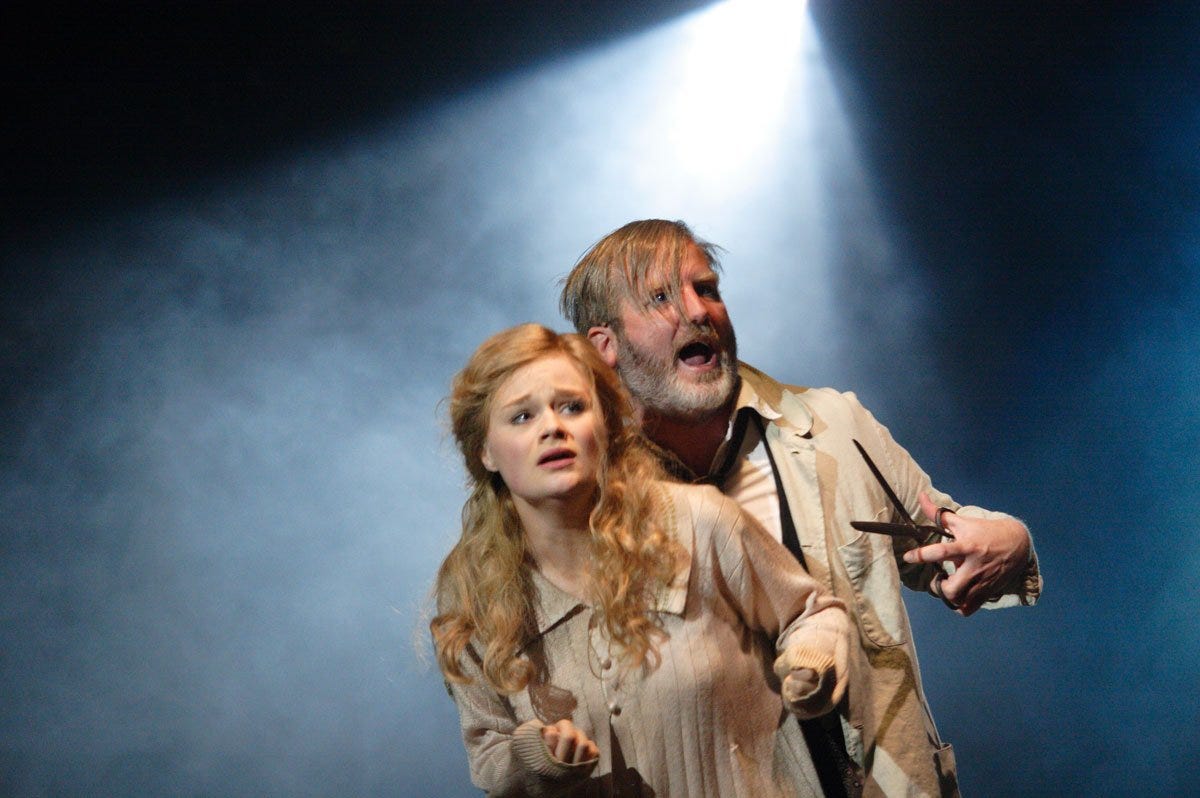
It was interesting, actually. I saw that surface sweetness of Johanna, and in rehearsals I tried to play that — and sometimes they would stop me. “Stop it, you don’t need to do that. You can give the grit of her.” Because ultimately, she shows that in the end.
Honestly, I was so green when I did it. I think I had all of that natural innocence, and I look back and think: I barely had a clue what I was doing. And I think, actually, that was possibly why they wanted me for the job. I too saw her as quite sweet and innocent — and she is all of those things — but I don’t think I saw the full depth of her at the time. Maybe that was the point.
In such a starry production, and being so young at the time, what was the rehearsal room dynamic like from your perspective?
Michael and Imelda were incredible leaders. Absolutely. I’m actually doing a massive clear-out at the minute and I found their gifts the other day: they got everyone pie bowls, signed and everything. It’s such a good reminder that they were so kind and gentle, because they’re obviously both hugely experienced — and that’s something I’ve been super aware of recently as I’ve done more teaching. The best way to get the best out of people is to build them up.
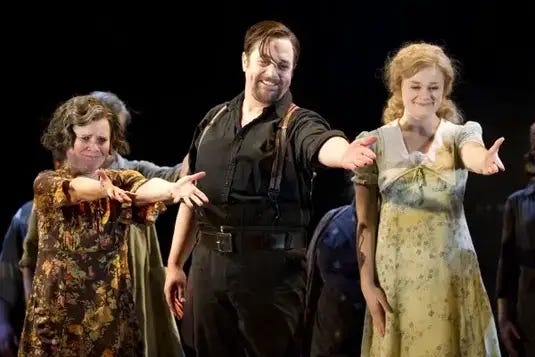
There’s this very old-school idea that you must be broken into a million pieces in order to truly find yourself — it’s all a load of shit, actually. The best way for people to improve, in my experience — and I have about twenty years of that now — is to build them up. That is exactly what Michael and Imelda did. They were so supportive, so careful. I found it really hard at times; it was really out of my comfort zone. But they were nothing but supportive, and the rehearsal room was just magical.
We come to know the Beggar Woman, of course, as Lucy. And her surname is Barker… How long did it take before someone in the cast talked to you about the fact that you share her name?
It’s crazy! I already knew, of course, because of my teenage Mrs. Lovett era. And obviously everyone was like, “God, that’s so strange!” I remember when the cast was announced — it was the early days of social media, and shows were actually quite strict about what you were and weren’t allowed to post — people online were like: “What?!” It really is such a weird, brilliant coincidence.
I’d love to zoom in on the vocal side of things. Were there any particular challenges in singing Johanna that might not be immediately obvious audience members?
The main thing was: when you’re singing that high up, it’s so hard to make it sound genuine. I know that sounds very general, but the whole point of singing — and I teach singing now, so this is my most-used phrase with students — is that it’s an extension of your communication and your emotion. I say to all of them: stop singing. Stop doing singing, and just let it flow out of you — which sounds a bit hippie, but it actually does work.
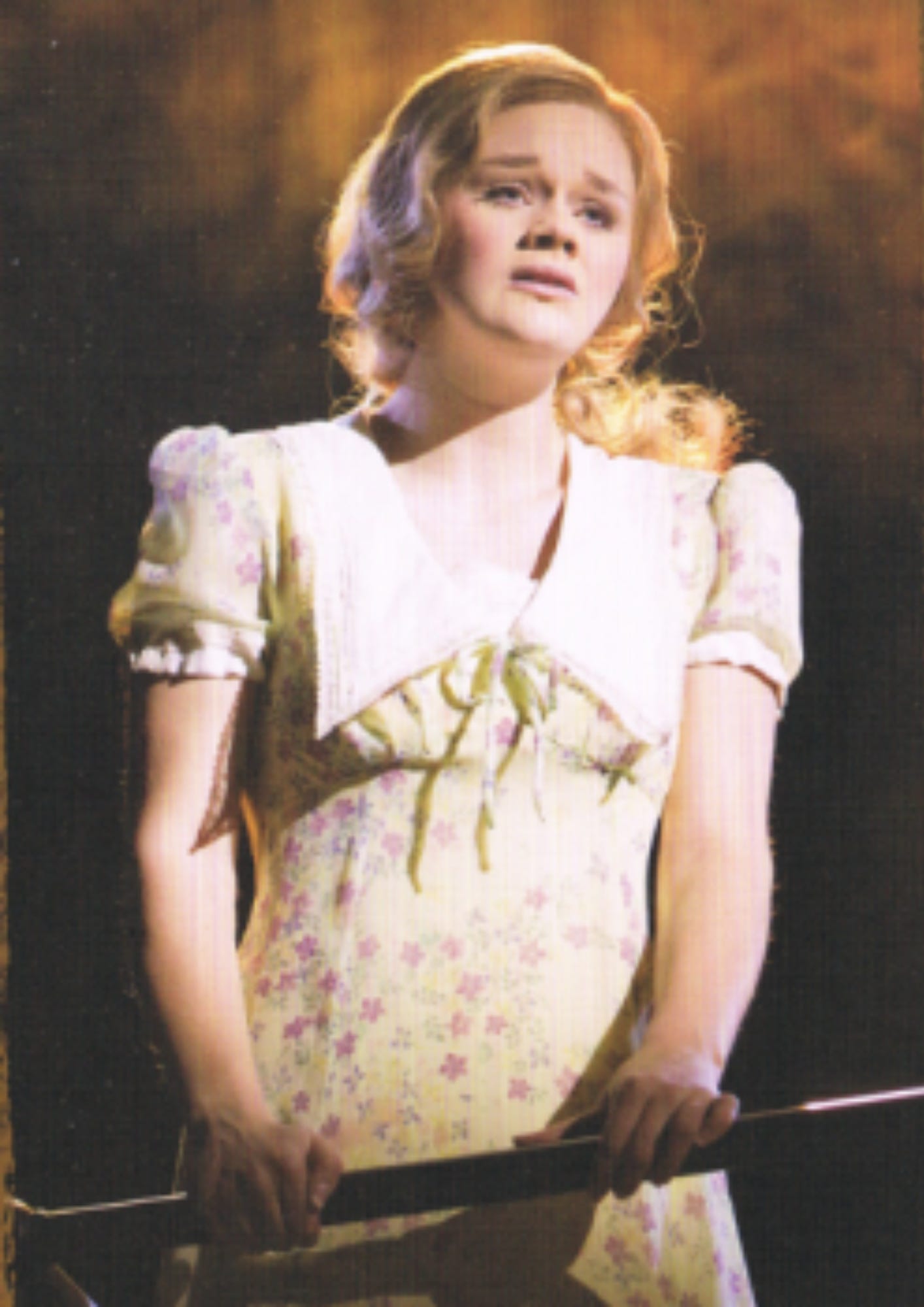
The challenge with anything that pushes your voice to an extreme — especially when it doesn’t naturally sit there, which mine doesn’t — is that it’s so hard to really connect it to the emotion, because you’re thinking so technically all the time. There’s that moment just before the escape, when Johanna is with Anthony, and it’s just unbelievable. Every night I was saying a small prayer. I’d had the training, I’d practised and practised until I was blue in the face.
One of my proudest moments was when Sondheim came to see the show a second time, after some time had elapsed since his first visit, and he said: “I can really hear the difference in your voice. I can hear you’ve been working on this. And now you’ve built the muscle up, you can be a bit freer with it.” It is just practice, ultimately. Flexing those muscles will help you make it more real. It’s just hard to get the extremes of the voice to sound genuinely authentic.
Were you told in advance when Sondheim would be at the show, or did his visits come as a surprise?
We were told when he’d be coming to see the show — but there was one time we’d all been given the date, and then at warm-up that night they told us that he was not actually coming. He’d had an operation on his toe.
On the first night he came, I remember being in Michael’s dressing room afterwards, everyone chatting, pictures and all of that — and it was just such a great reminder of what it means to have been performing his music in an era when he was still alive. It’s like with Andrew Lloyd Webber and Cats — we’re in a time when some of these greats are still alive, and it’s really special. To have had the opportunity not only to meet Sondheim but to actually sing one of his songs in front of him was quite unbelievable. I do think I understood the weight of that at the time — but in true Johanna form, maybe I didn’t fully realize what a gift that was.
Now that you’ve played such a wide range of roles, do you see any through-line in how you approach characters in seemingly very different contexts? Is being inside a Lloyd Webber, a Sondheim, or a Mamma Mia! actually as different as we might think?
The questions are always the same: how do I make this character real? How do I make this character effective as a cog in the machine of the story? What did the writer care about, and how do I honour that? And — is there anything that only I can bring that everybody else has missed? I’ve only really put that last one into practice in the last couple of years, but it’s about trusting your own instincts and being brave in how you act on them.
And actually, I would argue it’s even more important to get something like Mamma Mia! right. This could be the decider of whether someone ever walks back into a theatre. They might be there for the first time, potentially been dragged there against their will. If I had to choose one that was more important, I’d say Mamma Mia!. And with Cats — loads of people have a preconceived idea about it, an opinion, even if they’ve never seen it. If you’re one of those people, I think it’s actually for you, because the show is literally about looking beyond your preconceived ideas and seeing what else you find. I just love it all, more than ever. Theatre is just unbelievable.
I know there’s a limit to how much a performer can control their future — but if you imagine a career over the next few years that would really nourish you, what does the mix of musicals and straight plays look like? And might there be more Sondheim ahead for you?
I used to not think about this actively at all. It was always just, oh God, hopefully someone will give me a job again at some point. But now I know I actually have to go after the things I want. I have to decide, as much as I actually can — which isn’t a lot, but still.
It would be fab to come full circle and play Mrs. Lovett. Those sorts of roles are just the best. I love making people laugh. I kept trying to make Sophie in Mamma Mia! more of a comedy role — and I do think I succeeded many a night. But to make people laugh at the absurdity of life is the best feeling. The Wagatha Christie play I did was just unbelievable for that — people were in bits every night, laughing at the reality of something like that actually happening.
And the big, big musicals? I don’t think I’m afraid of those anymore. After doing Cats, I was like, oh no, I can do this. All those big roles, I’m ready. So: Mrs. Lovett, 2047!
✍️ Please support our work by upgrading to a premium subscription:
The Sondheim Hub exists solely thanks to the generous support of our readers. Please consider supporting our work for a few dollars each month. A premium subscription gives you full access to The Sondheim Hub: an exclusive essay, crossword, extended interview & more each week, plus our complete, paywall-free library of 250+ essays, features & interviews. 📚